Learning Cantonese for your partner’s family: where to start
Learning Cantonese for your partner’s family? What to learn first, what to call their parents, how to stop everyone switching to English, and a plan that fits.

Family first:
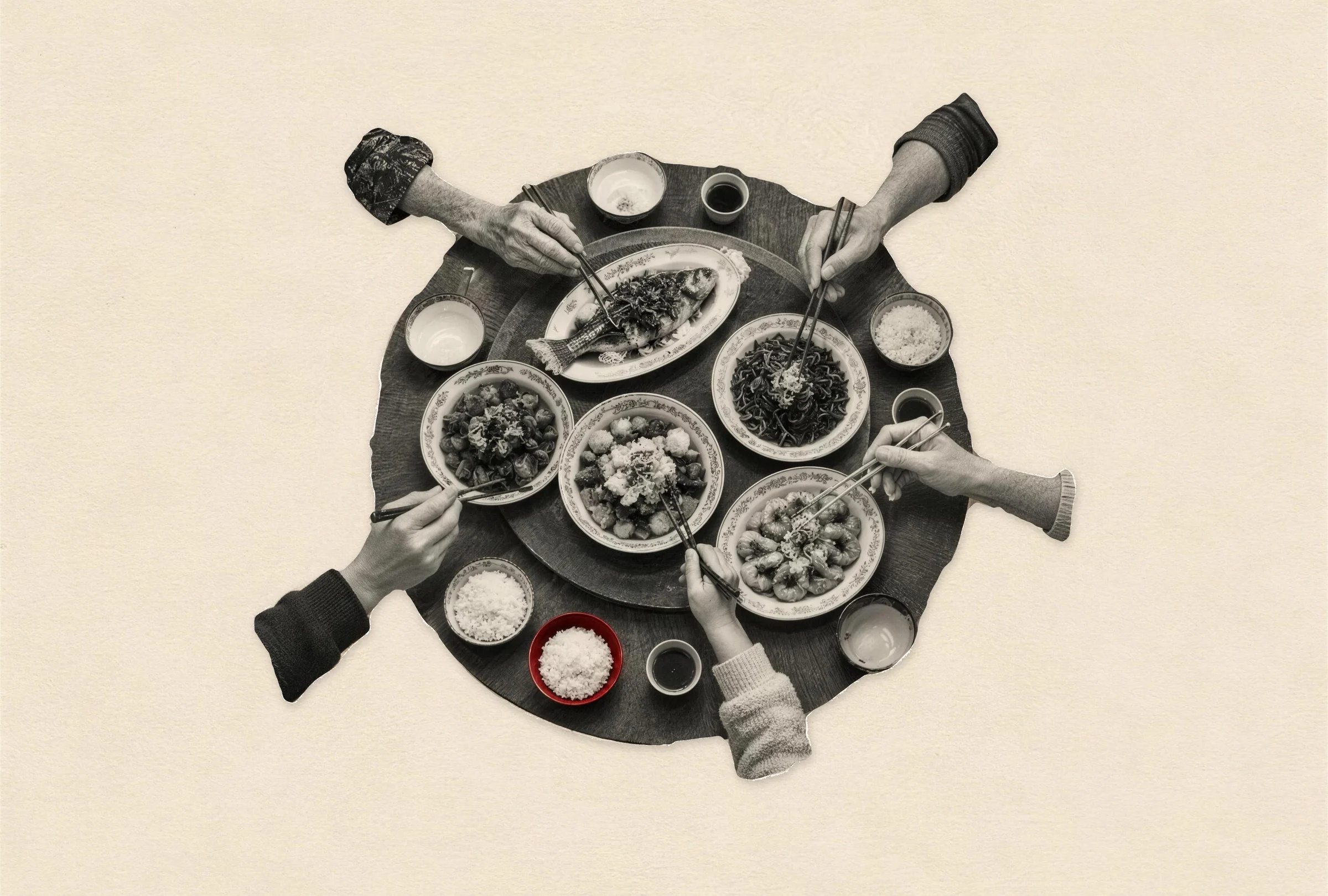
Have some more. You’ll hear it more often than you can eat.
Key takeaways
If your partner’s family is from Hong Kong, the language at the table is almost certainly Cantonese. Mandarin won’t carry you there.
You don’t need fluency to make a difference. The right titles, a few table manners and some questions of your own change how a family dinner feels.
The hardest part isn’t the tones. It’s stopping everyone from kindly switching to English for you, so ask them not to.
Your partner is your best practice partner and cultural guide, but rarely your best teacher.
The family dinner is in full swing. Someone tells a story, the whole table laughs, and your partner leans over to translate between mouthfuls.
By the time you’ve heard the punchline, the conversation has moved on twice.
If that sounds familiar, you’re in good company. Plenty of adults learn Cantonese for partner and family reasons, and there’s no better motive, because the people you’re learning for are sitting right there.
This guide is for partners of Hong Kongers who want to speak Cantonese with the in-laws, or who tried to learn Cantonese once and stalled.
It covers which Cantonese words and phrases to learn first, what “enough” looks like, which apps and resources help, and how to keep the family talking to you in Cantonese rather than English.
Why learn Cantonese for a partner’s family if everyone speaks English?
Plenty of Hong Kong parents speak good English, and many will happily use it with you. So why bother?
Because the family’s real life happens in Cantonese. The jokes, the teasing, the stories about your partner as a child, the arguments about where to have dim sum: all of it runs in a language you can’t yet follow.
English is the polite version of the family. Cantonese is the family.
Then there are the relatives who don’t speak much English at all. Grandparents, an aunt who does most of the cooking, the cousins you’ll meet at Chinese New Year.
For older Cantonese speakers especially, a guest who tries to speak Cantonese stands out. A few words of effort tend to be noticed and remembered long after the dinner is over.
It also means you can communicate with people you’d otherwise only smile at.
The language is your way into the culture, too. The festivals, the food and the family habits make a lot more sense once you know the Cantonese words that go with them.
And if you have children, or plan to, Cantonese is how they’ll talk to their grandparents. Our guide to keeping your child speaking Cantonese is easier to follow when both parents can join in.
Cantonese or Mandarin: which does a Hong Kong family speak?
Before you start learning Cantonese, ask your partner which language the family speaks at home. Plenty of people start with Mandarin because it’s better known, then discover it doesn’t help at the table.
For families from Hong Kong, the answer is almost always Cantonese. In the 2021 census, 88.2% of Hong Kong people aged five and over said Cantonese was the language they usually speak.
Families from Guangzhou and Macau are usually Cantonese speakers too. Mandarin is the language of schools and offices in mainland China.
Some Chinese families overseas speak one of the other Chinese languages at home, such as Hakka or Hokkien, so it’s still worth asking.
Cantonese and Mandarin share most of their written characters, but as spoken Chinese languages they’re different enough that one won’t get you through a conversation in the other.
Cantonese has six tones, or nine if you count the short tones on words ending in p, t or k separately. Mandarin has four. Around 85 million people speak Yue languages, the branch Cantonese belongs to, as their first language, in southern China, Hong Kong, Macau and communities all over the world.
Our honest comparison, is Cantonese harder than Mandarin?, goes into the differences.
What “enough” looks like
Nobody expects you to follow a fast family argument in your first year. It helps to think in stages, each one worth having on its own.
The first dinner
The aim here is good manners, not conversation. Learn what to call your partner’s parents, a basic greeting, how to say thank you and how to praise the food.
Before you’re married, the usual Cantonese titles are 伯父 (baak3 fu2) and 伯母 (baak3 mou5), “uncle” and “auntie”. Some families prefer something more casual, so check with your partner on the way there.
伯父好,伯母好 (
baak3 fu2 hou2, baak3 mou5 hou2): hello, uncle; hello, auntie.多謝晒你哋請我食飯 (
do1 ze6 saai3 nei5 dei6 ceng2 ngo5 sik6 faan6): thank you so much for having me for dinner.好好食呀 (
hou2 hou2 sik6 aa3): this is delicious.唔好意思 (
m4 hou2 ji3 si1): sorry, for small slips like knocking over the soy sauce. Save 對唔住 (deoi3 m4 zyu6) for real mistakes.
Our guides to meeting the parents and Cantonese family terms have the full set of titles and table phrases, and sorry in Cantonese covers every other apology you might need.
The first year
Now you’re aiming to follow the gist and answer the questions that come up on every visit.
Family small talk is surprisingly predictable. Have you eaten? How’s work? When are you two coming back? And, at some point, the big one: when are you getting married?
Learn to recognise those questions and have a short answer ready for each, even if it’s only a sentence or two.
That’s when you start taking part in real conversations rather than waiting for a translation.
The long run
Further on, you’re telling your own stories, catching the jokes, chatting to the grandparents on a video call and maybe giving a short toast at a wedding banquet.
This is where most of the reward is, and it comes from consistent practice over time rather than a crash course.
Our guide to how long it takes to learn Cantonese is honest about what shapes the pace.
Should your partner teach you?
It’s the obvious plan. You live with a native speaker, so why pay anyone else? Here’s why it rarely works on its own.
Why native speakers make tricky teachers
Native speakers usually can’t explain their own language. Ask why a word goes up at the end and you’ll get “it just does”.
Many partners grew up overseas and speak family Cantonese: fluent around the dinner table, shakier on grammar, and often unfamiliar with Jyutping.
Correcting someone you love is awkward on both sides. After a long day, switching to English is always easier for both of you.
Lessons from your partner also tend to happen when there’s time, which in most couples means rarely.
What your partner is brilliant for
None of that makes your partner less useful. It makes them useful for different things.
They’re your best practice partner, your guide to who’s who in the family and the person who can tell you what auntie actually meant.
Regular practice with native speakers is what builds conversational confidence, and your partner’s family is full of them.
Agree on small, regular Cantonese moments, such as the first ten minutes of dinner or texting in Cantonese. Leave the explaining of grammar and tones to a teacher.
If your partner grew up overseas and wants to improve too, you can learn Cantonese side by side. Our guide for heritage learners is written for them.
The essential Cantonese words and phrases to learn first
You can’t learn everything at once, so focus on the words and phrases the family will actually say to you. In your first few weeks, that comes down to five things.
Names and titles
In a Cantonese family, you greet people by their title. Titles are etiquette in miniature: they show you know who is older and how everyone is related, which is a big part of good manners.
Getting it right at the door sets the tone for the evening, and it’s the first Cantonese word most relatives will hear from you.
The questions you’ll be asked
Learn to recognise these three phrases, because they come up on every visit.
食咗飯未呀? (
sik6 zo2 faan6 mei6 aa3): have you eaten yet? It’s often just a friendly hello.你做咩工呀? (
nei5 zou6 me1 gung1 aa3): what do you do for work?幾時結婚呀? (
gei2 si4 git3 fan1 aa3): when are you getting married?
Food and the table
Much of family life happens over meals, and in many Hong Kong families food is how affection is shown. You’ll hear 食多啲啦 (sik6 do1 di1 laa1), “have some more”, more often than you can eat, and someone will keep topping up your bowl. Take it as love.

At a family meal, wait for the elders to sit down and start eating before you do. If you’re not sure where to go, 我坐呢度得唔得呀? (ngo5 co5 ni1 dou6 dak1 m4 dak1 aa3), “can I sit here?”, does the job.
If you finish first, 大家慢慢食 (daai6 gaa1 maan6 maan2 sik6), literally “everyone eat slowly”, is the polite thing to say as you leave the table.
Tones and pronunciation
Those six tones change meaning, so correct pronunciation matters from your first lesson.
The same syllable said with a different tone can be a different Cantonese word entirely, so practise your pronunciation out loud, with a teacher who can correct it. Our Cantonese tones guide explains them with a pitch chart.
Jyutping
Jyutping is the system that writes Cantonese sounds in Latin letters.
It lets you note down what you hear at dinner and look it up later, long before reading Chinese characters is on the cards.
How to stop everyone switching to English
Here’s the thing nobody warns you about. The moment you hesitate, someone will kindly switch to English, and you’ll lose the practice you came for.
They’re being considerate. You just need to tell them it’s fine to stay in Cantonese, and give them the phrases to make it easy. Most native speakers will happily slow down once they know you want them to.
Four phrases that keep the conversation in Cantonese
我想練習廣東話 (
ngo5 soeng2 lin6 zaap6 gwong2 dung1 waa2): I want to practise my Cantonese.你講慢啲得唔得呀? (
nei5 gong2 maan6 di1 dak1 m4 dak1 aa3): could you speak a bit more slowly?唔該再講多次 (
m4 goi1 zoi3 gong2 do1 ci3): could you repeat that, please?呢個廣東話點講呀? (
ni1 go3 gwong2 dung1 waa2 dim2 gong2 aa3): how do you say this in Cantonese?
The last one works especially well with grandparents. Point at something on the table, ask for the Cantonese version, and you’ve started a conversation they’re in charge of.
Most grandparents are very interested in a partner who asks. Teaching you is half the fun for them.
Bring one topic to every visit
It also helps to prepare one thing to say on each visit. A question about a dish, a story about your week, a compliment on the new curtains.
One planned topic gets you further than a hundred memorised words, because it starts a real conversation.
That’s where your conversational skills grow fastest, and where the Cantonese speakers in the family see that you mean it.
Is a Cantonese learning app enough?
Apps, flashcards and online videos are useful, and many of them are free. They’re just better at some things than others.
Language learning apps and flashcards
Language learning apps and flashcards are good for vocabulary, and a Cantonese learning app with audio is better still. Five minutes on the bus is enough to keep new words fresh.
Repeat each word out loud as you go. An app can play you the sound, but only your own mouth can practise it.
YouTube videos, TV and music
YouTube videos, TV dramas and Cantopop are good listening practice, and a fun way to catch how Cantonese speakers really talk. Because they show the language in context, they help you follow everyday conversations. And methods you enjoy are the ones you’ll stick with.
Free audio from native speakers, such as podcasts, helps your ear tune in to the tones before you try them yourself.
What no app can do
No app can teach you your partner’s family. It won’t know that grandma has her own name for a dish, and it can’t answer back when you get a sentence wrong.
Use these free resources to fill the gaps between lessons and visits, not as the whole course. The right resources are the ones that get you speaking to people.
A plan that fits around real life
You have a job, a relationship and, at times, a family who wants you at dinner every Sunday. Here’s a rhythm that tends to hold up.
Before the first visit
Learn the titles, a greeting, a thank you, a compliment on the food and the four phrases above for keeping people talking.
Every week
Have one or two bite-sized lessons and one real conversation in Cantonese, even if it’s five minutes on a video call with your partner’s parents.
Keep a running vocabulary list of the words and phrases the family actually uses, and review it before each visit.
Before a big occasion
Prepare the lines you’ll need. Our guides to Chinese New Year greetings and happy birthday in Cantonese cover two of the big ones.
Regular, short practice beats an occasional burst before a trip.
Cantonese builds on itself, and so does the family’s confidence that it’s worth speaking to you in it.
Cantonese lessons built around your partner’s family
The fastest way to make it stick is to learn Cantonese with your family in mind from the start. That’s how we teach.
We write the materials for each learner, so your Cantonese lessons can begin with your partner’s family: the titles you’ll need, the dishes on their table and the questions they always ask.
Lessons are one-to-one and online, with a native Hong Kong tutor, so they fit around work and family visits.
Our Complete Cantonese pathway takes you from your first words at the table to real conversation.
If you’re weighing up your options, our guide to how to choose a Cantonese tutor covers what to look for.
Frequently asked questions
Will my partner’s parents expect me to speak Cantonese?
Usually not. Most families are delighted by any effort and patient with mistakes. Your partner is the best guide to what their own family will appreciate, so ask them.
What should I call my partner’s parents in Cantonese?
Before marriage, 伯父 (baak3 fu2) and 伯母 (baak3 mou5), “uncle” and “auntie”, are the safe choice. After marriage, many people simply say 爸爸 (baa4 baa1) and 媽媽 (maa4 maa1), but every family is different. Our guide to Cantonese family terms has the rest.
Is Cantonese hard for English-speaking language learners?
It’s different rather than impossible. If you learnt French or Spanish at school, you’ll be pleased to know Cantonese has no verb endings to memorise. The new skill is tones, and that takes focus and practice. More than most other languages, Cantonese rewards listening early and often.
How long until I can follow a family dinner?
Longer than you can follow a slow one-to-one chat, because family dinners are fast, overlapping and full of in-jokes. Like most language learners, you’ll understand more than you can say at first, and listening comprehension grows with regular practice. Expect to catch the topic before you catch the details.
Do I need to learn Chinese characters?
Not to start. Jyutping lets you learn the spoken language first, and reading and writing can come later. Reading everyday Chinese takes a few thousand characters, often put at 2,000 to 3,000, so it’s a long-term project. Characters become useful if the family group chat runs in Cantonese. Our guide to written Cantonese explains how Hong Kong people text.
Can I learn Cantonese online?
Yes. Speaking and listening are what matter most for family life, and both work well over video. Online lessons also mean you can learn from a native Hong Kong tutor wherever you live in the world. For busy adult learners, they’re easier to fit around work than a class across town.
What’s the first thing I should say when I meet them?
伯父好,伯母好 (baak3 fu2 hou2, baak3 mou5 hou2), “hello, uncle; hello, auntie”, with a smile. Greet the oldest people first, and you’ve started well.
Complete Cantonese takes you from first words to real conversations with a native Hong Kong tutor.
Book a £30 trial lesson
Book a £30 trial lesson