Cantonese phrases for parents: from breakfast to bedtime
Everyday Cantonese phrases for your kids, from mealtimes and the school run to bath and bed, with Jyutping, plus how Hong Kong parents praise and say no.

Little and often:
Up! Some Cantonese needs no translation.
Key takeaways
Most Cantonese at home comes from a few dozen sentences said every day. Learn those and a large part of family life can happen in Cantonese.
Three small words do a lot of the work: 啦 makes a request friendly, 先 means “first” and 未 turns a sentence into a “yet?” question.
Hong Kong parents often show love with 錫 (
sek3), which means both to dote on and to kiss.Manners have a Hong Kong shape: children 叫人, greeting each relative by their title, and invite the elders to eat before they start.
Talking to your kids in Cantonese doesn’t take a big vocabulary. Most of what parents say at home is the same few dozen sentences, said over and over: get up, eat up, shoes on, careful, well done, bath, bed. Get those down and a lot of the day can happen in Cantonese.
These Cantonese phrases for parents follow a normal day, from the first wake-up call to lights out, then add the phrases for praise, comfort, manners and the occasional standoff. Every line has Jyutping, the standard way to write Cantonese sounds in the Latin alphabet, so you can say it even if you can’t read the characters yet. If you grew up with Cantonese and feel rusty, most of these will come back the moment you see them. If you’re the parent learning from scratch, start with one section and use it until it feels boring.
For the bigger picture, including what to do when your child answers in English, read our guide to keeping your child speaking Cantonese abroad. This one is the phrasebook.
Three little words that do a lot of work
Before the lists, three tiny words you’ll see again and again. Know them and half the phrases below explain themselves.
啦 (
laa1) at the end of a sentence turns an order into a friendly nudge. 食飯 is “eat”. 食飯啦 is “come on, time to eat”.先 (
sin1) at the end means “first”. 洗手先 is “wash your hands first”.未 (
mei6) at the end turns a sentence into a “yet?” question. 飽未呀? is “are you full yet?”, and the answer is 飽喇 (baau2 laa3), “I’m full”, or 未呀 (mei6 aa3), “not yet”.
Morning: getting up and out the door
Cantonese | Jyutping | Meaning |
|---|---|---|
起身啦! |
| Time to get up! |
早晨! |
| Good morning! |
瞓得好唔好呀? |
| Did you sleep well? |
去洗面刷牙 |
| Go and wash your face and brush your teeth |
着衫啦 |
| Get dressed |
着鞋 |
| Put your shoes on |
快啲啦,要遲到喇! |
| Hurry up, we’re going to be late! |
帶埋水樽 |
| Take your water bottle too |
着 (zoek3) is the everyday verb for putting on clothes, shoes and socks. 埋 (maai4) after a verb means “as well”, so 帶埋水樽 is “take your water bottle along too”. For more ways to greet the day, here’s how to say hello in Cantonese.
Mealtimes: phrases for the dinner table
Cantonese | Jyutping | Meaning |
|---|---|---|
食飯啦! |
| Time to eat! |
洗手先 |
| Wash your hands first |
坐好 |
| Sit properly |
慢慢食 |
| Eat slowly |
食多啖 |
| One more mouthful |
唔好揀飲擇食 |
| Don’t be fussy |
飽未呀? |
| Are you full yet? |
好唔好食呀? |
| Is it nice? |
多 (do1) before a measure word means “one more”, so 食多啖 is the “just one more mouthful” every child negotiates. 揀飲擇食 (gaan2 jam2 zaak6 sik6), literally “picking what to drink and choosing what to eat”, is the four-character way to call someone a fussy eater.
The school run and after school
Cantonese | Jyutping | Meaning |
|---|---|---|
執好書包未呀? |
| Have you packed your school bag? |
返學喇 |
| Off to school |
放學見 |
| See you after school |
今日學咗乜嘢呀? |
| What did you learn today? |
你同邊個玩呀? |
| Who did you play with? |
肚唔肚餓呀? |
| Are you hungry? |
做完功課先玩 |
| Homework first, then play |
返學 (faan1 hok6) is “go to school” and 放學 (fong3 hok6) is “school’s out”. Specific questions like 你同邊個玩呀? tend to get more back than “how was school?”, which most children answer with one word in any language.
Playtime, the park and staying safe
Cantonese | Jyutping | Meaning |
|---|---|---|
出去玩啦 |
| Let’s go out and play |
小心呀! |
| Careful! |
唔好走咁快 |
| Don’t run so fast |
拖住我隻手 |
| Hold my hand |
等埋我 |
| Wait for me |
俾佢玩吓啦 |
| Let them have a go |
執玩具啦 |
| Tidy up your toys |
夠鐘返屋企喇 |
| Time to go home |
One trap for learners: 走 (zau2) means “run” in Cantonese, not “walk”. Walking is 行 (haang4). So 唔好走 is “don’t run”, which is exactly what you want to call across a playground.
Bath time, bedtime and saying good night
Cantonese | Jyutping | Meaning |
|---|---|---|
去沖涼啦 |
| Bath time |
除衫 |
| Take your clothes off |
抹乾身 |
| Dry yourself off |
刷牙未呀? |
| Have you brushed your teeth? |
講個故事俾你聽 |
| I’ll tell you a story |
熄燈喇 |
| Lights out |
瞓覺啦 |
| Time to sleep |
早唞 |
| Good night |
發個好夢 |
| Sweet dreams |
沖涼 (cung1 loeng4) literally means “rinse cool”, and it covers both a bath and a shower. 早唞 (zou2 tau2), “rest early”, is how Hong Kong says good night.
Praise: how to say “good job” in Cantonese
Cantonese | Jyutping | Meaning |
|---|---|---|
好叻呀! |
| Well done! Clever you! |
好乖 |
| So good (well behaved) |
做得好好 |
| You did really well |
你好努力呀 |
| You worked really hard |
再試吓 |
| Have another go |
慢慢嚟 |
| Take your time |
加油! |
| Keep going! |
乖 (gwaai1) and 叻 (lek1) are the two big praise words, and they mean different things. 乖 is about behaviour: good, well behaved, doing as you’re asked. 叻 is about ability: clever, capable, good at it. To praise effort rather than talent, reach for 你好努力呀. And 加油 is the Hong Kong cheer for anyone who needs to keep going; here’s the story behind add oil.
Feelings and comfort
Cantonese | Jyutping | Meaning |
|---|---|---|
做咩事呀? |
| What’s the matter? |
邊度痛呀? |
| Where does it hurt? |
唔使驚 |
| Don’t be scared |
媽媽喺度 |
| Mummy’s here |
唔緊要 |
| It’s OK, never mind |
你係咪嬲呀? |
| Are you cross? |
你係咪攰呀? |
| Are you tired? |
講俾我聽 |
| Tell me about it |
Swap 媽媽 for 爸爸 (baa4 baa1) as needed. Naming the feeling helps, and the basic set is short: 嬲 (nau1) is cross, 攰 (gui6) is tired, 驚 (geng1) is scared and 唔開心 (m4 hoi1 sam1), literally “not happy”, is sad.
Manners: 叫人 and other Hong Kong habits
When relatives arrive, Hong Kong parents say 叫人啦 (giu3 jan4 laa1), literally “call people”. It means greet everyone by their title: 爺爺 (je4 je4) for grandpa on dad’s side, 婆婆 (po4 po2) for grandma on mum’s side, and so on down the family. The full list is in Cantonese family terms, and it’s worth a look before any big family dinner.
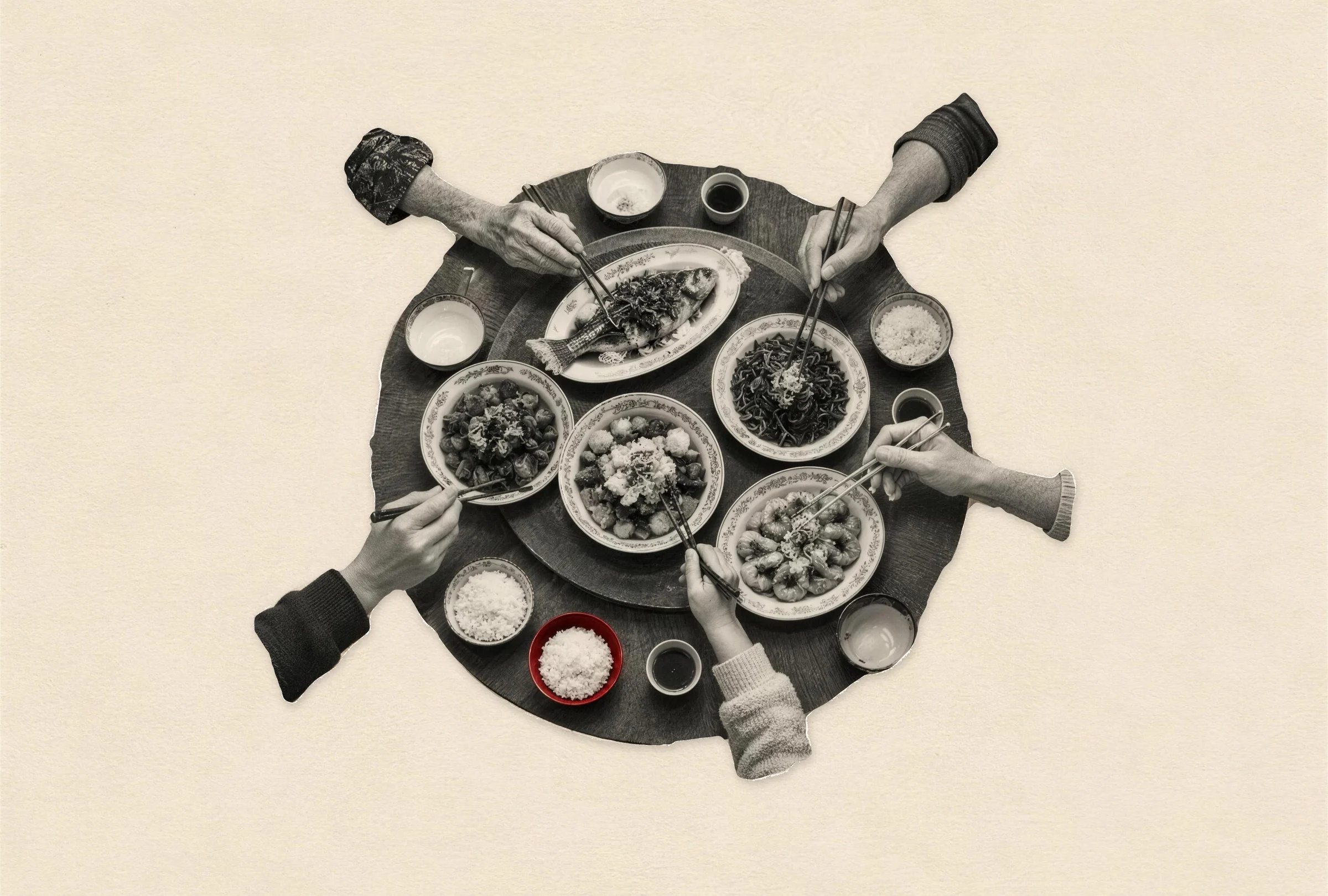
Meals have their own version. Before picking up their chopsticks, children invite each elder at the table to eat, one by one: 爺爺食飯,嫲嫲食飯 (je4 je4 sik6 faan6, maa4 maa4 sik6 faan6). At a big table it takes a while. That’s rather the point.
Cantonese | Jyutping | Meaning |
|---|---|---|
叫人啦 |
| Say hello to everyone |
講多謝 |
| Say thank you (for a gift) |
講唔該 |
| Say thank you (for help) |
講對唔住 |
| Say sorry |
講拜拜 |
| Say bye-bye |
講 (gong2) means “say”. Cantonese has two thank yous, 多謝 for a gift and 唔該 for a favour or a service, and it’s worth teaching both from the start. How to say thank you in Cantonese explains when to use each, and sorry in Cantonese covers 對唔住 and its softer cousins.
Saying no (without shouting)
Cantonese | Jyutping | Meaning |
|---|---|---|
唔可以 |
| No, you can’t |
唔好掂 |
| Don’t touch |
好熱呀! |
| It’s hot! |
停手 |
| Stop that |
細聲啲 |
| Quieter, please |
我數三聲 |
| I’m counting to three |
我數三聲 is a classic of Hong Kong parenting, and nobody has ever found out what happens at three. Keep these for when you mean them. If Cantonese becomes the language of “no” and English the language of fun, children notice.
How Hong Kong parents say “I love you”
Plenty of Hong Kong parents say 我愛你 (ngo5 oi3 nei5) to their children. But the most family-flavoured word for love is 錫 (sek3). It means to dote on someone, and it also means to kiss.
Cantonese | Jyutping | Meaning |
|---|---|---|
我好錫你 |
| I love you so much |
俾媽媽錫一啖 |
| Give Mummy a kiss |
攬攬 |
| Cuddle |
乖女 |
| My girl, sweetheart |
乖仔 |
| My boy, sweetheart |
囡囡 |
| Little girl, darling |
寶貝 |
| Treasure, darling |
乖女 and 乖仔 literally mean “good girl” and “good boy”, but they work like “sweetheart”, and you’ll still hear them used for grown-up sons and daughters. BB (bi4 bi1), borrowed from the English “baby”, is everywhere. The romantic side has its own page: I love you in Cantonese.
Cantonese words for babies and toddlers
Cantonese | Jyutping | Meaning |
|---|---|---|
抱抱 |
| Carry me, up! |
飲奶 |
| Milk time |
換片 |
| Nappy change |
屙尿 |
| Wee |
屙屎 |
| Poo |
瞓晏覺 |
| Nap time |
拍拍手 |
| Clap your hands |
拜拜 |
| Bye-bye |
Doubling a word makes it baby-sized: 抱抱 (pou5 pou5) is “carry me” or “up!”. 晏覺 (aan3 gaau3) is an afternoon nap, from 晏, which here means midday.
How to make the phrases stick
Pick one routine at a time. Do bath time in Cantonese for a week before you add bedtime.
Put the phrases where they happen: a note on the fridge for mealtimes, another by the front door for shoes and coats.
Say the same sentence the same way every time. Repetition is how small children learn, and it works on adults too.
Don’t wait to be perfect. A slightly wobbly tone said every day does more than a perfect sentence never said. When you’re ready to tighten things up, our Cantonese tones guide shows what the numbers mean.
To keep the language around the house between conversations, our guide to Cantonese cartoons and nursery rhymes has the shows and songs Hong Kong children grow up with.
Learning alongside your child
If you’re learning at the same time as your child, whether you’re a partner who didn’t grow up with Cantonese or a heritage speaker whose Cantonese stalled at primary school, lessons built around your family can speed things up. We write the materials for each learner, so yours can start with your own routines: the school run, the dinner table, the video call with the grandparents. Our online Cantonese lessons are one-to-one with a native Hong Kong tutor.
Frequently asked questions
How do you say “good job” in Cantonese?
好叻呀 (hou2 lek1 aa3) is the everyday “well done”, and 做得好好 (zou6 dak1 hou2 hou2) means “you did really well”. To praise effort, say 你好努力呀 (nei5 hou2 nou5 lik6 aa3), “you worked really hard”.
How do you say “I love you” to a child in Cantonese?
我愛你 (ngo5 oi3 nei5) works, but the warmer family phrase is 我好錫你 (ngo5 hou2 sek3 nei5), “I dote on you so much”. A cuddle is 攬攬 (laam2 laam2).
What do Cantonese parents call their children?
乖女 (gwaai1 neoi2) and 乖仔 (gwaai1 zai2), literally “good girl” and “good boy”, are the classics. Parents also use 囡囡 (neoi4 neoi2) for a little girl, 寶貝 (bou2 bui3), “treasure”, and BB (bi4 bi1), “baby”.
How do you say “hurry up” in Cantonese?
快啲 (faai3 di1), literally “faster a bit”. Add 啦 to make it a nudge, 快啲啦, and add 要遲到喇 (jiu3 ci4 dou3 laa3), “we’re going to be late”, when it’s urgent.
How do you say “be careful” in Cantonese?
小心 (siu2 sam1). Add 呀 for a call across the room, 小心呀!, or 啲 for a gentler 小心啲 (siu2 sam1 di1), “be a bit careful”.
How do you say good night to a child in Cantonese?
早唞 (zou2 tau2) is good night. Add 發個好夢 (faat3 go3 hou2 mung6) for “sweet dreams”.
Complete Cantonese takes you from first words to real conversations with a native Hong Kong tutor.
Book a £30 trial lesson
Book a £30 trial lesson