Cantonese family terms: who is who, and what to call them
Cantonese family terms for grandparents, aunts, uncles, cousins and in-laws on both sides of the family, plus what to call your partner’s parents.
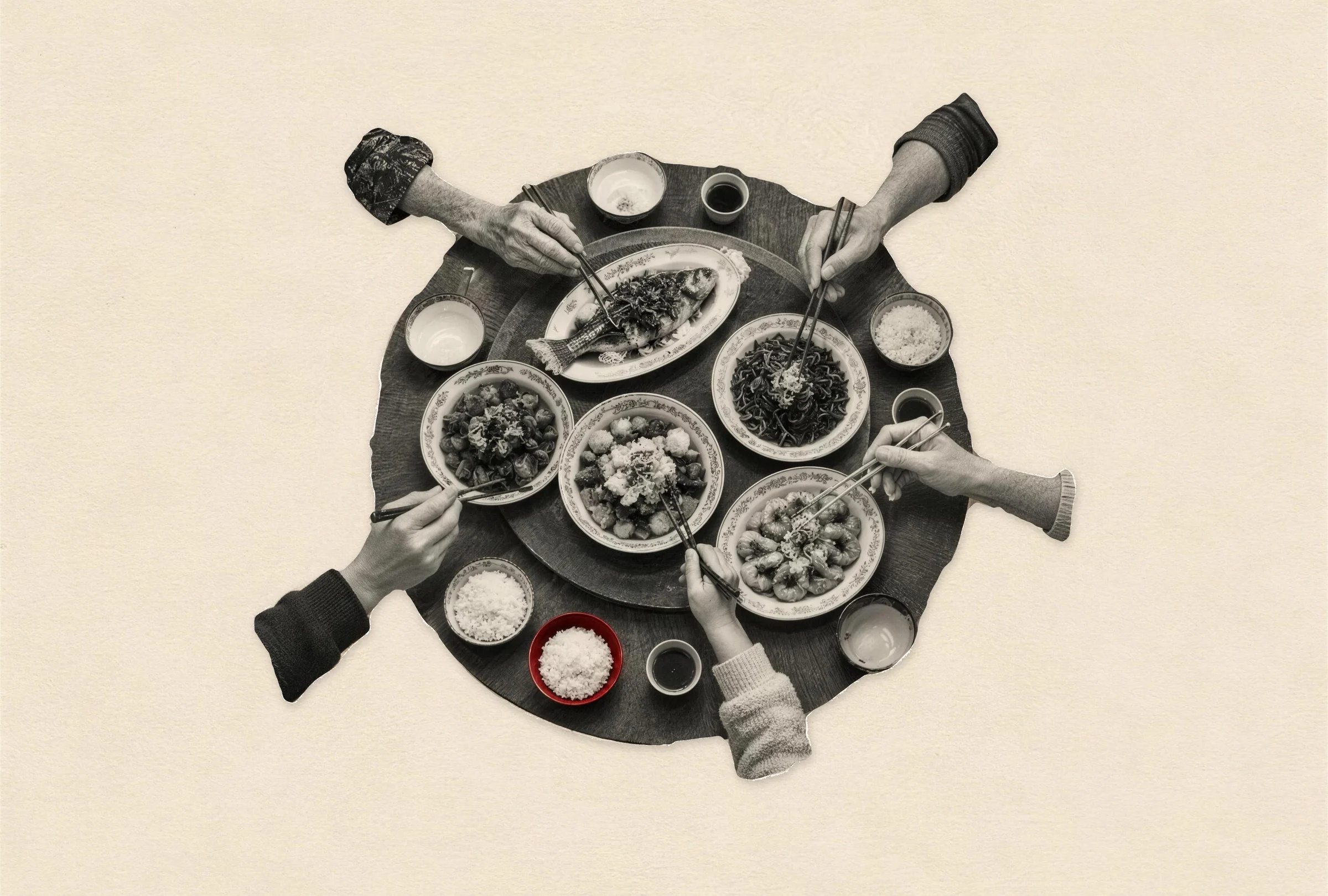
Who’s who:
One table, and a title for everyone around it.
Key takeaways
Cantonese splits relatives by side of the family and by age, so there’s no single word for “uncle” or “grandma”.
Dad’s parents are 爺爺 (
je4 je4) and 嫲嫲 (maa4 maa4); Mum’s are 公公 (gung4 gung1) and 婆婆 (po4 po2).Older and younger siblings get different words: 家姐 (
gaa1 ze1) is an older sister, 細佬 (sai3 lou2) a younger brother.What you call someone to their face often differs from how you talk about them, especially with in-laws.
Meeting your partner’s parents? 伯父 (
baak3 fu2) and 伯母 (baak3 mou5) are the safe choice.
If you’re about to sit down at a dinner table with your partner’s Cantonese-speaking family, or you grew up hearing these words but never quite pinned them down, this guide is for you. Cantonese family terms are more specific than English ones. Getting them right is one of the quickest ways to show warmth and respect.
Below you’ll find immediate family first, then grandparents, aunts and uncles, cousins, in-laws, and grandchildren, nieces and nephews. Every term comes in traditional characters, Jyutping and English. Then we cover what to say when you meet your partner’s parents. Start with your immediate family members and add the extended family as you need it.
Why Cantonese has no single word for uncle
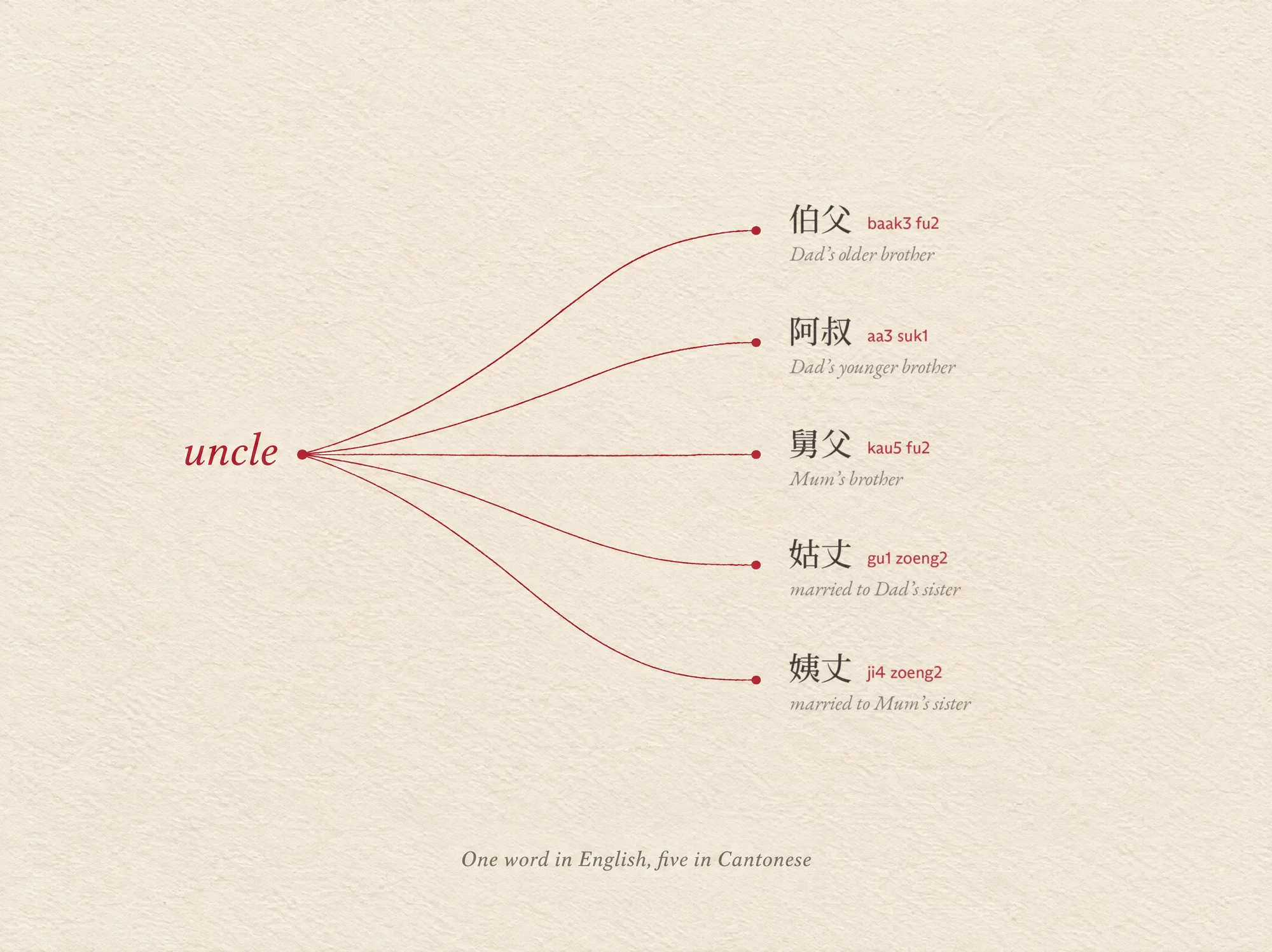
When someone says “my uncle” in English, you can’t tell whether they mean their dad’s older brother, their mum’s brother or someone who married into the family. Cantonese doesn’t leave that open. Each of those people has their own title, and the title tells you exactly where they sit on the family tree.
This is the Chinese kinship system at work, and Cantonese keeps it very much alive in everyday speech. Two questions decide almost every term:
Whose side are they on: your father’s or your mother’s?
Are they older or younger than the person they’re linked to?
So “uncle” splits into 伯父 (baak3 fu2), your father’s older brother, 阿叔 (aa3 suk1), your father’s younger brother, and 舅父 (kau5 fu2), your mother’s brother, among others.
Hong Kong also borrows from English. You’ll often hear “uncle” and “auntie” said in English in the middle of a Cantonese sentence, especially for family friends.
That sounds like a lot, but you only need the terms that match your own family. If your mum’s younger sister lives in Manchester, you need 阿姨 (aa3 ji1). You don’t need every possible aunt and uncle before your next family dinner.
There’s a second layer too: what you call someone to their face isn’t always the word you use when you talk about them. We’ll keep coming back to both.
Parents and siblings
Start here. The same older-or-younger logic runs through the whole system, so these words make everything else easier.
A few useful framing words: 屋企人 (uk1 kei2 jan4) is the everyday way to say “my family”, and 家人 (gaa1 jan4) is the written form. The formal word is 家屬 (gaa1 suk6), which you’ll see in places like hospitals and official notices.
Parents and children
爸爸 (
baa4 baa1): dad媽媽 (
maa4 maa1): mum阿爸 (
aa3 baa4) and 阿媽 (aa3 maa1): more casual, often used by adults about their own parents父母 (
fu6 mou5): parents, in more formal or written contexts仔 (
zai2): son; 女 (neoi2): daughter; 仔女 (zai2 neoi2): children
Brothers and sisters
The umbrella term is 兄弟姊妹 (hing1 dai6 zi2 mui6), but day to day you always say which sibling you mean.
哥哥 (
go4 go1) or 阿哥 (aa3 go1): older brother家姐 (
gaa1 ze1): older sister. This is the Hong Kong word; 姐姐 (ze4 ze1) also exists.細佬 (
sai3 lou2): younger brother細妹 (
sai3 mui2) or 妹妹 (mui4 mui2): younger sister
In bigger families, birth order goes in front. 大 (daai6) means the eldest, then numbers follow: 大哥 (daai6 go1) is the eldest brother, 二哥 (ji6 go1) the second, and 大家姐 (daai6 gaa1 ze1) the eldest sister.
To their face, you use the title rather than a first name: an older sister is simply 家姐. When you talk about her, add 我 (ngo5), “my”: 我家姐 (ngo5 gaa1 ze1), my older sister.
呢個係我家姐。(
ni1 go3 hai6 ngo5 gaa1 ze1.) This is my older sister.家姐,你食咗飯未呀?(
gaa1 ze1, nei5 sik6 zo2 faan6 mei6 aa3?) Have you eaten yet? (said to your older sister)
Grandparents
Grandparents are split by side, and this is the pair of words most heritage learners want to get right.
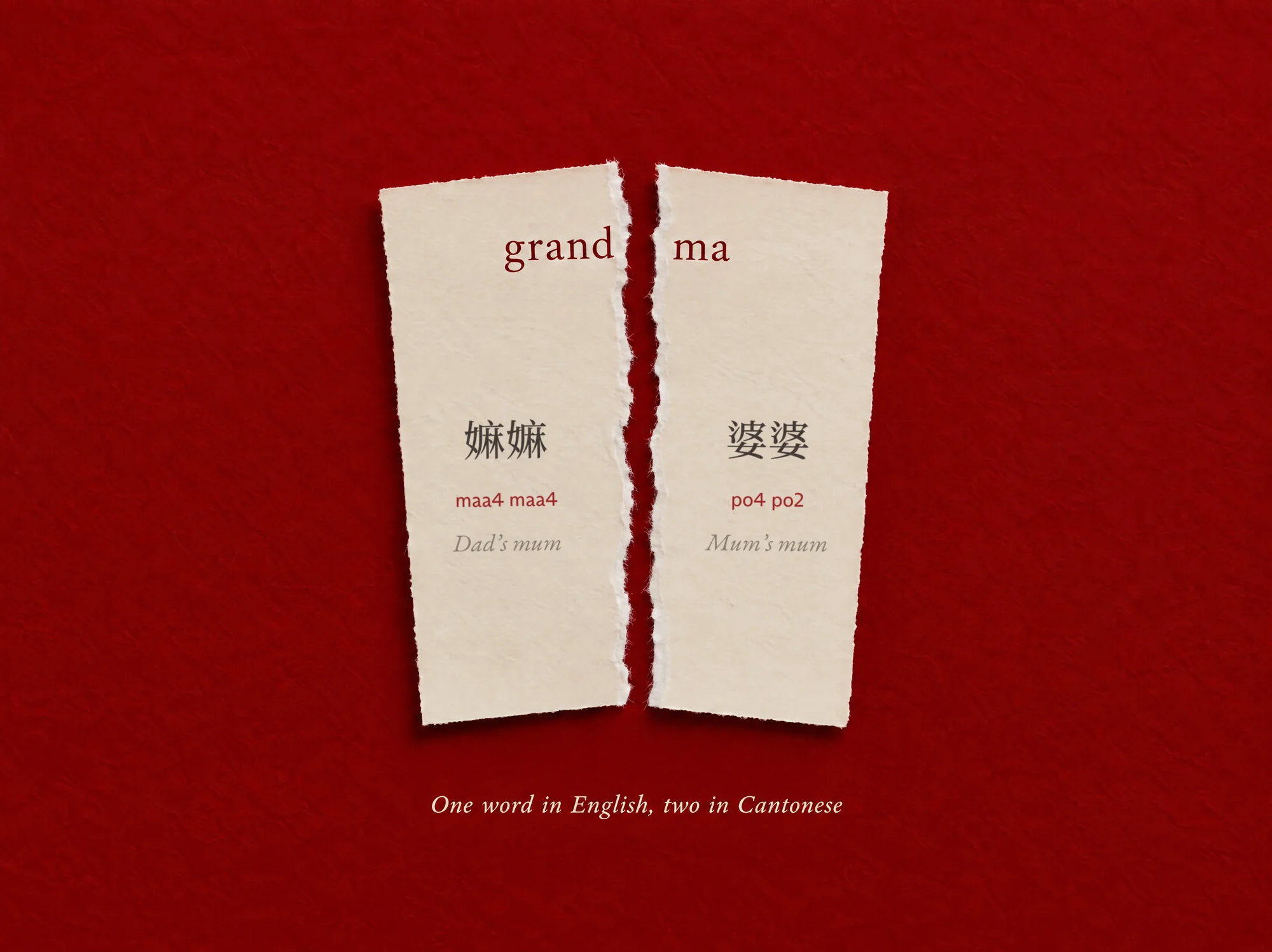
Your father’s parents
爺爺 (
je4 je4) or 阿爺 (aa3 je4): grandfather嫲嫲 (
maa4 maa4) or 阿嫲 (aa3 maa4): grandmother
Your mother’s parents
公公 (
gung4 gung1) or 阿公 (aa3 gung1): grandfather婆婆 (
po4 po2) or 阿婆 (aa3 po4): grandmother
In writing, you’ll also see 外公 (ngoi6 gung1) and 外婆 (ngoi6 po4), which make it clear you mean your mother’s side. In speech, it’s 公公 and 婆婆.
The picture is simple: dad’s parents are 爺爺 and 嫲嫲; mum’s parents are 公公 and 婆婆. Watch the tones on 嫲嫲 (maa4 maa4), grandma, and 媽媽 (maa4 maa1), mum. Only the second syllable changes.
我暑假會去香港探公公婆婆。(
ngo5 syu2 gaa3 wui5 heoi3 hoeng1 gong2 taam3 gung4 gung1 po4 po2.) I’m going to Hong Kong to visit my grandparents (mum’s side) in the summer holidays.
Aunts and uncles
This is where it can feel complicated. Remember, you only need the ones in your own family.
Your father’s side
伯父 (
baak3 fu2) or 阿伯 (aa3 baak3): father’s elder brother. His wife is 伯娘 (baak3 noeng4).阿叔 (
aa3 suk1) or 叔叔 (suk1 suk1): father’s younger brother, the younger paternal uncle. His wife is 嬸嬸 (sam2 sam2).姑媽 (
gu1 maa1): father’s older sister姑姐 (
gu1 ze1): father’s younger sister, the younger paternal aunt
Your mother’s side
On the maternal side, the words change completely.
舅父 (
kau5 fu2) or 阿舅 (aa3 kau5): mother’s brother. His wife is 舅母 (kau5 mou5).姨媽 (
ji4 maa1): mother’s older sister阿姨 (
aa3 ji1): mother’s younger sister
阿叔 and 阿姨 also do a second job. In Hong Kong, children use them for any friendly adult, from a neighbour to a parent’s friend, so you’ll hear them everywhere, not just in families.
嗰位係我舅父。(
go2 wai2 hai6 ngo5 kau5 fu2.) That’s my uncle (mum’s brother).姨媽,你好耐冇嚟英國喇。(
ji4 maa1, nei5 hou2 noi6 mou5 lai4 jing1 gwok3 laa3.) Auntie, it’s been ages since you came to the UK.
When in doubt, copy what your partner or cousins say. If everyone calls her 姨媽, so should you.
Cousins
Two little words do the heavy lifting: 堂 (tong4) and 表 (biu2).
堂 is for the children of your father’s brothers. They usually share your surname.
表 is for everyone else: the children of your father’s sisters and all cousins on your mother’s side.
Then you add the older or younger sibling word:
堂哥 (
tong4 go1), 堂弟 (tong4 dai2), 堂姐 (tong4 ze2), 堂妹 (tong4 mui2): older male cousin, younger male cousin, older female cousin and younger female cousin on your father’s side表哥 (
biu2 go1), 表弟 (biu2 dai2), 表姐 (biu2 ze2), 表妹 (biu2 mui2): the same, on the 表 side
To a cousin’s face, many people drop the 堂 or 表 and just use the name. When explaining the relationship to someone else, the full title comes back.
呢個係我表妹。(
ni1 go3 hai6 ngo5 biu2 mui2.) This is my younger cousin.
In-laws
Here the gap between what you call someone and how you refer to them matters most.
Your partner’s parents
外父 (
ngoi6 fu2) and 外母 (ngoi6 mou2): a husband’s words for his wife’s father and wife’s mother. 岳父 (ngok6 fu6) and 岳母 (ngok6 mou5) are the written forms.家公 (
gaa1 gung1) and 家婆 (gaa1 po2): a wife’s words for her husband’s father and husband’s mother老爺 (
lou5 je4) and 奶奶 (naai4 naai2): the traditional titles a wife uses to address her husband’s parents
Those are mostly words for talking about in-laws. To their face, many married couples in Hong Kong today simply say 爸爸 and 媽媽, but every family is different, so ask your partner.
Husband, wife and siblings-in-law
老公 (
lou5 gung1): husband; 老婆 (lou5 po4): wife. These are the everyday words, even between couples.新抱 (
san1 pou5): daughter-in-law; 女婿 (neoi5 sai3): son-in-law姐夫 (
ze2 fu1): older sister’s husband; 妹夫 (mui6 fu1): younger sister’s husband阿嫂 (
aa3 sou2): older brother’s wife; 弟婦 (dai6 fu5): younger brother’s wife
我細佬同佢老婆都住喺倫敦。(
ngo5 sai3 lou2 tung4 keoi5 lou5 po4 dou1 zyu6 hai2 leon4 deon1.) My younger brother and his wife both live in London.
Grandchildren, nieces and nephews
The same side-of-the-family logic carries on down the generations. Grandchildren through a son are 孫 (syun1); through a daughter, they’re 外孫 (ngoi6 syun1), with 外 marking the outside line.
孫仔 (
syun1 zai2): son’s son; 孫女 (syun1 neoi2): son’s daughter外孫 (
ngoi6 syun1): daughter’s son; 外孫女 (ngoi6 syun1 neoi2): daughter’s daughter姪仔 (
zat6 zai2) and 姪女 (zat6 neoi2): a brother’s son and daughter, your nephew and niece姨甥仔 (
ji4 sang1 zai2) and 姨甥女 (ji4 sang1 neoi2): a sister’s son and daughter. In writing, you’ll see 外甥 and 外甥女.
One generation up from your grandparents, great-grandparents are usually called 太公 (taai3 gung1) and 太婆 (taai3 po2).
Meeting your partner’s parents
Picture the scene: you’re about to walk into a family dinner. Using the right title at the door sets the tone for the whole evening.
Before you’re married, the safe choice is 伯父 (baak3 fu2) and 伯母 (baak3 mou5), literally “uncle” and “auntie”, for your partner’s father and mother. Some families prefer the more casual 叔叔 and 阿姨. Check with your partner on the way there.
伯父,伯母,你好。(
baak3 fu2, baak3 mou5, nei5 hou2.) Hello, Uncle and Auntie.多謝晒你哋請我食飯。(
do1 ze6 saai3 nei5 dei6 ceng2 ngo5 sik6 faan6.) Thank you so much for having me for dinner.
Greet the oldest people first, and at the table it’s polite to invite the elders to start eating before you do. Our guides to saying hello in Cantonese and saying thank you cover the rest of the small talk.
When you tell friends about it afterwards, you might say 我女朋友個媽媽 (ngo5 neoi5 pang4 jau5 go3 maa4 maa1), my girlfriend’s mum. To her face, though, she’s 伯母.
If you freeze and forget a title, a warm 叔叔 or 阿姨 with a smile will get you through. Ask your partner afterwards which word to practise.
Quick phrase list
我屋企人都識講廣東話。(
ngo5 uk1 kei2 jan4 dou1 sik1 gong2 gwong2 dung1 waa2.) My family all speak Cantonese.呢個係我細佬。(
ni1 go3 hai6 ngo5 sai3 lou2.) This is my younger brother.我妹妹喺香港出世。(
ngo5 mui4 mui2 hai2 hoeng1 gong2 ceot1 sai3.) My younger sister was born in Hong Kong.嫲嫲而家住喺倫敦。(
maa4 maa4 ji4 gaa1 zyu6 hai2 leon4 deon1.) Grandma (dad’s side) lives in London now.聽日去探公公婆婆。(
ting1 jat6 heoi3 taam3 gung4 gung1 po4 po2.) Tomorrow we’re visiting Grandpa and Grandma (mum’s side).伯父,伯母,多謝晒你哋。(
baak3 fu2, baak3 mou5, do1 ze6 saai3 nei5 dei6.) Uncle, Auntie, thank you so much.
How to practise Cantonese family terms
Start with your immediate family and add relatives as they come up. Lists of kinship words rarely stick on their own. Tie each word to a real person instead. Draw your own family tree and write the Cantonese title under each name: “Auntie May (姨媽, ji4 maa1) in Birmingham”. Then practise both ways of speaking: talking about each person, and greeting them. Hong Kong TV dramas are full of family scenes, and they’re a painless way to hear these titles in real conversations.
Tones matter here, because family words come in near-identical pairs like 媽媽 and 嫲嫲. Our guide to Cantonese tones is a good next step. If you understand your family’s Cantonese but freeze when it’s your turn to speak, our guide for heritage learners is written for you.
And if you’d like to rehearse the real thing, from a first dinner with your partner’s parents to a video call with your grandparents, one-to-one lessons with a native Hong Kong tutor are built around your own family and the conversations you actually need.
FAQ
How do you say family members in Cantonese?
The everyday word is 屋企人 (uk1 kei2 jan4), literally “home people”. 家人 (gaa1 jan4) is the written form, 家屬 (gaa1 suk6) is the formal word, and 親戚 (can1 cik1) covers your relatives in the wider extended family.
Is it rude if I get a family term wrong?
Rarely. Most Cantonese speakers know the system is tricky for learners, and trying counts for a lot. If you catch yourself, just correct it with a smile and ask afterwards which word to use next time.
Do I have to use Cantonese titles if the family also speaks English?
No, and many UK families mix freely, with “Auntie May” in English and 嫲嫲 in Cantonese. Even one or two Cantonese titles usually go down warmly.
Can I just say uncle or auntie to every older relative?
In English, many families do. In Cantonese, people usually keep the exact titles for relatives, but 叔叔 and 阿姨 are safe fallbacks for older adults who aren’t your grandparents.
What should I call my partner’s parents?
Before marriage, 伯父 (baak3 fu2) and 伯母 (baak3 mou5) are the safe, polite choice. After marriage, many people switch to 爸爸 and 媽媽. Ask your partner what their family expects.
How good is your Cantonese?
Five quick questions to see where your Cantonese is at.
Question 1 of 5. The waiter brings your food. What do you say?
Complete Cantonese takes you from first words to real conversations with a native Hong Kong tutor.
Book a £30 trial lesson
Book a £30 trial lesson