Learn Cantonese
7 min read
I understand Cantonese but can’t speak it: a guide for heritage learners
Understand Cantonese but can’t speak it? Why heritage learners freeze, and a practical plan to start speaking with your parents and grandparents.

Heard, not said:
Years of listening at the family table are a head start, not a lost cause.
Key takeaways
Understanding Cantonese but not being able to speak it is one of the most common experiences for British-born Hong Kongers who heard Cantonese at home and used English everywhere else.
Your “passive Cantonese” is a real head start. The rhythm, the particles and most of the everyday grammar are already in your ear, even when your mouth freezes.
Speaking feels hard because of gaps in adult vocabulary, shaky tones and the emotional weight of speaking in front of family, not because you are bad at languages.
A simple plan works: start saying the phrases you already understand, drill tones with Jyutping, build grown-up vocabulary around conversations you actually want to have, and practise with someone who won’t switch to English.
You grew up hearing Cantonese at home. You follow what your parents say at the dinner table. You laugh at the right moments during TVB dramas. But when you try to speak Cantonese yourself, your brain goes blank and English tumbles out instead.
If you’re in the same boat, you are far from alone, and you are much closer to being able to speak Cantonese than it feels. This guide explains why the gap exists and how to close it.
Why understanding comes so much easier than speaking
If you grew up in the UK with Cantonese-speaking parents, you are what linguists call a heritage speaker. For many heritage speakers, Cantonese was actually their first language. You absorbed it through years of listening, even if you never sat in a Cantonese class.
The gap between what you understand and what you can say comes down to passive and active vocabulary. You recognise 食飯 (sik6 faan6), 早抖 (zou2 tau2) and 唔好嘈 (m4 hou2 cou4) the moment you hear them. You know the parenting phrases by heart, from 快啲啦 (faai3 di1 laa1) to 早啲瞓 (zou2 di1 fan3). But producing a full sentence yourself is a different skill.
Your passive vocabulary kept growing. Your active vocabulary stalled somewhere around primary school.
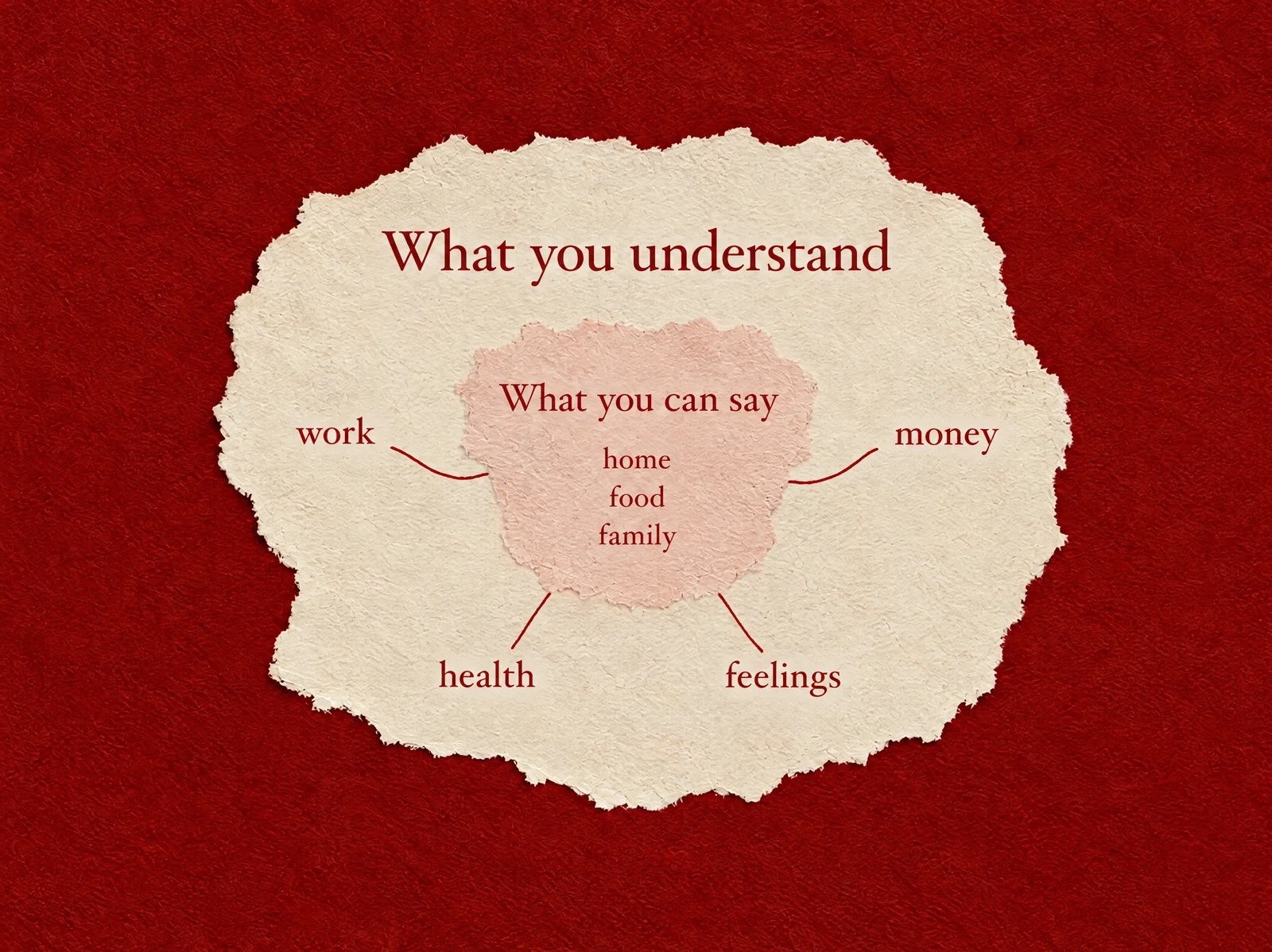
The pattern is usually the same. Cantonese at home with parents and grandparents, then English from nursery onwards: school, friends, homework, TV and YouTube, all in English. Your parents kept speaking Cantonese, you replied in English, and eventually they answered in English too. Nobody decided it. It just happened, and your speaking muscles stopped getting a workout.
The result is a child’s vocabulary built around food, family and basic feelings. You can tell your mum you want to eat, but not that your manager keeps moving meetings. So the real-life conversations stay in English, and every few years the gap widens a little more.
What makes speaking hard for heritage speakers
You are not starting from zero, but you face different problems from non-native speakers who learn Cantonese from scratch.
Tones you recognise but can’t control
In a conversation you rarely need to catch every tone precisely, because context fills the gaps. Saying 媽 (maa1) and 馬 (maa5) yourself is different: it can feel like guessing.
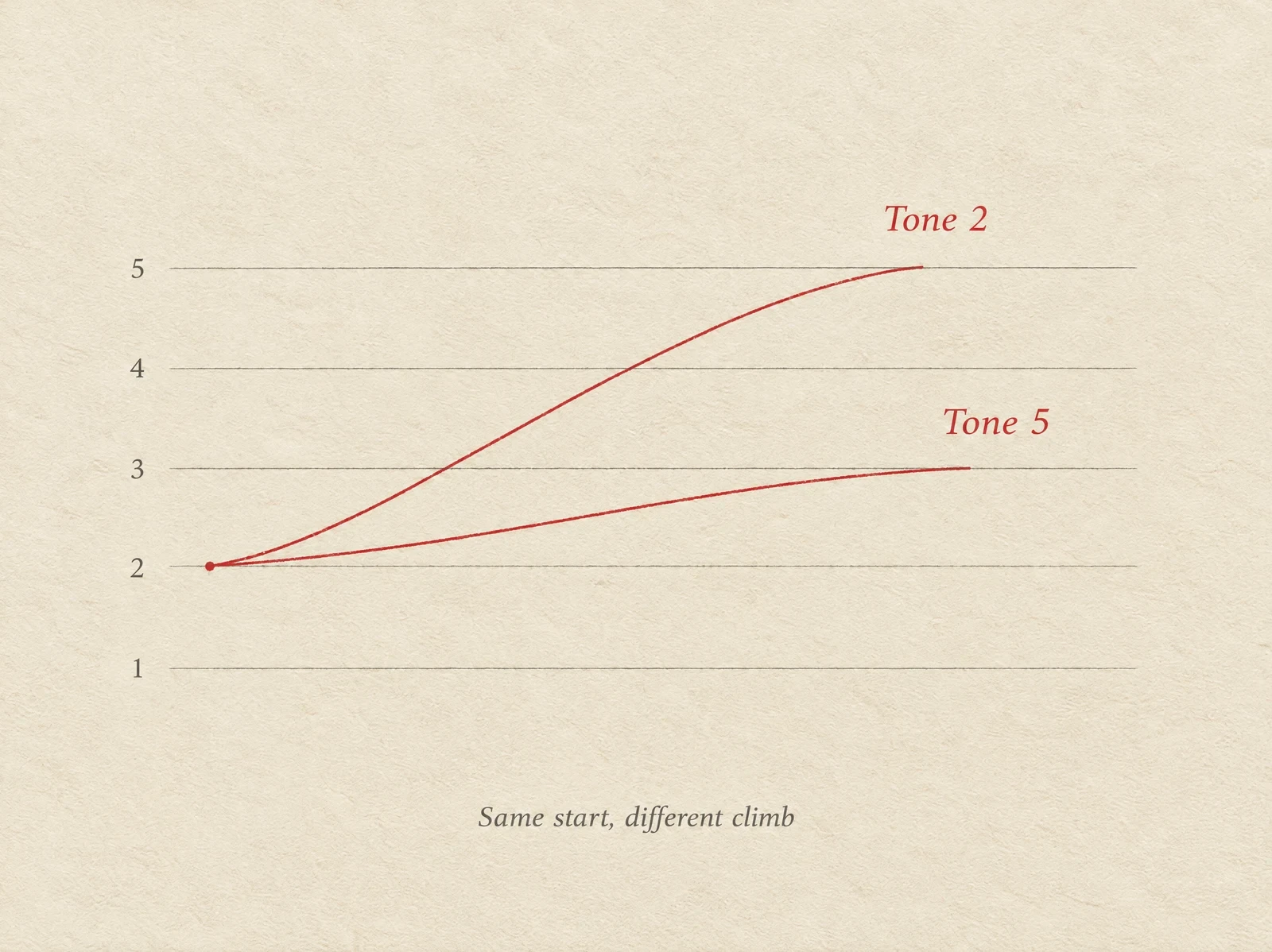
Research backs this up. A study of young heritage speakers found Tone 2 and Tone 5, which have similar rising contours, the hardest pair to tell apart. Research with adult heritage speakers in Canada found they leaned more on sentence meaning than on pitch to work out which word they’d heard. That is exactly why you can follow a conversation but wobble when you speak.
The adult vocabulary gap
“I’m tired” might come easily. “The rent just went up” or “I’ve been feeling anxious” stays in English. At family gatherings like Chinese New Year dinner, you follow every word your uncle says about politics, but can’t reply with a single sentence. So you smile, nod and reach for another 蝦餃 (haa1 gaau2).
Embarrassment, and sometimes guilt
You freeze when your grandparent asks you something directly. You worry about hearing “your Cantonese is so bad”. Picture sitting in A&E translating for your grandmother and realising you don’t know the word for “prescription”. That gap stings, and it makes avoiding Cantonese altogether feel safer.
Code-switching habits
As a teenager you probably started dropping English nouns and verbs into whatever Cantonese you did speak. Hong Kong people mix English in too, so that isn’t the problem. The problem is when English becomes the only way you can finish a sentence.
Why Mandarin classes and beginner apps don’t fit
People often call Cantonese a dialect, but in practice Cantonese and Mandarin are different spoken languages. A Cantonese speaker in Hong Kong and a Mandarin speaker in Beijing can’t understand each other in conversation. If your family speaks Cantonese, being able to speak Mandarin won’t unlock the conversations you want to have.
The tonal system is different too. Cantonese has six tones (numbered 1 to 6 in Jyutping); Mandarin has four plus a neutral tone. Learning Mandarin in the UK also usually means Pinyin and Simplified characters, while you grew up seeing Traditional Chinese characters on dim sum menus, shop signs and red packets.
Beginner Cantonese apps have the opposite problem. They start with “Hello, my name is…” and drill common phrases you’ve understood since you were four. That wastes your head start and kills your motivation fast.
Recognise the head start you already have
You are not a “failed native speaker”. You already have things most learners spend years trying to get.
You can tell when someone sounds natural and when they sound like a textbook. You have a feel for sentence-final particles like 呀 (aa3), 喎 (wo3) and 囉 (lo1), even if you couldn’t explain them. Everyday Cantonese like 唔該 (m4 goi1), 多謝 (do1 ze6), 冇所謂 (mou5 so2 wai6) and 好攰呀 (hou2 gui6 aa3) has been in your head for years. You probably know some slang too, and you can follow the grammar of a long, messy family argument. Someone who wants to learn Cantonese from scratch would love to have all of that.
Try a quick self-audit. For one normal day, quietly note every Cantonese phrase you understand: family chats, WhatsApp voice notes, a drama on in the background. The list will probably surprise you.
A practical plan to start speaking again
Start from what you understand
Pick a handful of phrases you hear all the time, like 食咗飯未呀? (sik6 zo2 faan6 mei6 aa3) or 返工點呀? (faan1 gung1 dim2 aa3), and say them out loud yourself every day. Learn whole phrases, not single words, so they come out without you translating from English first. This is how you start to speak Cantonese rather than recite it.
Write it down in Jyutping
Note your target phrases with Jyutping and tone numbers, and practise them slowly. Romanisation makes the pitch pattern visible, which is exactly what you need when your ear knows the word but your mouth doesn’t. Our Cantonese tones guide walks through all six tones.
Build new vocabulary one area at a time
Choose one part of life, like work, health or relationships, and learn 20 to 30 words and sentence patterns for it. This is how you move from childhood Cantonese to Cantonese you can use about your actual life.
Make it daily
Ten minutes of listening (podcasts, dramas, YouTube), ten minutes of speaking out loud, and one short real exchange. Shadowing helps: play a clip and speak along with it in real time. So does narrating what you’re doing in Cantonese, even if it’s only to yourself. The goal is to speak Cantonese a little every single day.
A practical Cantonese phrasebook for adult life
These are the kinds of sentences heritage learners tell us they’re missing: not “hello”, but the grown-up things you want to say to your family. Each one is short enough to learn this week.
For when you get stuck
我明白,但係唔識講。 (
ngo5 ming4 baak6, daan6 hai6 m4 sik1 gong2) I understand, but I can’t say it.呢個用廣東話點講? (
ni1 go3 jung6 gwong2 dung1 waa2 dim2 gong2) How do you say this in Cantonese?你講慢啲得唔得? (
nei5 gong2 maan6 di1 dak1 m4 dak1) Could you speak a bit more slowly?
For work and everyday life
我今日好忙。 (
ngo5 gam1 jat6 hou2 mong4) I’m really busy today.我聽日要返工。 (
ngo5 ting1 jat6 jiu3 faan1 gung1) I’ve got work tomorrow.
For health
我有啲唔舒服。 (
ngo5 jau5 di1 m4 syu1 fuk6) I’m not feeling very well.我想睇醫生。 (
ngo5 soeng2 tai2 ji1 sang1) I want to see a doctor.
For family gatherings
恭喜發財! (
gung1 hei2 faat3 coi4) Happy Chinese New Year!身體健康! (
san1 tai2 gin6 hong1) Wishing you good health! (a classic for older relatives)
The first one is worth learning today. Saying it in Cantonese, rather than switching to English, keeps the conversation going and usually earns you some patience.
Getting comfortable with tones you already “hear”
Noticing that someone else’s tone is off is one skill. Controlling your own pitch in a full sentence is another, and it’s worth focused practice.
Jyutping numbers the six tones: 1 (high level), 2 (high rising), 3 (mid level), 4 (low falling), 5 (low rising) and 6 (low level). The classic example is one syllable with six meanings: 詩 (si1) poem, 史 (si2) history, 試 (si3) try, 時 (si4) time, 市 (si5) market, 事 (si6) matter.
Three drills that work:
Minimal pairs: Say 媽 (
maa1) then 馬 (maa5) back to back and listen to the difference in your own voice.Whole phrases: Drill everyday chunks like 唔該晒 (
m4 goi1 saai3) or 真係好正呀 (zan1 hai6 hou2 zeng3 aa3) until they feel automatic.Record yourself: Compare your recording with a native speaker and notice where your pitch drifts. Tone 2 and Tone 5 are the usual suspects.
Common mistakes heritage learners make
Waiting until you feel fluent
Many heritage learners don’t speak until they’re sure it’ll come out perfectly, which means they never speak. The aim is to communicate, not to perform. A slightly wrong sentence in Cantonese does more for you than a perfect one in English.
Translating English word order
Cantonese puts time before the verb, so “I’m going tomorrow” is 我聽日去 (ngo5 ting1 jat6 heoi3), literally “I tomorrow go”. If you build sentences in English and translate them word by word, they come out sounding odd. Copying whole phrases you’ve heard avoids this.
Only practising with people who switch to English
Family love you, which is exactly why they switch to English the second you struggle. You need some practice time with someone who will wait for you to finish in Cantonese.
Skipping tones because you “know” the word
Your ear fills in tones from context, so it’s easy to assume your own tones are fine. Record yourself once and you’ll know for sure.
Learning lists instead of conversations
A list of 50 words feels productive. Being able to respond to “how’s work?” with three sentences is far more useful.
Practising at home without it getting awkward
Plenty of heritage learners want to speak Cantonese properly with their parents and grandparents but dread “performing” Cantonese at home. You don’t need to give a speech.
Start with tiny, repeatable moments
Say 我返嚟喇 (ngo5 faan1 lei4 laa3) when you walk through the door. Ask 食咩好呀? (sik6 me1 hou2 aa3) before dinner. Offer 我幫你沖茶 (ngo5 bong1 nei5 cung1 caa4). After a few days they stop feeling forced.
Ask for help
In English or simple Cantonese, tell your family you’re trying to speak more. Ask them not to switch to English straight away unless you’re properly stuck. Even five Cantonese-only minutes at the dinner table count.
Do things together
Cook, go for dim sum on a Sunday, or watch a drama and ask what’s going on. Talking happens naturally when there’s something to talk about, and food is the easiest topic there is.
Agree some ground rules
It’s fine to ask relatives not to tease your accent. Ask them to say the phrase back to you once, then move on.
Do you need to read Chinese characters?
No. You can learn Cantonese and get much better at speaking without reading or writing a single character. Many heritage learners have little or no literacy in Chinese, and it doesn’t stop them having real conversations with family.
Jyutping is the most useful first tool. It shows pronunciation and tones in the Latin alphabet, so you can read phrase lists, look words up and make your own notes. For how spoken Cantonese, written Cantonese, Standard Written Chinese and Jyutping fit together, see Written Cantonese explained.
A phased approach works well:
First: Jyutping plus audio, until speaking feels less scary.
Then: start recognising the high-frequency Chinese characters you see in WhatsApp messages, menus and subtitles, such as 唔 (
m4), 冇 (mou5), 喺 (hai2), 咗 (zo2) and 佢 (keoi5).Later, if you want: deeper literacy in reading and writing. If your main goal is chatting with your grandparents, it’s helpful but not urgent.
Getting help that starts from your real level
Most language learning courses are built for complete beginners, so they feel painfully slow when you already understand a lot. You don’t need six weeks on greetings. You need someone who can find your real level quickly: which tones you produce well, which grammar you already use without thinking, and which adult vocabulary gaps keep pushing you back into English.
A native Hong Kong tutor can hold relaxed conversations about your work, family and interests, and gently keep you in Cantonese instead of letting you switch. Speaking without preparing first, and getting corrected as you go, is the practice that’s hardest to find on your own.
Cantoflow is built around Ficke, a native Hong Kong Cantonese tutor teaching one-to-one online lessons. The Complete Cantonese pathway starts from what you already understand, not from “hello”. If you’re not sure what level you are, which most heritage learners aren’t, a £30 trial lesson is the easiest way to find out where you stand and what to work on first.
Frequently asked questions
Am I too old to fix my Cantonese in my thirties?
No. Adults learn Cantonese and improve their speaking all the time, and heritage learners often move faster than complete beginners because the sounds, rhythm and grammar are already familiar. Twenty or thirty minutes of practice around a full-time job is realistic. Consistency matters more than age. For a broader look at timelines, see How long does it take to learn Cantonese?
Is Cantonese a dialect?
It’s often called one, but for a learner the label doesn’t matter much: Cantonese and Mandarin aren’t mutually intelligible when spoken. Cantonese is the everyday language of Hong Kong and Macau, it’s widely spoken across Guangdong in southern China, and it has long been the language of many Hong Kong and Cantonese-speaking communities in the UK, Canada and beyond. Some southern Chinese families speak other Chinese languages, such as Hokkien, and the same advice applies: learn the language your family actually speaks.
Should I stop mixing English into my Cantonese?
Not completely. Hong Kong people mix English in all the time, so a bit of it is natural. The aim is to be able to finish a sentence in Cantonese when you want to. Try saying the whole sentence in Cantonese first, and if you genuinely don’t know a key word, drop in the English and ask how to say it next time.
Should I learn Mandarin properly first and come back to Cantonese later?
If your goal is talking with Cantonese-speaking family or friends, put your time into Cantonese directly and learn Cantonese first. Learning Mandarin is worthwhile in its own right, but it won’t get you into the conversations at your family’s dinner table.
Can I pass Cantonese on to my own kids if mine isn’t perfect?
Yes, and many heritage learners start improving their Cantonese for exactly this reason. Children pick up a lot from everyday routines: mealtimes, bath time, the phrases you say every day without thinking. Grandparents can do a lot of the heavy lifting too, and your own Cantonese will grow alongside your child’s.
How much time do I need each week to see progress?
There’s no magic number. Fifteen to thirty minutes a day builds momentum, as long as you’re speaking out loud and using Cantonese in real conversations. Judge progress by how many real Cantonese moments you have each week, not by hours logged.
What if my accent never sounds “proper”?
An accent doesn’t cancel out your identity or your connection to your family. Plenty of native speakers in Guangdong, Macau and overseas sound different from each other too. Focus on clarity: get your tones and key vowels right, and if people understand you and you can respond in Cantonese, you’re doing it right.
Ready to learn Cantonese? Build confident, fluent communication with personalised lessons from Cantoflow.
Book a £30 trial lesson
Book a £30 trial lesson