Skip to content

8 min read

I love you in Cantonese: romantic phrases, pet names and meeting the parents

How to say I love you in Cantonese, why many Hong Kongers rarely say it, and the softer phrases, pet names and polite words for meeting the parents.

A young couple in dark wool coats stand forehead to forehead, eyes closed and smiling, her hand resting on his chest. A black-and-white cut-out on cream paper over a torn blush patch, with a thin red thread curling away to the right.

Say it softly:

Sometimes the biggest words go unsaid.

Key takeaways

  • 我愛你 (ngo5 oi3 nei5) is “I love you”, but in Hong Kong it is saved for big moments.

  • Day to day, couples lean on 我鍾意你 (ngo5 zung1 ji3 nei5), “I like you”, and 我掛住你 (ngo5 gwaa3 zyu6 nei5), “I miss you”.

  • Care is often shown rather than said: 食咗飯未呀? (sik6 zo2 faan6 mei6 aa3), “have you eaten?”, can mean more than a speech.

  • Pet names range from sweet 寶貝 (bou2 bui3) to teasing 傻豬 (so4 zyu1). Keep the mushy ones away from the dinner table.

  • Meeting the parents, call them 伯父 (baak3 fu2) and 伯母 (baak3 mou2), bring fruit, and praise the food.

Maybe you’re dating someone from Hong Kong, maybe a big dinner with their loved ones is on the calendar, or maybe you just want to tell a special person you care in their own language. Whatever the reason, saying I love you in Cantonese works a little differently from English. Cantonese speakers often express love through small actions and everyday words rather than big verbal declarations.

This guide is for anyone learning Cantonese for love: partners, British-born Hong Kongers reconnecting with relatives, or anyone who wants to speak Cantonese from the heart. It covers the direct phrase, the softer Cantonese love phrases people actually use, pet names, lines for cards and texts, and the polite language that gets you through meeting the parents.

How to say “I love you” in Cantonese

The direct translation of I love you in Cantonese is 我愛你 (ngo5 oi3 nei5). It literally means “I love you”, word for word. It is correct, it is beautiful, and in Hong Kong it carries real weight, because it is reserved for strong feelings. People tend to keep it for big moments: a proposal, an anniversary, a goodbye at the airport. It isn’t something you toss out at the end of a phone call.

The phrase couples reach for day to day is 我鍾意你 (ngo5 zung1 ji3 nei5), “I like you”. 鍾意 (zung1 ji3) covers a lot of ground, from liking a film to being properly smitten with someone. In a romantic context, 我鍾意你 carries feeling without the full weight of 愛 (oi3), which is why many Cantonese speakers treat it as the everyday way to say love you in Cantonese. It suits the early stages of dating and long relationships alike.

Context is everything. Here’s how the two sit in real life:

  • Early days, texting late: 我好鍾意同你傾偈 (ngo5 hou2 zung1 ji3 tung4 nei5 king1 gai2), “I really like talking to you”. Dropping 我愛你 here would raise eyebrows.

  • An anniversary dinner: 我愛你 (ngo5 oi3 nei5). The moment is big enough for the big phrase.

  • Last thing at night: 掛住你 (gwaa3 zyu6 nei5), “miss you”. No speech needed.

Getting the tones right

Cantonese is a tonal language, and the number after each Jyutping syllable tells you the tone. Here’s how to pronounce the pieces:

  • 我 (ngo5), “I”: tone 5, a low rise

  • 愛 (oi3), “love”: tone 3, mid and level

  • 鍾意 (zung1 ji3), “to like”: tone 1 high and level, then tone 3

  • 你 (nei5), “you”: tone 5 again

Practise the whole phrase rather than single words. Say 我鍾意你 slowly a few times, then speed up until it comes out as one smooth line. Record yourself on your phone and compare it with a native speaker. You’ll hear your own wobbles faster than any book can point them out.

Why many Hong Kongers rarely say it out loud

In Cantonese culture, as in much of Chinese culture, love is something you show rather than say. Someone peeling fruit for you late at night, or a partner telling you to take a jacket, is doing the work that “I love you” does in English. Younger speakers, who grew up with English films and messaging apps, are often more relaxed about saying it, and plenty of couples finish a voice note with an English “love you”. But spoken aloud, 我愛你 still feels like an event to many.
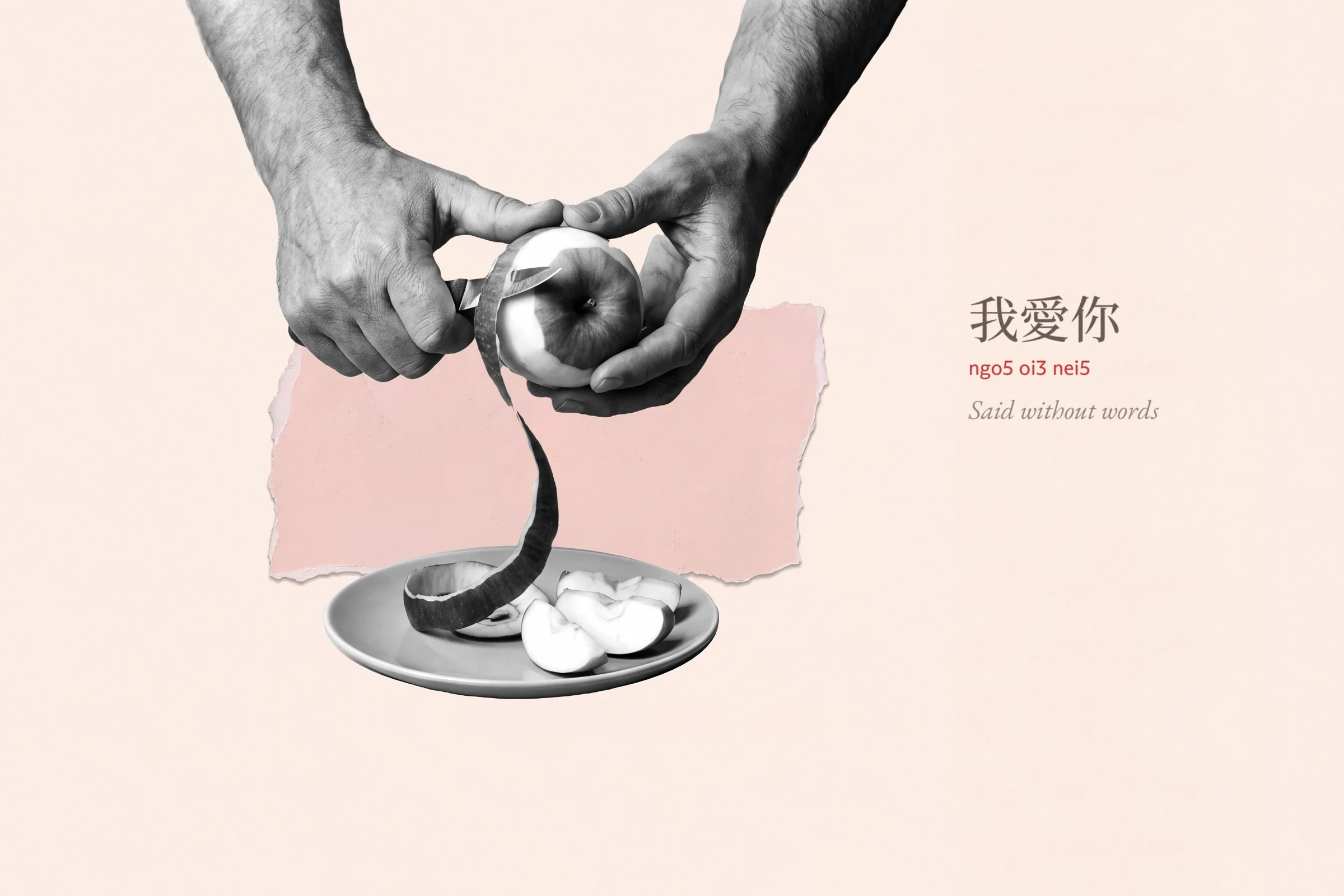
On cream paper with a torn blush patch, a black-and-white cut-out of two hands peeling an apple in one long spiral, the peel falling onto a plate of slices. Label: 我愛你, ngo5 oi3 nei5, said without words.

These common phrases from everyday conversation carry more feeling than they seem to:

  • 食咗飯未呀? (sik6 zo2 faan6 mei6 aa3), “have you eaten yet?”

  • 記得著多件衫 (gei3 dak1 zoek3 do1 gin6 saam1), “remember to wear an extra layer”

  • 早啲瞓啦 (zou2 di1 fan3 laa1), “get to bed a bit earlier”

If someone asks whether you’ve eaten, they’re not making small talk. They’re telling you they care.

Softer ways to say you care

This is the everyday toolkit: Cantonese words that express warmth without the drama.

  • 我好鍾意你 (ngo5 hou2 zung1 ji3 nei5), “I really like you”. A step up from 我鍾意你.

  • 我掛住你 (ngo5 gwaa3 zyu6 nei5), “I miss you”. Perfect for time apart.

  • 你對我好重要 (nei5 deoi3 ngo5 hou2 zung6 jiu3), “you’re very important to me”. Sincere without being heavy.

  • 小心啲呀 (siu2 sam1 di1 aa3), “be careful”. Small, warm and never strange to say.

  • 有咩需要同我講 (jau5 me1 seoi1 jiu3 tung4 ngo5 gong2), “if you need anything, tell me”.

  • 我唔想見到你傷心 (ngo5 m4 soeng2 gin3 dou2 nei5 soeng1 sam1), “I don’t want to see you sad”.

On cream paper with a torn blush patch, a black-and-white cut-out of a hand reaching down to hold up a knitted cardigan on a wooden hanger. Label: 記得著多件衫, gei3 dak1 zoek3 do1 gin6 saam1, remember to wear an extra layer.

Cantonese pet names: what couples call each other

Hong Kong couples mix Cantonese, English and a bit of teasing. These are the ones you’ll hear most:

  • 寶貝 (bou2 bui3), “darling” or “baby”. Sweet and very common.

  • BB (bi4 bi1), “babe”. Borrowed from English “baby” and written as BB in messages.

  • 心肝 (sam1 gon1), literally “heart and liver”, meaning “my dearest”. The longer 心肝寶貝 (sam1 gon1 bou2 bui3) is even more doting.

  • 老公 (lou5 gung1), “husband”, and 老婆 (lou5 po4), “wife”. Couples often use them well before any wedding, a bit like “hubby” and “wifey”.

  • 傻豬 (so4 zyu1), “silly pig”. A gentle tease that is really a term of affection.

One word of warning: around older relatives, dial the mushy names right down. Calling your partner BB across the dinner table may earn you a look. Keep those for messages and quiet moments.

Romantic phrases for texts, cards and special moments

These Cantonese love phrases build from simple to more poetic. In Hong Kong, short and sincere usually lands better than flowery, which can sound like a line from a TV drama. They also work when you’re spending time apart.

  • 我好想見到你 (ngo5 hou2 soeng2 gin3 dou2 nei5), “I really want to see you”.

  • 同你一齊好開心 (tung4 nei5 jat1 cai4 hou2 hoi1 sam1), “I’m so happy when I’m with you”. A birthday card favourite.

  • 你令到我好幸福 (nei5 ling6 dou3 ngo5 hou2 hang6 fuk1), “you make me so happy”. 幸福 is a deep, settled kind of happiness, so it suits an anniversary.

  • 冇你唔得 (mou5 nei5 m4 dak1), “I can’t do without you”.

  • 你喺我心入面 (nei5 hai2 ngo5 sam1 jap6 min6), “you’re in my heart”.

  • 我對你一見鍾情 (ngo5 deoi3 nei5 jat1 gin3 zung1 cing4), “I fell for you at first sight”. Better in a letter than a Tuesday morning text.

  • 希望同你天長地久 (hei1 mong6 tung4 nei5 tin1 coeng4 dei6 gau2), “I hope we last forever”. 天長地久 means “as long as heaven and earth”, a lovely way to sign off a card.

Meeting the parents: polite Cantonese for the dinner table

The invitation has arrived. The language here is more formal than anything above, so here’s what to say, and a few things to do.

What to call your partner’s parents

  • 伯父 (baak3 fu2), “uncle”, for your partner’s father.

  • 伯母 (baak3 mou2), “auntie”, for your partner’s mother.

  • If the parents are on the younger side, 叔叔 (suk1 suk1), “uncle”, and 姨姨 (ji4 ji1), “auntie”, can feel more natural. Follow your partner’s lead.

Avoid first names, and avoid the street versions such as 阿伯 (aa3 baak3), which is more “old man” than “uncle”. For aunts, cousins and grandparents, our guide to Cantonese family terms has the full list.

Greetings and first impressions

  • 伯父好,伯母好 (baak3 fu2 hou2, baak3 mou2 hou2), “hello, uncle; hello, auntie”. Greeting each parent by title is the polite way in.

  • 我係… (ngo5 hai6…), “I’m…”, followed by your name.

  • 多多指教 (do1 do1 zi2 gaau3), literally “please give me your guidance”. Humble and respectful.
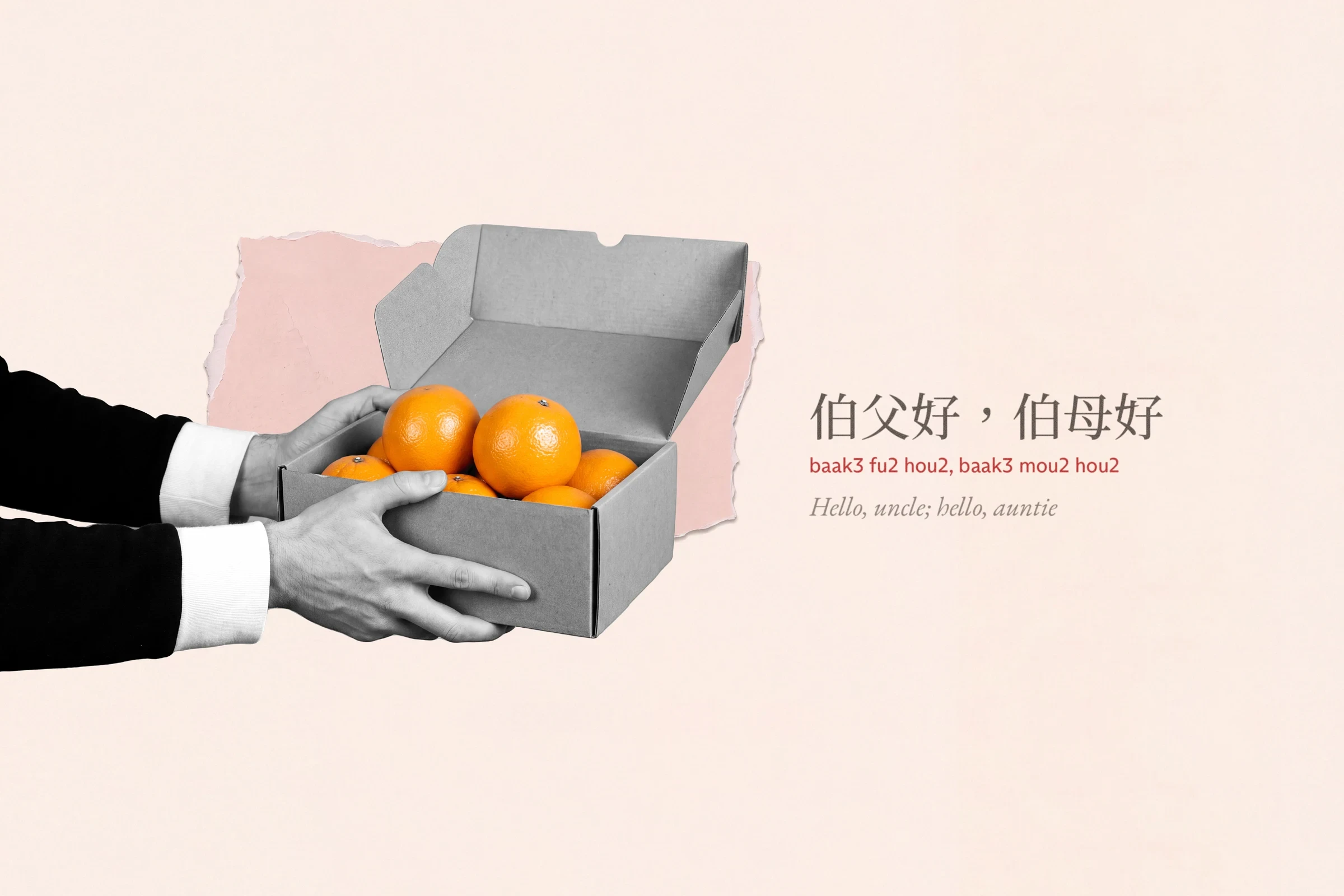
On cream paper with a torn blush patch, two hands offer an open box of bright oranges, the only colour in the black-and-white cut-out. Label: 伯父好,伯母好, baak3 fu2 hou2, baak3 mou2 hou2, hello, uncle; hello, auntie.

At the table

  • 多謝你哋請我食飯 (do1 ze6 nei5 dei6 ceng2 ngo5 sik6 faan6), “thank you for having me for dinner”.

  • 好好食呀 (hou2 hou2 sik6 aa3), “this is delicious”. Use it generously.

  • 唔該 (m4 goi1), “thank you”, when someone pours your tea. Many people also tap two fingers on the table.

  • 伯父,食飯 (baak3 fu2, sik6 faan6), “uncle, let’s eat”. Inviting the elders to start before you pick up your chopsticks is a small touch that gets noticed.
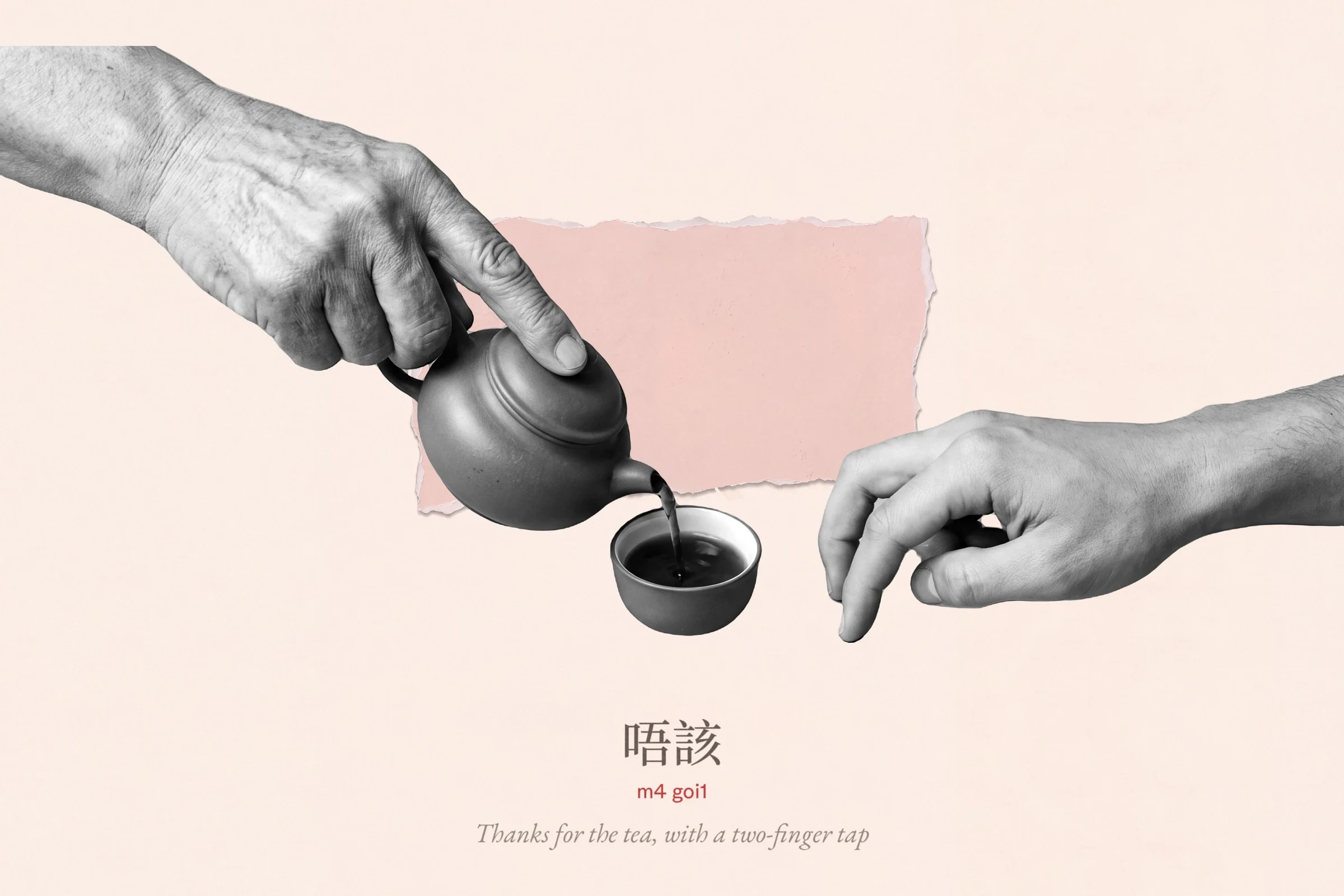
On cream paper with a torn blush patch, a black-and-white cut-out of an older hand pouring tea from a small clay teapot into a little cup while a younger hand taps two fingers beside it. Label: 唔該, m4 goi1, thanks for the tea, with a two-finger tap.

A few things to do

  • Bring a gift: a box of good fruit, biscuits or tea. Hand it over with both hands.

  • Skip clocks as presents. 送鐘 (sung3 zung1), giving a clock, sounds like 送終 (sung3 zung1), seeing someone off at their death.

  • Help clear the table, pour tea for others, and smile. In a Hong Kong family, that says more than any phrase.
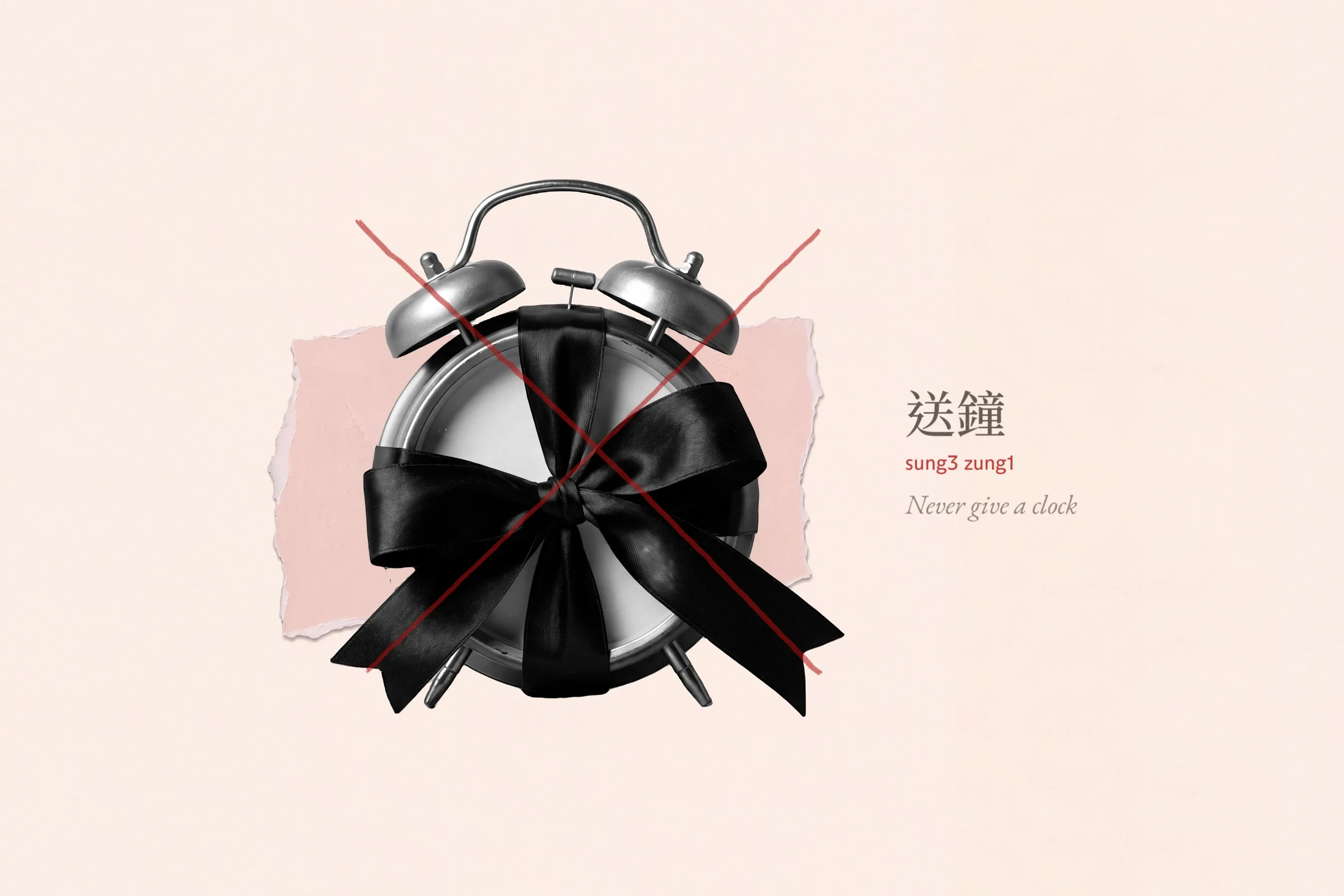
On cream paper with a torn blush patch, a black-and-white cut-out of a twin-bell alarm clock wrapped in a black satin bow like a present, crossed out with a loose red pencil X. Label: 送鐘, sung3 zung1, never give a clock.

Caring phrases for loved ones

With older relatives, 我愛你 is rare. Love is spoken through small, practical worries, and you can use these with your partner’s relatives too:

  • 食咗飯未呀? (sik6 zo2 faan6 mei6 aa3), “have you eaten yet?”. The classic.

  • 唔好咁辛苦 (m4 hou2 gam3 san1 fu2), “don’t work so hard”.

  • 小心身體 (siu2 sam1 san1 tai2), “look after your health”.
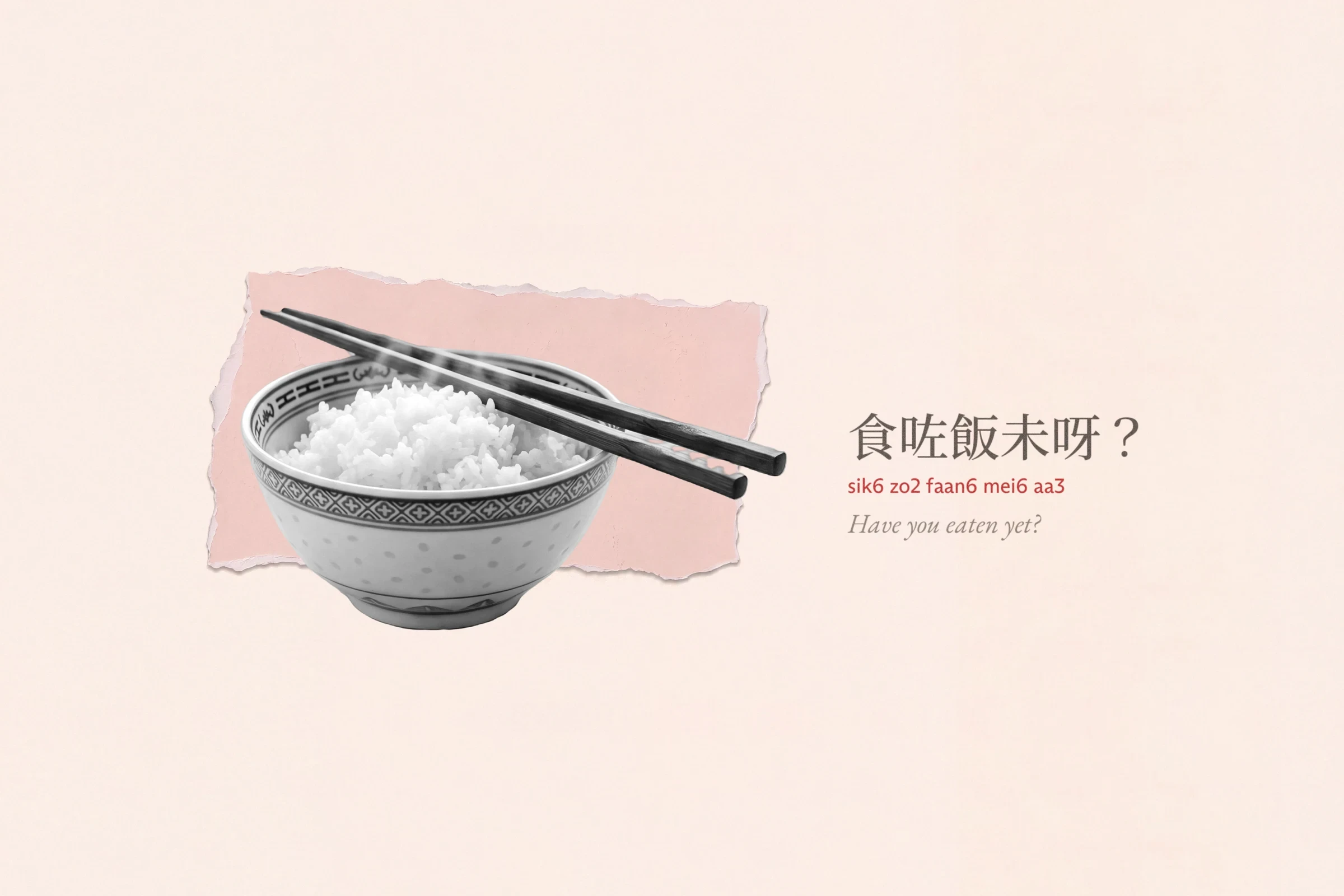
On cream paper with a torn blush patch, a black-and-white cut-out of a porcelain rice bowl full of white rice with chopsticks resting across it. Label: 食咗飯未呀?, sik6 zo2 faan6 mei6 aa3, have you eaten yet?

Frequently asked questions

Is it strange to say I love you in Cantonese to my partner?

Not at all, but it can sound intense depending on the person and the moment. Lots of couples keep 我愛你 (ngo5 oi3 nei5) for special occasions and use 我鍾意你 (ngo5 zung1 ji3 nei5) or 我掛住你 (ngo5 gwaa3 zyu6 nei5) day to day. Listen to how your partner talks and follow their lead.

Can I say 我鍾意你 to a friend?

Said seriously, one to one, it usually sounds romantic. For a friend, try 同你一齊好開心 (tung4 nei5 jat1 cai4 hou2 hoi1 sam1), “I always have fun with you”.

How do I say “we love you” in Cantonese?

我哋愛你 (ngo5 dei6 oi3 nei5) means “we love you” and works in a card. A softer line that feels more natural is 我哋好掛住你 (ngo5 dei6 hou2 gwaa3 zyu6 nei5), “we miss you so much”.

Is “I love you” the same in Cantonese and Mandarin?

The Chinese characters are the same, 我愛你, but the spoken sounds are completely different. Mandarin is wǒ ài nǐ; Cantonese is ngo5 oi3 nei5. Everything in this guide is Hong Kong Cantonese.

Which phrases should I learn first?

If you’re learning Cantonese for someone special, start with four: 我鍾意你, 我掛住你, 食咗飯未呀 and 伯父好,伯母好. Say them out loud every day for a week, and they’ll be ready when you need them.

How good is your Cantonese?

Five quick questions to see where your Cantonese is at.

Question 1 of 5. The waiter brings your food. What do you say?

Complete Cantonese takes you from first words to real conversations with a native Hong Kong tutor.

Book a £30 trial lesson

Book a £30 trial lesson

8 min read

I love you in Cantonese: romantic phrases, pet names and meeting the parents

How to say I love you in Cantonese, why many Hong Kongers rarely say it, and the softer phrases, pet names and polite words for meeting the parents.

A young couple in dark wool coats stand forehead to forehead, eyes closed and smiling, her hand resting on his chest. A black-and-white cut-out on cream paper over a torn blush patch, with a thin red thread curling away to the right.

Say it softly:

Sometimes the biggest words go unsaid.

Key takeaways

  • 我愛你 (ngo5 oi3 nei5) is “I love you”, but in Hong Kong it is saved for big moments.

  • Day to day, couples lean on 我鍾意你 (ngo5 zung1 ji3 nei5), “I like you”, and 我掛住你 (ngo5 gwaa3 zyu6 nei5), “I miss you”.

  • Care is often shown rather than said: 食咗飯未呀? (sik6 zo2 faan6 mei6 aa3), “have you eaten?”, can mean more than a speech.

  • Pet names range from sweet 寶貝 (bou2 bui3) to teasing 傻豬 (so4 zyu1). Keep the mushy ones away from the dinner table.

  • Meeting the parents, call them 伯父 (baak3 fu2) and 伯母 (baak3 mou2), bring fruit, and praise the food.

Maybe you’re dating someone from Hong Kong, maybe a big dinner with their loved ones is on the calendar, or maybe you just want to tell a special person you care in their own language. Whatever the reason, saying I love you in Cantonese works a little differently from English. Cantonese speakers often express love through small actions and everyday words rather than big verbal declarations.

This guide is for anyone learning Cantonese for love: partners, British-born Hong Kongers reconnecting with relatives, or anyone who wants to speak Cantonese from the heart. It covers the direct phrase, the softer Cantonese love phrases people actually use, pet names, lines for cards and texts, and the polite language that gets you through meeting the parents.

How to say “I love you” in Cantonese

The direct translation of I love you in Cantonese is 我愛你 (ngo5 oi3 nei5). It literally means “I love you”, word for word. It is correct, it is beautiful, and in Hong Kong it carries real weight, because it is reserved for strong feelings. People tend to keep it for big moments: a proposal, an anniversary, a goodbye at the airport. It isn’t something you toss out at the end of a phone call.

The phrase couples reach for day to day is 我鍾意你 (ngo5 zung1 ji3 nei5), “I like you”. 鍾意 (zung1 ji3) covers a lot of ground, from liking a film to being properly smitten with someone. In a romantic context, 我鍾意你 carries feeling without the full weight of 愛 (oi3), which is why many Cantonese speakers treat it as the everyday way to say love you in Cantonese. It suits the early stages of dating and long relationships alike.

Context is everything. Here’s how the two sit in real life:

  • Early days, texting late: 我好鍾意同你傾偈 (ngo5 hou2 zung1 ji3 tung4 nei5 king1 gai2), “I really like talking to you”. Dropping 我愛你 here would raise eyebrows.

  • An anniversary dinner: 我愛你 (ngo5 oi3 nei5). The moment is big enough for the big phrase.

  • Last thing at night: 掛住你 (gwaa3 zyu6 nei5), “miss you”. No speech needed.

Getting the tones right

Cantonese is a tonal language, and the number after each Jyutping syllable tells you the tone. Here’s how to pronounce the pieces:

  • 我 (ngo5), “I”: tone 5, a low rise

  • 愛 (oi3), “love”: tone 3, mid and level

  • 鍾意 (zung1 ji3), “to like”: tone 1 high and level, then tone 3

  • 你 (nei5), “you”: tone 5 again

Practise the whole phrase rather than single words. Say 我鍾意你 slowly a few times, then speed up until it comes out as one smooth line. Record yourself on your phone and compare it with a native speaker. You’ll hear your own wobbles faster than any book can point them out.

Why many Hong Kongers rarely say it out loud

In Cantonese culture, as in much of Chinese culture, love is something you show rather than say. Someone peeling fruit for you late at night, or a partner telling you to take a jacket, is doing the work that “I love you” does in English. Younger speakers, who grew up with English films and messaging apps, are often more relaxed about saying it, and plenty of couples finish a voice note with an English “love you”. But spoken aloud, 我愛你 still feels like an event to many.

On cream paper with a torn blush patch, a black-and-white cut-out of two hands peeling an apple in one long spiral, the peel falling onto a plate of slices. Label: 我愛你, ngo5 oi3 nei5, said without words.

These common phrases from everyday conversation carry more feeling than they seem to:

  • 食咗飯未呀? (sik6 zo2 faan6 mei6 aa3), “have you eaten yet?”

  • 記得著多件衫 (gei3 dak1 zoek3 do1 gin6 saam1), “remember to wear an extra layer”

  • 早啲瞓啦 (zou2 di1 fan3 laa1), “get to bed a bit earlier”

If someone asks whether you’ve eaten, they’re not making small talk. They’re telling you they care.

Softer ways to say you care

This is the everyday toolkit: Cantonese words that express warmth without the drama.

  • 我好鍾意你 (ngo5 hou2 zung1 ji3 nei5), “I really like you”. A step up from 我鍾意你.

  • 我掛住你 (ngo5 gwaa3 zyu6 nei5), “I miss you”. Perfect for time apart.

  • 你對我好重要 (nei5 deoi3 ngo5 hou2 zung6 jiu3), “you’re very important to me”. Sincere without being heavy.

  • 小心啲呀 (siu2 sam1 di1 aa3), “be careful”. Small, warm and never strange to say.

  • 有咩需要同我講 (jau5 me1 seoi1 jiu3 tung4 ngo5 gong2), “if you need anything, tell me”.

  • 我唔想見到你傷心 (ngo5 m4 soeng2 gin3 dou2 nei5 soeng1 sam1), “I don’t want to see you sad”.

On cream paper with a torn blush patch, a black-and-white cut-out of a hand reaching down to hold up a knitted cardigan on a wooden hanger. Label: 記得著多件衫, gei3 dak1 zoek3 do1 gin6 saam1, remember to wear an extra layer.

Cantonese pet names: what couples call each other

Hong Kong couples mix Cantonese, English and a bit of teasing. These are the ones you’ll hear most:

  • 寶貝 (bou2 bui3), “darling” or “baby”. Sweet and very common.

  • BB (bi4 bi1), “babe”. Borrowed from English “baby” and written as BB in messages.

  • 心肝 (sam1 gon1), literally “heart and liver”, meaning “my dearest”. The longer 心肝寶貝 (sam1 gon1 bou2 bui3) is even more doting.

  • 老公 (lou5 gung1), “husband”, and 老婆 (lou5 po4), “wife”. Couples often use them well before any wedding, a bit like “hubby” and “wifey”.

  • 傻豬 (so4 zyu1), “silly pig”. A gentle tease that is really a term of affection.

One word of warning: around older relatives, dial the mushy names right down. Calling your partner BB across the dinner table may earn you a look. Keep those for messages and quiet moments.

Romantic phrases for texts, cards and special moments

These Cantonese love phrases build from simple to more poetic. In Hong Kong, short and sincere usually lands better than flowery, which can sound like a line from a TV drama. They also work when you’re spending time apart.

  • 我好想見到你 (ngo5 hou2 soeng2 gin3 dou2 nei5), “I really want to see you”.

  • 同你一齊好開心 (tung4 nei5 jat1 cai4 hou2 hoi1 sam1), “I’m so happy when I’m with you”. A birthday card favourite.

  • 你令到我好幸福 (nei5 ling6 dou3 ngo5 hou2 hang6 fuk1), “you make me so happy”. 幸福 is a deep, settled kind of happiness, so it suits an anniversary.

  • 冇你唔得 (mou5 nei5 m4 dak1), “I can’t do without you”.

  • 你喺我心入面 (nei5 hai2 ngo5 sam1 jap6 min6), “you’re in my heart”.

  • 我對你一見鍾情 (ngo5 deoi3 nei5 jat1 gin3 zung1 cing4), “I fell for you at first sight”. Better in a letter than a Tuesday morning text.

  • 希望同你天長地久 (hei1 mong6 tung4 nei5 tin1 coeng4 dei6 gau2), “I hope we last forever”. 天長地久 means “as long as heaven and earth”, a lovely way to sign off a card.

Meeting the parents: polite Cantonese for the dinner table

The invitation has arrived. The language here is more formal than anything above, so here’s what to say, and a few things to do.

What to call your partner’s parents

  • 伯父 (baak3 fu2), “uncle”, for your partner’s father.

  • 伯母 (baak3 mou2), “auntie”, for your partner’s mother.

  • If the parents are on the younger side, 叔叔 (suk1 suk1), “uncle”, and 姨姨 (ji4 ji1), “auntie”, can feel more natural. Follow your partner’s lead.

Avoid first names, and avoid the street versions such as 阿伯 (aa3 baak3), which is more “old man” than “uncle”. For aunts, cousins and grandparents, our guide to Cantonese family terms has the full list.

Greetings and first impressions

  • 伯父好,伯母好 (baak3 fu2 hou2, baak3 mou2 hou2), “hello, uncle; hello, auntie”. Greeting each parent by title is the polite way in.

  • 我係… (ngo5 hai6…), “I’m…”, followed by your name.

  • 多多指教 (do1 do1 zi2 gaau3), literally “please give me your guidance”. Humble and respectful.

On cream paper with a torn blush patch, two hands offer an open box of bright oranges, the only colour in the black-and-white cut-out. Label: 伯父好,伯母好, baak3 fu2 hou2, baak3 mou2 hou2, hello, uncle; hello, auntie.

At the table

  • 多謝你哋請我食飯 (do1 ze6 nei5 dei6 ceng2 ngo5 sik6 faan6), “thank you for having me for dinner”.

  • 好好食呀 (hou2 hou2 sik6 aa3), “this is delicious”. Use it generously.

  • 唔該 (m4 goi1), “thank you”, when someone pours your tea. Many people also tap two fingers on the table.

  • 伯父,食飯 (baak3 fu2, sik6 faan6), “uncle, let’s eat”. Inviting the elders to start before you pick up your chopsticks is a small touch that gets noticed.

On cream paper with a torn blush patch, a black-and-white cut-out of an older hand pouring tea from a small clay teapot into a little cup while a younger hand taps two fingers beside it. Label: 唔該, m4 goi1, thanks for the tea, with a two-finger tap.

A few things to do

  • Bring a gift: a box of good fruit, biscuits or tea. Hand it over with both hands.

  • Skip clocks as presents. 送鐘 (sung3 zung1), giving a clock, sounds like 送終 (sung3 zung1), seeing someone off at their death.

  • Help clear the table, pour tea for others, and smile. In a Hong Kong family, that says more than any phrase.

On cream paper with a torn blush patch, a black-and-white cut-out of a twin-bell alarm clock wrapped in a black satin bow like a present, crossed out with a loose red pencil X. Label: 送鐘, sung3 zung1, never give a clock.

Caring phrases for loved ones

With older relatives, 我愛你 is rare. Love is spoken through small, practical worries, and you can use these with your partner’s relatives too:

  • 食咗飯未呀? (sik6 zo2 faan6 mei6 aa3), “have you eaten yet?”. The classic.

  • 唔好咁辛苦 (m4 hou2 gam3 san1 fu2), “don’t work so hard”.

  • 小心身體 (siu2 sam1 san1 tai2), “look after your health”.

On cream paper with a torn blush patch, a black-and-white cut-out of a porcelain rice bowl full of white rice with chopsticks resting across it. Label: 食咗飯未呀?, sik6 zo2 faan6 mei6 aa3, have you eaten yet?

Frequently asked questions

Is it strange to say I love you in Cantonese to my partner?

Not at all, but it can sound intense depending on the person and the moment. Lots of couples keep 我愛你 (ngo5 oi3 nei5) for special occasions and use 我鍾意你 (ngo5 zung1 ji3 nei5) or 我掛住你 (ngo5 gwaa3 zyu6 nei5) day to day. Listen to how your partner talks and follow their lead.

Can I say 我鍾意你 to a friend?

Said seriously, one to one, it usually sounds romantic. For a friend, try 同你一齊好開心 (tung4 nei5 jat1 cai4 hou2 hoi1 sam1), “I always have fun with you”.

How do I say “we love you” in Cantonese?

我哋愛你 (ngo5 dei6 oi3 nei5) means “we love you” and works in a card. A softer line that feels more natural is 我哋好掛住你 (ngo5 dei6 hou2 gwaa3 zyu6 nei5), “we miss you so much”.

Is “I love you” the same in Cantonese and Mandarin?

The Chinese characters are the same, 我愛你, but the spoken sounds are completely different. Mandarin is wǒ ài nǐ; Cantonese is ngo5 oi3 nei5. Everything in this guide is Hong Kong Cantonese.

Which phrases should I learn first?

If you’re learning Cantonese for someone special, start with four: 我鍾意你, 我掛住你, 食咗飯未呀 and 伯父好,伯母好. Say them out loud every day for a week, and they’ll be ready when you need them.

How good is your Cantonese?

Five quick questions to see where your Cantonese is at.

Question 1 of 5. The waiter brings your food. What do you say?

Complete Cantonese takes you from first words to real conversations with a native Hong Kong tutor.

Book a £30 trial lesson

Book a £30 trial lesson
8 min read

I love you in Cantonese: romantic phrases, pet names and meeting the parents

How to say I love you in Cantonese, why many Hong Kongers rarely say it, and the softer phrases, pet names and polite words for meeting the parents.

A young couple in dark wool coats stand forehead to forehead, eyes closed and smiling, her hand resting on his chest. A black-and-white cut-out on cream paper over a torn blush patch, with a thin red thread curling away to the right.

Say it softly:

Sometimes the biggest words go unsaid.

Key takeaways

  • 我愛你 (ngo5 oi3 nei5) is “I love you”, but in Hong Kong it is saved for big moments.

  • Day to day, couples lean on 我鍾意你 (ngo5 zung1 ji3 nei5), “I like you”, and 我掛住你 (ngo5 gwaa3 zyu6 nei5), “I miss you”.

  • Care is often shown rather than said: 食咗飯未呀? (sik6 zo2 faan6 mei6 aa3), “have you eaten?”, can mean more than a speech.

  • Pet names range from sweet 寶貝 (bou2 bui3) to teasing 傻豬 (so4 zyu1). Keep the mushy ones away from the dinner table.

  • Meeting the parents, call them 伯父 (baak3 fu2) and 伯母 (baak3 mou2), bring fruit, and praise the food.

Maybe you’re dating someone from Hong Kong, maybe a big dinner with their loved ones is on the calendar, or maybe you just want to tell a special person you care in their own language. Whatever the reason, saying I love you in Cantonese works a little differently from English. Cantonese speakers often express love through small actions and everyday words rather than big verbal declarations.

This guide is for anyone learning Cantonese for love: partners, British-born Hong Kongers reconnecting with relatives, or anyone who wants to speak Cantonese from the heart. It covers the direct phrase, the softer Cantonese love phrases people actually use, pet names, lines for cards and texts, and the polite language that gets you through meeting the parents.

How to say “I love you” in Cantonese

The direct translation of I love you in Cantonese is 我愛你 (ngo5 oi3 nei5). It literally means “I love you”, word for word. It is correct, it is beautiful, and in Hong Kong it carries real weight, because it is reserved for strong feelings. People tend to keep it for big moments: a proposal, an anniversary, a goodbye at the airport. It isn’t something you toss out at the end of a phone call.

The phrase couples reach for day to day is 我鍾意你 (ngo5 zung1 ji3 nei5), “I like you”. 鍾意 (zung1 ji3) covers a lot of ground, from liking a film to being properly smitten with someone. In a romantic context, 我鍾意你 carries feeling without the full weight of 愛 (oi3), which is why many Cantonese speakers treat it as the everyday way to say love you in Cantonese. It suits the early stages of dating and long relationships alike.

Context is everything. Here’s how the two sit in real life:

  • Early days, texting late: 我好鍾意同你傾偈 (ngo5 hou2 zung1 ji3 tung4 nei5 king1 gai2), “I really like talking to you”. Dropping 我愛你 here would raise eyebrows.

  • An anniversary dinner: 我愛你 (ngo5 oi3 nei5). The moment is big enough for the big phrase.

  • Last thing at night: 掛住你 (gwaa3 zyu6 nei5), “miss you”. No speech needed.

Getting the tones right

Cantonese is a tonal language, and the number after each Jyutping syllable tells you the tone. Here’s how to pronounce the pieces:

  • 我 (ngo5), “I”: tone 5, a low rise

  • 愛 (oi3), “love”: tone 3, mid and level

  • 鍾意 (zung1 ji3), “to like”: tone 1 high and level, then tone 3

  • 你 (nei5), “you”: tone 5 again

Practise the whole phrase rather than single words. Say 我鍾意你 slowly a few times, then speed up until it comes out as one smooth line. Record yourself on your phone and compare it with a native speaker. You’ll hear your own wobbles faster than any book can point them out.

Why many Hong Kongers rarely say it out loud

In Cantonese culture, as in much of Chinese culture, love is something you show rather than say. Someone peeling fruit for you late at night, or a partner telling you to take a jacket, is doing the work that “I love you” does in English. Younger speakers, who grew up with English films and messaging apps, are often more relaxed about saying it, and plenty of couples finish a voice note with an English “love you”. But spoken aloud, 我愛你 still feels like an event to many.

On cream paper with a torn blush patch, a black-and-white cut-out of two hands peeling an apple in one long spiral, the peel falling onto a plate of slices. Label: 我愛你, ngo5 oi3 nei5, said without words.

These common phrases from everyday conversation carry more feeling than they seem to:

  • 食咗飯未呀? (sik6 zo2 faan6 mei6 aa3), “have you eaten yet?”

  • 記得著多件衫 (gei3 dak1 zoek3 do1 gin6 saam1), “remember to wear an extra layer”

  • 早啲瞓啦 (zou2 di1 fan3 laa1), “get to bed a bit earlier”

If someone asks whether you’ve eaten, they’re not making small talk. They’re telling you they care.

Softer ways to say you care

This is the everyday toolkit: Cantonese words that express warmth without the drama.

  • 我好鍾意你 (ngo5 hou2 zung1 ji3 nei5), “I really like you”. A step up from 我鍾意你.

  • 我掛住你 (ngo5 gwaa3 zyu6 nei5), “I miss you”. Perfect for time apart.

  • 你對我好重要 (nei5 deoi3 ngo5 hou2 zung6 jiu3), “you’re very important to me”. Sincere without being heavy.

  • 小心啲呀 (siu2 sam1 di1 aa3), “be careful”. Small, warm and never strange to say.

  • 有咩需要同我講 (jau5 me1 seoi1 jiu3 tung4 ngo5 gong2), “if you need anything, tell me”.

  • 我唔想見到你傷心 (ngo5 m4 soeng2 gin3 dou2 nei5 soeng1 sam1), “I don’t want to see you sad”.

On cream paper with a torn blush patch, a black-and-white cut-out of a hand reaching down to hold up a knitted cardigan on a wooden hanger. Label: 記得著多件衫, gei3 dak1 zoek3 do1 gin6 saam1, remember to wear an extra layer.

Cantonese pet names: what couples call each other

Hong Kong couples mix Cantonese, English and a bit of teasing. These are the ones you’ll hear most:

  • 寶貝 (bou2 bui3), “darling” or “baby”. Sweet and very common.

  • BB (bi4 bi1), “babe”. Borrowed from English “baby” and written as BB in messages.

  • 心肝 (sam1 gon1), literally “heart and liver”, meaning “my dearest”. The longer 心肝寶貝 (sam1 gon1 bou2 bui3) is even more doting.

  • 老公 (lou5 gung1), “husband”, and 老婆 (lou5 po4), “wife”. Couples often use them well before any wedding, a bit like “hubby” and “wifey”.

  • 傻豬 (so4 zyu1), “silly pig”. A gentle tease that is really a term of affection.

One word of warning: around older relatives, dial the mushy names right down. Calling your partner BB across the dinner table may earn you a look. Keep those for messages and quiet moments.

Romantic phrases for texts, cards and special moments

These Cantonese love phrases build from simple to more poetic. In Hong Kong, short and sincere usually lands better than flowery, which can sound like a line from a TV drama. They also work when you’re spending time apart.

  • 我好想見到你 (ngo5 hou2 soeng2 gin3 dou2 nei5), “I really want to see you”.

  • 同你一齊好開心 (tung4 nei5 jat1 cai4 hou2 hoi1 sam1), “I’m so happy when I’m with you”. A birthday card favourite.

  • 你令到我好幸福 (nei5 ling6 dou3 ngo5 hou2 hang6 fuk1), “you make me so happy”. 幸福 is a deep, settled kind of happiness, so it suits an anniversary.

  • 冇你唔得 (mou5 nei5 m4 dak1), “I can’t do without you”.

  • 你喺我心入面 (nei5 hai2 ngo5 sam1 jap6 min6), “you’re in my heart”.

  • 我對你一見鍾情 (ngo5 deoi3 nei5 jat1 gin3 zung1 cing4), “I fell for you at first sight”. Better in a letter than a Tuesday morning text.

  • 希望同你天長地久 (hei1 mong6 tung4 nei5 tin1 coeng4 dei6 gau2), “I hope we last forever”. 天長地久 means “as long as heaven and earth”, a lovely way to sign off a card.

Meeting the parents: polite Cantonese for the dinner table

The invitation has arrived. The language here is more formal than anything above, so here’s what to say, and a few things to do.

What to call your partner’s parents

  • 伯父 (baak3 fu2), “uncle”, for your partner’s father.

  • 伯母 (baak3 mou2), “auntie”, for your partner’s mother.

  • If the parents are on the younger side, 叔叔 (suk1 suk1), “uncle”, and 姨姨 (ji4 ji1), “auntie”, can feel more natural. Follow your partner’s lead.

Avoid first names, and avoid the street versions such as 阿伯 (aa3 baak3), which is more “old man” than “uncle”. For aunts, cousins and grandparents, our guide to Cantonese family terms has the full list.

Greetings and first impressions

  • 伯父好,伯母好 (baak3 fu2 hou2, baak3 mou2 hou2), “hello, uncle; hello, auntie”. Greeting each parent by title is the polite way in.

  • 我係… (ngo5 hai6…), “I’m…”, followed by your name.

  • 多多指教 (do1 do1 zi2 gaau3), literally “please give me your guidance”. Humble and respectful.

On cream paper with a torn blush patch, two hands offer an open box of bright oranges, the only colour in the black-and-white cut-out. Label: 伯父好,伯母好, baak3 fu2 hou2, baak3 mou2 hou2, hello, uncle; hello, auntie.

At the table

  • 多謝你哋請我食飯 (do1 ze6 nei5 dei6 ceng2 ngo5 sik6 faan6), “thank you for having me for dinner”.

  • 好好食呀 (hou2 hou2 sik6 aa3), “this is delicious”. Use it generously.

  • 唔該 (m4 goi1), “thank you”, when someone pours your tea. Many people also tap two fingers on the table.

  • 伯父,食飯 (baak3 fu2, sik6 faan6), “uncle, let’s eat”. Inviting the elders to start before you pick up your chopsticks is a small touch that gets noticed.

On cream paper with a torn blush patch, a black-and-white cut-out of an older hand pouring tea from a small clay teapot into a little cup while a younger hand taps two fingers beside it. Label: 唔該, m4 goi1, thanks for the tea, with a two-finger tap.

A few things to do

  • Bring a gift: a box of good fruit, biscuits or tea. Hand it over with both hands.

  • Skip clocks as presents. 送鐘 (sung3 zung1), giving a clock, sounds like 送終 (sung3 zung1), seeing someone off at their death.

  • Help clear the table, pour tea for others, and smile. In a Hong Kong family, that says more than any phrase.

On cream paper with a torn blush patch, a black-and-white cut-out of a twin-bell alarm clock wrapped in a black satin bow like a present, crossed out with a loose red pencil X. Label: 送鐘, sung3 zung1, never give a clock.

Caring phrases for loved ones

With older relatives, 我愛你 is rare. Love is spoken through small, practical worries, and you can use these with your partner’s relatives too:

  • 食咗飯未呀? (sik6 zo2 faan6 mei6 aa3), “have you eaten yet?”. The classic.

  • 唔好咁辛苦 (m4 hou2 gam3 san1 fu2), “don’t work so hard”.

  • 小心身體 (siu2 sam1 san1 tai2), “look after your health”.

On cream paper with a torn blush patch, a black-and-white cut-out of a porcelain rice bowl full of white rice with chopsticks resting across it. Label: 食咗飯未呀?, sik6 zo2 faan6 mei6 aa3, have you eaten yet?

Frequently asked questions

Is it strange to say I love you in Cantonese to my partner?

Not at all, but it can sound intense depending on the person and the moment. Lots of couples keep 我愛你 (ngo5 oi3 nei5) for special occasions and use 我鍾意你 (ngo5 zung1 ji3 nei5) or 我掛住你 (ngo5 gwaa3 zyu6 nei5) day to day. Listen to how your partner talks and follow their lead.

Can I say 我鍾意你 to a friend?

Said seriously, one to one, it usually sounds romantic. For a friend, try 同你一齊好開心 (tung4 nei5 jat1 cai4 hou2 hoi1 sam1), “I always have fun with you”.

How do I say “we love you” in Cantonese?

我哋愛你 (ngo5 dei6 oi3 nei5) means “we love you” and works in a card. A softer line that feels more natural is 我哋好掛住你 (ngo5 dei6 hou2 gwaa3 zyu6 nei5), “we miss you so much”.

Is “I love you” the same in Cantonese and Mandarin?

The Chinese characters are the same, 我愛你, but the spoken sounds are completely different. Mandarin is wǒ ài nǐ; Cantonese is ngo5 oi3 nei5. Everything in this guide is Hong Kong Cantonese.

Which phrases should I learn first?

If you’re learning Cantonese for someone special, start with four: 我鍾意你, 我掛住你, 食咗飯未呀 and 伯父好,伯母好. Say them out loud every day for a week, and they’ll be ready when you need them.

How good is your Cantonese?

Five quick questions to see where your Cantonese is at.

Question 1 of 5. The waiter brings your food. What do you say?

Complete Cantonese takes you from first words to real conversations with a native Hong Kong tutor.

Book a £30 trial lesson

Book a £30 trial lesson

A young woman with long, sleek dark hair cups one hand beside her mouth as if whispering a secret, smiling knowingly at the camera. A black-and-white portrait on deep red paper.

7 min read

Cantonese expressions: funny sayings Hong Kongers actually use

22 Oct 2026

A young woman with long, sleek dark hair cups one hand beside her mouth as if whispering a secret, smiling knowingly at the camera. A black-and-white portrait on deep red paper.

7 min read

Cantonese expressions: funny sayings Hong Kongers actually use

22 Oct 2026

A young woman with long, sleek dark hair cups one hand beside her mouth as if whispering a secret, smiling knowingly at the camera. A black-and-white portrait on deep red paper.

7 min read

Cantonese expressions: funny sayings Hong Kongers actually use

22 Oct 2026

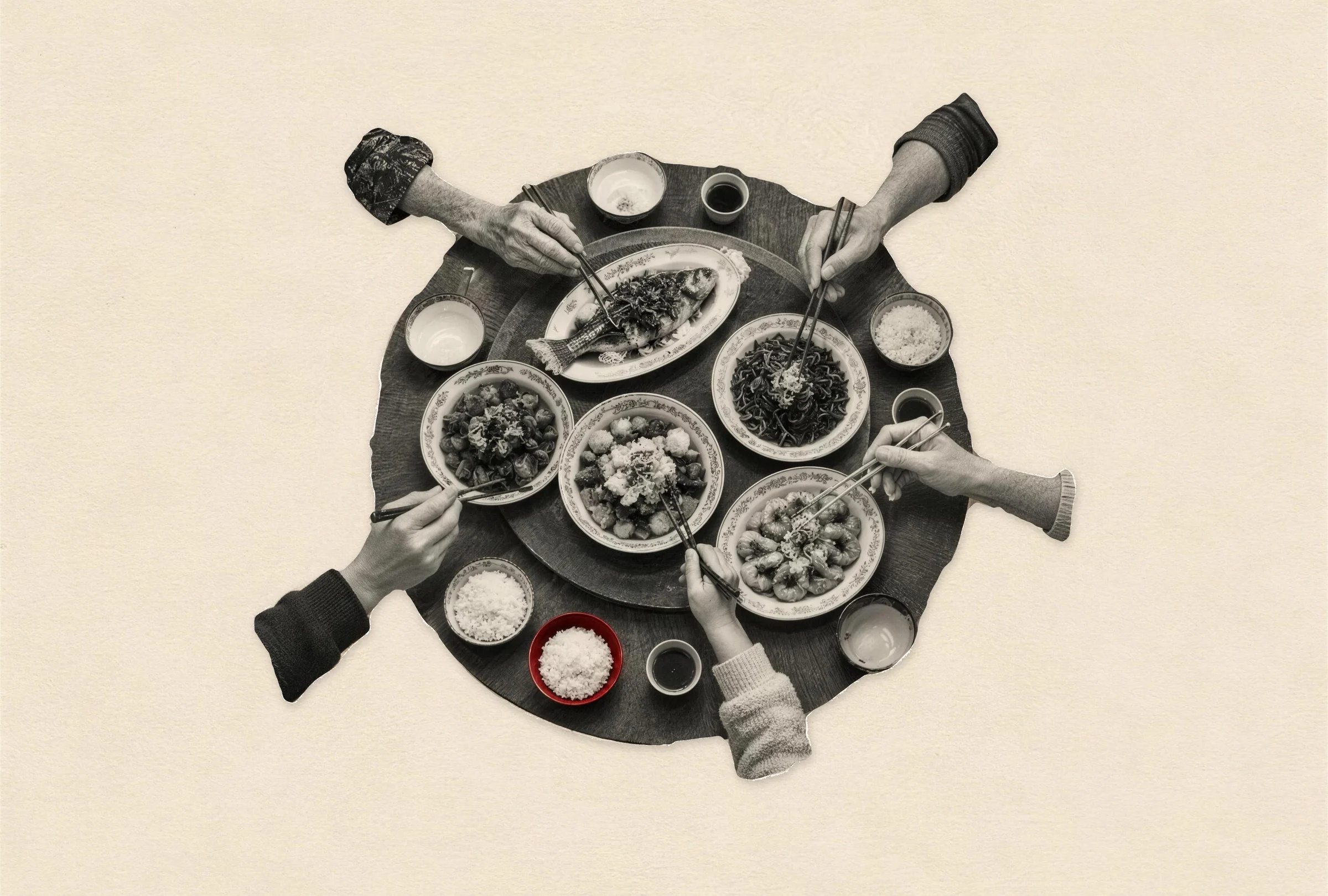
An overhead black-and-white cut-out of a round family dinner table on cream paper. Hands of every age, from an elderly grandparent’s to a small child’s, reach in with chopsticks over shared dishes of steamed fish, greens and prawns, beside small bowls of rice, one of them red.

Cantonese family terms: who is who, and what to call them

21 Oct 2026

A young man and woman laughing together, with handwritten red Cantonese exclamations between them, 得啦! (dak1 laa1, “all right!”) and 正呀! (zeng3 aa3, “brilliant!”), on torn cream paper.

Updated for 2026

12 min read

Cantonese slang: essential Hong Kong street language for 2026

27 Aug 2025

A young man and woman laughing together, with handwritten red Cantonese exclamations between them, 得啦! (dak1 laa1, “all right!”) and 正呀! (zeng3 aa3, “brilliant!”), on torn cream paper.

12 min read

Cantonese slang: essential Hong Kong street language for 2026

27 Aug 2025

A young man and woman laughing together, with handwritten red Cantonese exclamations between them, 得啦! (dak1 laa1, “all right!”) and 正呀! (zeng3 aa3, “brilliant!”), on torn cream paper.

12 min read

Cantonese slang: essential Hong Kong street language for 2026

27 Aug 2025

The Cantoflow letter, sent once a month. Join and get our free tone cheat sheet. Unsubscribe any time.

© 2026 Cantoflow

Privacy policy

Terms and conditions

Cookie policy

The Cantoflow letter, sent once a month. Join and get our free tone cheat sheet. Unsubscribe any time.

© 2026 Cantoflow

Privacy policy

Terms and conditions

Cookie policy

The Cantoflow letter, sent once a month. Join and get our free tone cheat sheet. Unsubscribe any time.

© 2026 Cantoflow

Privacy policy

Terms and conditions

Cookie policy