Skip to content

6 min read

Language in Hong Kong: what the city really sounds like

What language do they speak in Hong Kong? Cantonese for 88% of people, with English and Mandarin layered on top. Here’s what you’ll actually hear, and where.

Three black-and-white cut-out portraits on torn cream paper against red: a woman in a blazer talking on her phone, an older stallholder in an apron calling out with a hand cupped to her mouth, and a young man with a backpack reading a map. A red thread runs from mouth to mouth.

Listen closely:

In Hong Kong, 講廣東話 (gong2 gwong2 dung1 waa2), “speaking Cantonese”, is the default, with English and Mandarin layered on top.

Key takeaways

  • In the 2021 census, 88.2% of Hong Kongers said Cantonese was their usual spoken language. English was 4.6% and Putonghua (Mandarin) 2.3%.

  • Many more people can speak English or Putonghua than use them day to day: over half of Hong Kongers can speak each one.

  • Hong Kong’s official languages are Chinese and English. In practice, people speak Cantonese and write standard Chinese in traditional characters.

  • English gets visitors through hotels, the MTR and the main sights. Taxis, wet markets and small local shops are far easier with some Cantonese.

  • Mixing English words into Cantonese sentences is completely normal, and a big part of how Hong Kong sounds.

Step off the Star Ferry and you walk into a city where Cantonese, English and Mandarin overlap, separate and recombine depending on which street you turn down. Ask what language they speak in Hong Kong and the short answer is Cantonese. The longer answer is far more interesting. This guide to language in Hong Kong is for anyone visiting, moving there or reconnecting with family. It covers what you’ll actually hear, where each language helps, and whether you need to speak Cantonese yourself, because knowing that before you land changes how the city feels.

What does language in Hong Kong sound like day to day?

In the glass towers of Central on Hong Kong Island, you’ll hear English on conference calls and Mandarin in meetings with mainland clients. Walk fifteen minutes to a Kowloon wet market and the scene changes completely: stallholders call out prices in Cantonese, customers bargain in Cantonese, and the only English is a brand name printed on a box of imported fruit.

English and Mandarin are most audible around offices, luxury malls and international hotels. Cantonese runs neighbourhood restaurants, cha chaan tengs, minibuses and family life. Many Hong Kong people switch language depending on who they’re talking to. If you look like a visitor, they may try English first, but among themselves Cantonese is the default.

For an English speaker, the city sounds unlike both London and Beijing. Cantonese tones rise and fall, English words pop up in the middle of Cantonese sentences, and the occasional Mandarin announcement drifts out of a shop aimed at mainland visitors.

What are the official languages of Hong Kong?

Hong Kong has two official languages: Chinese and English. In practice, “Chinese” means two things at once. On paper it’s standard written Chinese in traditional characters; out loud, it’s overwhelmingly Cantonese.

When Hong Kong was a British colony, English was for a long time the only official language. Chinese was made an official language alongside English in 1974, and after the 1997 handover the Basic Law confirmed both. That’s why road signs, government forms and MTR maps are bilingual. Yet when a government official speaks to a local audience, it’s usually in Cantonese.

What does “biliterate and trilingual” mean?

It’s the goal of Hong Kong’s language policy, and it’s simpler than it sounds. Biliterate means reading and writing two languages: Chinese and English. Trilingual means speaking three: Cantonese, Putonghua (Mandarin) and English. Schools teach all of them, which is why many young Hong Kongers move between three languages in a single day.

How many people in Hong Kong speak Cantonese?

The 2021 census asked people aged five and over for their usual spoken language. 88.2% said Cantonese, 4.6% said English and 2.3% said Putonghua. Asked instead which languages they could speak, 93.7% said Cantonese, and over half said they could speak English, with a similar share able to speak Mandarin.

That gap tells the real story. Cantonese runs home life, friendships and the street. English and Mandarin sit on top of it, for work, school and media. Plenty of people can speak them, but very few choose them as their everyday language, and being able to speak a language isn’t the same as being comfortable chatting in it.

What will you hear, and where?

Language in Hong Kong changes with the setting as much as with the statistics. Here’s what to expect.

On the MTR

Train announcements play three times: Cantonese first, then Mandarin, then English. Listen closely and you’ll hear the same station name pronounced three different ways. Next stop Central is 中環 (zung1 waan4) in Cantonese, Zhōnghuán in Mandarin, and Central in English. Signs use traditional characters with English underneath.
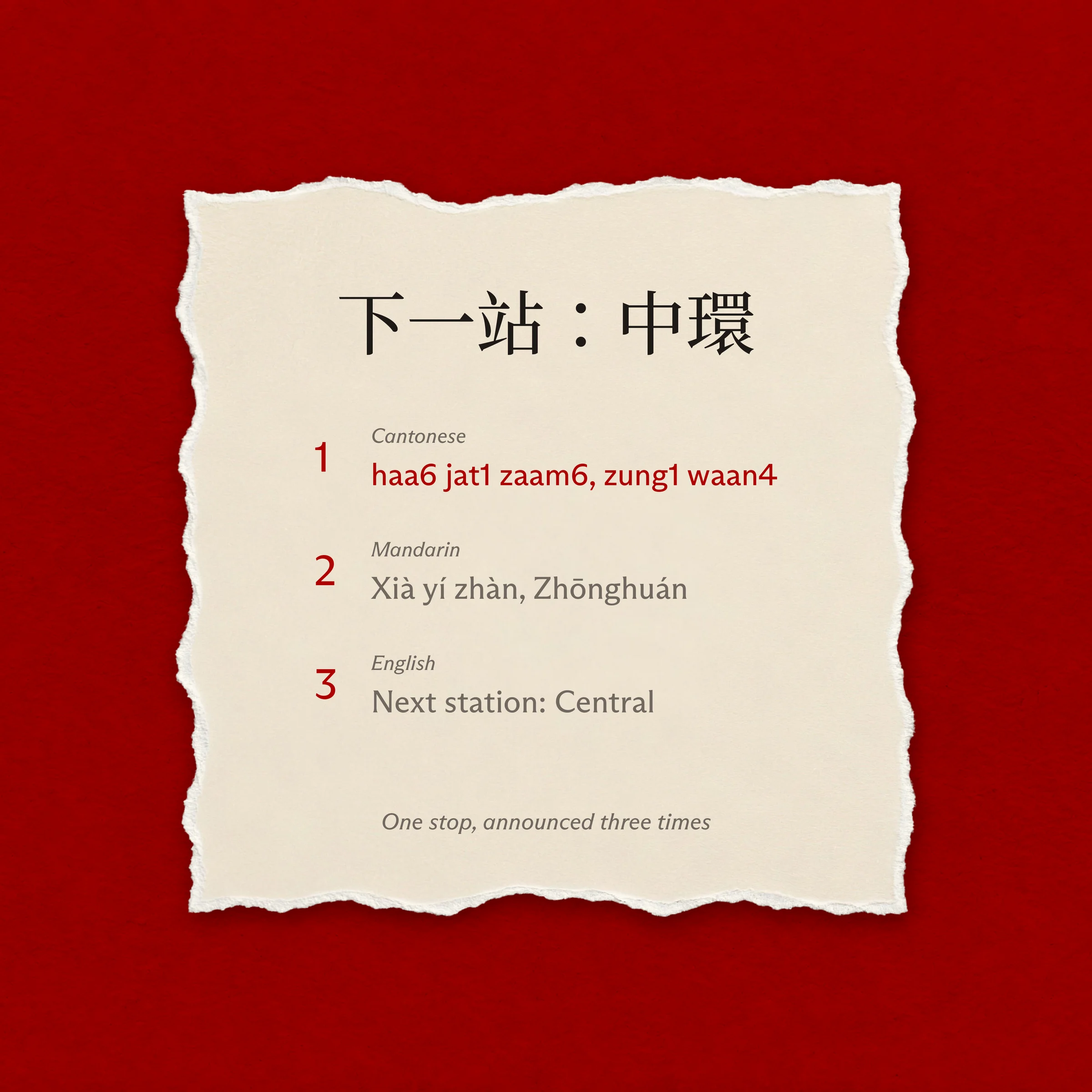
A torn cream card on red paper showing one MTR announcement, 下一站:中環, said three ways: first Cantonese, haa6 jat1 zaam6, zung1 waan4; then Mandarin, Xià yí zhàn, Zhōnghuán; then English, Next station: Central.

In offices and banks

Multinational firms often run meetings in English, then local teams switch to Cantonese among themselves. The ability to speak Mandarin matters more and more in finance, property and anything involving the Chinese mainland. Our guide to Cantonese for work covers what you’ll hear around the office.

In shops, malls and cha chaan tengs

Staff speak Cantonese among themselves and switch easily to English words like “take away” or “OK”. Speak English and you’ll usually get English back. In shops near the big tourist spots, you may even be answered in Mandarin.

In taxis and minibuses

This is where Cantonese matters most. Many drivers speak some English, but plenty, especially older drivers, speak very little. Having your destination written in Chinese characters is the most reliable way to get where you’re going.

In schools and international schools

Most local schools teach mainly in Cantonese, while some secondary schools teach in English. English and Putonghua are taught as subjects, international schools teach in English, and many university courses run in English.

What is Hong Kong Cantonese like?

Cantonese is the everyday spoken language of Hong Kong and its local TV, radio and film. It comes from the area around Guangzhou in southern China, and it’s a separate spoken language from Mandarin: a Mandarin speaker arriving in Hong Kong won’t understand street conversation without study. Our guide to Cantonese and Mandarin explains the difference.

Cantonese is tonal. Modern systems like Jyutping count six tones, while traditional counting gives nine, by adding three short “entering” tones for syllables ending in p, t or k. Change the tone and you change the word: 詩 (si1) means “poem”, while 市 (si5) means “market”. Our Cantonese tones guide shows all six on a pitch chart.

Hong Kong Cantonese has also absorbed plenty of English over the years, reshaped with Cantonese sounds and tones. 巴士 (baa1 si2), “bus”, and 的士 (dik1 si2), “taxi”, are so settled that most people don’t think of them as English at all. For English speakers, spotting them is a small, encouraging foothold.

Do Hong Kongers write the way they speak? Traditional vs simplified Chinese

Not quite, and this surprises a lot of people. Shop signs, menus, newspapers and government notices are written in standard Chinese, whose grammar and vocabulary are closer to formal Mandarin than to the way people talk. So a sign can say one thing while everyone reads it aloud in Cantonese, often with different words.

Hong Kong writes in traditional Chinese characters, which have more strokes than the simplified Chinese used on the Chinese mainland. “To learn” is 學 in traditional Chinese and 学 in simplified Chinese. You’ll see simplified Chinese mainly in shops and leaflets aimed at mainland visitors.

Cantonese can also be written the way it’s spoken, with its own characters for words standard Chinese doesn’t have. You’ll see it in adverts, comics, WhatsApp messages and social media. Our guide to written Cantonese explains how it works.

Why do Hong Kongers mix English and Cantonese? Code switching explained

Mixing languages, or code switching, is simply how many Hong Kongers talk, especially younger people and office workers. Cantonese supplies the grammar, and English slots in nouns, verbs and technical words.

我去 shopping (ngo5 heoi3 shopping) means “I’m going shopping”. 我唔 sure 喎 (ngo5 m4 sure wo3) means “I’m not sure”. English verbs even take Cantonese grammar: book 咗枱 (book zo2 toi2) means “booked a table”, and at work you’ll hear send 個 email 俾我 (send go3 email bei2 ngo5), “send me the email”.

There’s no stigma attached. Mixing is part of Hong Kong’s identity, not a sign of weak language skills, even if some older people prefer purer Cantonese. Our guide to Hong Kong slang has plenty more.

Can you speak English or Mandarin in Hong Kong?

If you speak English, you’ll do well in big hotels, international schools, many clinics and law firms, large shops, Western restaurants, museums and the main tourist sights. The airport, the MTR and the ferries all run in Chinese and English, so a visitor can get around the city centre in English without much trouble.

It gets harder in cha chaan tengs, wet markets, older residential districts, small clinics and taxis away from the tourist areas. If you speak Mandarin, you’ll be understood more widely than you would have been a decade ago, and you’ll hear it in luxury retail and cross-border business, but on the street, people default to Cantonese.

A few practical tips: carry key addresses written in Chinese characters, learn a handful of polite Cantonese phrases for travellers, and get to know the characters for exits and toilets.

Do you need Cantonese in Hong Kong?

If you’re visiting

For a short trip, English will get you through hotels, attractions and the main shopping areas. But a few words of Cantonese help with taxis and small restaurants, and they make you feel part of the city rather than floating above it. Even 唔該 (m4 goi1), “thanks” or “excuse me”, goes a long way.

If you’re moving there

Many people live in Hong Kong without learning Cantonese, especially in jobs where English is the working language. Life outside the office is another matter. Flat hunting, school-gate chats, local friendships, wet-market shopping and understanding what’s happening when the MTR breaks down all run in Cantonese. Even a modest level changes daily life, and our guide to moving to Hong Kong covers the Cantonese you’ll actually need.

If your family is from Hong Kong

Many British-born Hong Kongers understand quite a lot of Cantonese from home but feel shy speaking it. Building up your speaking deepens family ties in a way nothing else does: grandparents on the phone, relatives at dinner and neighbours in the lift all respond differently when you can hold your own. If that’s you, our guide to understanding Cantonese but not speaking it is a good place to start.

How can an English speaker learn Hong Kong Cantonese?

Cantonese looks and sounds complex, but English speakers can reach a practical level with steady listening and speaking practice. Because it’s so different from Mandarin, it’s worth learning from Hong Kong materials, with Hong Kong vocabulary and traditional characters.

Start with Jyutping, which spells out each syllable and marks its tone with a number. It gives you a pronunciation scaffold that characters alone can’t.

Then match your learning to what you need:

Practising real situations, like ordering at a cha chaan teng or chatting to your building’s security guard, builds confidence faster than textbook drills. Our one-to-one online lessons with a native Hong Kong tutor are built around exactly those moments, and tailored to you.

What other languages are spoken in Hong Kong?

Hong Kong has always been a port city, and you’ll hear far more than three languages. South Asian languages such as Hindi, Urdu, Punjabi and Nepali are spoken in long-established communities, especially around Tsim Sha Tsui and Jordan. On Sundays, Central and Victoria Park fill with domestic workers chatting in Tagalog and Indonesian. You’ll also hear Japanese, Korean, French and German, and other Chinese languages such as Hakka, Chiu Chow and Shanghainese, especially among older people. These other spoken languages are part of what makes Hong Kong sound like nowhere else.

Hong Kong also has its own sign language, Hong Kong Sign Language, which is different from both British and American Sign Language.

Frequently asked questions

Is English widely spoken in Hong Kong?

English is an official language and over half of Hong Kongers can speak English, but fewer than one in twenty use it as their everyday language. You’ll get by in English in hotels, on the MTR and in the main tourist areas. In local shops, markets and taxis, it’s less reliable.

Is Mandarin spoken in Hong Kong?

Yes, and more than it used to be. Over half of Hong Kongers can speak Mandarin, it’s taught in schools, and it’s common in shops and businesses that serve mainland visitors. But only around 2% of people use it as their main language.

Is Cantonese the same as Chinese?

Not exactly. “Chinese” covers several Chinese languages, including Cantonese and Mandarin, that share a writing system. Cantonese is the spoken language of Hong Kong; standard written Chinese is what appears on signs and in newspapers.

Is Hong Kong Cantonese different from Cantonese in Guangzhou?

Speakers from Hong Kong and Guangzhou understand each other easily. Grammar and most vocabulary are shared, but Hong Kong has its own slang and English loanwords, and it writes in traditional characters where Guangzhou uses simplified ones. If Hong Kong is your focus, learn Hong Kong Cantonese.

Can I live in Hong Kong long-term if I only speak English?

Yes, especially in some jobs and neighbourhoods. But it narrows your social life and makes dealing with landlords, local schools and government offices harder. Even a modest level of Cantonese changes how neighbours, drivers and shop staff respond to you.

Will taxi drivers understand Mandarin?

Some will, but it’s not guaranteed, especially with older drivers. Carrying addresses written in Chinese characters and knowing a few Cantonese basics makes things far easier.

Is it rude to try Cantonese and make mistakes?

Not at all. Hong Kongers are generally patient and appreciative when people try. Your tones will be off and your grammar will wobble, and that’s fine. Start with greetings and 唔該 (m4 goi1), and take any gentle correction as part of a friendly chat.

How good is your Cantonese?

Five quick questions to see where your Cantonese is at.

Question 1 of 5. The waiter brings your food. What do you say?

Heading to Hong Kong? Survival Cantonese gets you speaking the phrases you’ll actually use, in one-to-one lessons shaped around your trip.

Book a £30 trial lesson

Book a £30 trial lesson

6 min read

Language in Hong Kong: what the city really sounds like

What language do they speak in Hong Kong? Cantonese for 88% of people, with English and Mandarin layered on top. Here’s what you’ll actually hear, and where.

Three black-and-white cut-out portraits on torn cream paper against red: a woman in a blazer talking on her phone, an older stallholder in an apron calling out with a hand cupped to her mouth, and a young man with a backpack reading a map. A red thread runs from mouth to mouth.

Listen closely:

In Hong Kong, 講廣東話 (gong2 gwong2 dung1 waa2), “speaking Cantonese”, is the default, with English and Mandarin layered on top.

Key takeaways

  • In the 2021 census, 88.2% of Hong Kongers said Cantonese was their usual spoken language. English was 4.6% and Putonghua (Mandarin) 2.3%.

  • Many more people can speak English or Putonghua than use them day to day: over half of Hong Kongers can speak each one.

  • Hong Kong’s official languages are Chinese and English. In practice, people speak Cantonese and write standard Chinese in traditional characters.

  • English gets visitors through hotels, the MTR and the main sights. Taxis, wet markets and small local shops are far easier with some Cantonese.

  • Mixing English words into Cantonese sentences is completely normal, and a big part of how Hong Kong sounds.

Step off the Star Ferry and you walk into a city where Cantonese, English and Mandarin overlap, separate and recombine depending on which street you turn down. Ask what language they speak in Hong Kong and the short answer is Cantonese. The longer answer is far more interesting. This guide to language in Hong Kong is for anyone visiting, moving there or reconnecting with family. It covers what you’ll actually hear, where each language helps, and whether you need to speak Cantonese yourself, because knowing that before you land changes how the city feels.

What does language in Hong Kong sound like day to day?

In the glass towers of Central on Hong Kong Island, you’ll hear English on conference calls and Mandarin in meetings with mainland clients. Walk fifteen minutes to a Kowloon wet market and the scene changes completely: stallholders call out prices in Cantonese, customers bargain in Cantonese, and the only English is a brand name printed on a box of imported fruit.

English and Mandarin are most audible around offices, luxury malls and international hotels. Cantonese runs neighbourhood restaurants, cha chaan tengs, minibuses and family life. Many Hong Kong people switch language depending on who they’re talking to. If you look like a visitor, they may try English first, but among themselves Cantonese is the default.

For an English speaker, the city sounds unlike both London and Beijing. Cantonese tones rise and fall, English words pop up in the middle of Cantonese sentences, and the occasional Mandarin announcement drifts out of a shop aimed at mainland visitors.

What are the official languages of Hong Kong?

Hong Kong has two official languages: Chinese and English. In practice, “Chinese” means two things at once. On paper it’s standard written Chinese in traditional characters; out loud, it’s overwhelmingly Cantonese.

When Hong Kong was a British colony, English was for a long time the only official language. Chinese was made an official language alongside English in 1974, and after the 1997 handover the Basic Law confirmed both. That’s why road signs, government forms and MTR maps are bilingual. Yet when a government official speaks to a local audience, it’s usually in Cantonese.

What does “biliterate and trilingual” mean?

It’s the goal of Hong Kong’s language policy, and it’s simpler than it sounds. Biliterate means reading and writing two languages: Chinese and English. Trilingual means speaking three: Cantonese, Putonghua (Mandarin) and English. Schools teach all of them, which is why many young Hong Kongers move between three languages in a single day.

How many people in Hong Kong speak Cantonese?

The 2021 census asked people aged five and over for their usual spoken language. 88.2% said Cantonese, 4.6% said English and 2.3% said Putonghua. Asked instead which languages they could speak, 93.7% said Cantonese, and over half said they could speak English, with a similar share able to speak Mandarin.

That gap tells the real story. Cantonese runs home life, friendships and the street. English and Mandarin sit on top of it, for work, school and media. Plenty of people can speak them, but very few choose them as their everyday language, and being able to speak a language isn’t the same as being comfortable chatting in it.

What will you hear, and where?

Language in Hong Kong changes with the setting as much as with the statistics. Here’s what to expect.

On the MTR

Train announcements play three times: Cantonese first, then Mandarin, then English. Listen closely and you’ll hear the same station name pronounced three different ways. Next stop Central is 中環 (zung1 waan4) in Cantonese, Zhōnghuán in Mandarin, and Central in English. Signs use traditional characters with English underneath.

A torn cream card on red paper showing one MTR announcement, 下一站:中環, said three ways: first Cantonese, haa6 jat1 zaam6, zung1 waan4; then Mandarin, Xià yí zhàn, Zhōnghuán; then English, Next station: Central.

In offices and banks

Multinational firms often run meetings in English, then local teams switch to Cantonese among themselves. The ability to speak Mandarin matters more and more in finance, property and anything involving the Chinese mainland. Our guide to Cantonese for work covers what you’ll hear around the office.

In shops, malls and cha chaan tengs

Staff speak Cantonese among themselves and switch easily to English words like “take away” or “OK”. Speak English and you’ll usually get English back. In shops near the big tourist spots, you may even be answered in Mandarin.

In taxis and minibuses

This is where Cantonese matters most. Many drivers speak some English, but plenty, especially older drivers, speak very little. Having your destination written in Chinese characters is the most reliable way to get where you’re going.

In schools and international schools

Most local schools teach mainly in Cantonese, while some secondary schools teach in English. English and Putonghua are taught as subjects, international schools teach in English, and many university courses run in English.

What is Hong Kong Cantonese like?

Cantonese is the everyday spoken language of Hong Kong and its local TV, radio and film. It comes from the area around Guangzhou in southern China, and it’s a separate spoken language from Mandarin: a Mandarin speaker arriving in Hong Kong won’t understand street conversation without study. Our guide to Cantonese and Mandarin explains the difference.

Cantonese is tonal. Modern systems like Jyutping count six tones, while traditional counting gives nine, by adding three short “entering” tones for syllables ending in p, t or k. Change the tone and you change the word: 詩 (si1) means “poem”, while 市 (si5) means “market”. Our Cantonese tones guide shows all six on a pitch chart.

Hong Kong Cantonese has also absorbed plenty of English over the years, reshaped with Cantonese sounds and tones. 巴士 (baa1 si2), “bus”, and 的士 (dik1 si2), “taxi”, are so settled that most people don’t think of them as English at all. For English speakers, spotting them is a small, encouraging foothold.

Do Hong Kongers write the way they speak? Traditional vs simplified Chinese

Not quite, and this surprises a lot of people. Shop signs, menus, newspapers and government notices are written in standard Chinese, whose grammar and vocabulary are closer to formal Mandarin than to the way people talk. So a sign can say one thing while everyone reads it aloud in Cantonese, often with different words.

Hong Kong writes in traditional Chinese characters, which have more strokes than the simplified Chinese used on the Chinese mainland. “To learn” is 學 in traditional Chinese and 学 in simplified Chinese. You’ll see simplified Chinese mainly in shops and leaflets aimed at mainland visitors.

Cantonese can also be written the way it’s spoken, with its own characters for words standard Chinese doesn’t have. You’ll see it in adverts, comics, WhatsApp messages and social media. Our guide to written Cantonese explains how it works.

Why do Hong Kongers mix English and Cantonese? Code switching explained

Mixing languages, or code switching, is simply how many Hong Kongers talk, especially younger people and office workers. Cantonese supplies the grammar, and English slots in nouns, verbs and technical words.

我去 shopping (ngo5 heoi3 shopping) means “I’m going shopping”. 我唔 sure 喎 (ngo5 m4 sure wo3) means “I’m not sure”. English verbs even take Cantonese grammar: book 咗枱 (book zo2 toi2) means “booked a table”, and at work you’ll hear send 個 email 俾我 (send go3 email bei2 ngo5), “send me the email”.

There’s no stigma attached. Mixing is part of Hong Kong’s identity, not a sign of weak language skills, even if some older people prefer purer Cantonese. Our guide to Hong Kong slang has plenty more.

Can you speak English or Mandarin in Hong Kong?

If you speak English, you’ll do well in big hotels, international schools, many clinics and law firms, large shops, Western restaurants, museums and the main tourist sights. The airport, the MTR and the ferries all run in Chinese and English, so a visitor can get around the city centre in English without much trouble.

It gets harder in cha chaan tengs, wet markets, older residential districts, small clinics and taxis away from the tourist areas. If you speak Mandarin, you’ll be understood more widely than you would have been a decade ago, and you’ll hear it in luxury retail and cross-border business, but on the street, people default to Cantonese.

A few practical tips: carry key addresses written in Chinese characters, learn a handful of polite Cantonese phrases for travellers, and get to know the characters for exits and toilets.

Do you need Cantonese in Hong Kong?

If you’re visiting

For a short trip, English will get you through hotels, attractions and the main shopping areas. But a few words of Cantonese help with taxis and small restaurants, and they make you feel part of the city rather than floating above it. Even 唔該 (m4 goi1), “thanks” or “excuse me”, goes a long way.

If you’re moving there

Many people live in Hong Kong without learning Cantonese, especially in jobs where English is the working language. Life outside the office is another matter. Flat hunting, school-gate chats, local friendships, wet-market shopping and understanding what’s happening when the MTR breaks down all run in Cantonese. Even a modest level changes daily life, and our guide to moving to Hong Kong covers the Cantonese you’ll actually need.

If your family is from Hong Kong

Many British-born Hong Kongers understand quite a lot of Cantonese from home but feel shy speaking it. Building up your speaking deepens family ties in a way nothing else does: grandparents on the phone, relatives at dinner and neighbours in the lift all respond differently when you can hold your own. If that’s you, our guide to understanding Cantonese but not speaking it is a good place to start.

How can an English speaker learn Hong Kong Cantonese?

Cantonese looks and sounds complex, but English speakers can reach a practical level with steady listening and speaking practice. Because it’s so different from Mandarin, it’s worth learning from Hong Kong materials, with Hong Kong vocabulary and traditional characters.

Start with Jyutping, which spells out each syllable and marks its tone with a number. It gives you a pronunciation scaffold that characters alone can’t.

Then match your learning to what you need:

Practising real situations, like ordering at a cha chaan teng or chatting to your building’s security guard, builds confidence faster than textbook drills. Our one-to-one online lessons with a native Hong Kong tutor are built around exactly those moments, and tailored to you.

What other languages are spoken in Hong Kong?

Hong Kong has always been a port city, and you’ll hear far more than three languages. South Asian languages such as Hindi, Urdu, Punjabi and Nepali are spoken in long-established communities, especially around Tsim Sha Tsui and Jordan. On Sundays, Central and Victoria Park fill with domestic workers chatting in Tagalog and Indonesian. You’ll also hear Japanese, Korean, French and German, and other Chinese languages such as Hakka, Chiu Chow and Shanghainese, especially among older people. These other spoken languages are part of what makes Hong Kong sound like nowhere else.

Hong Kong also has its own sign language, Hong Kong Sign Language, which is different from both British and American Sign Language.

Frequently asked questions

Is English widely spoken in Hong Kong?

English is an official language and over half of Hong Kongers can speak English, but fewer than one in twenty use it as their everyday language. You’ll get by in English in hotels, on the MTR and in the main tourist areas. In local shops, markets and taxis, it’s less reliable.

Is Mandarin spoken in Hong Kong?

Yes, and more than it used to be. Over half of Hong Kongers can speak Mandarin, it’s taught in schools, and it’s common in shops and businesses that serve mainland visitors. But only around 2% of people use it as their main language.

Is Cantonese the same as Chinese?

Not exactly. “Chinese” covers several Chinese languages, including Cantonese and Mandarin, that share a writing system. Cantonese is the spoken language of Hong Kong; standard written Chinese is what appears on signs and in newspapers.

Is Hong Kong Cantonese different from Cantonese in Guangzhou?

Speakers from Hong Kong and Guangzhou understand each other easily. Grammar and most vocabulary are shared, but Hong Kong has its own slang and English loanwords, and it writes in traditional characters where Guangzhou uses simplified ones. If Hong Kong is your focus, learn Hong Kong Cantonese.

Can I live in Hong Kong long-term if I only speak English?

Yes, especially in some jobs and neighbourhoods. But it narrows your social life and makes dealing with landlords, local schools and government offices harder. Even a modest level of Cantonese changes how neighbours, drivers and shop staff respond to you.

Will taxi drivers understand Mandarin?

Some will, but it’s not guaranteed, especially with older drivers. Carrying addresses written in Chinese characters and knowing a few Cantonese basics makes things far easier.

Is it rude to try Cantonese and make mistakes?

Not at all. Hong Kongers are generally patient and appreciative when people try. Your tones will be off and your grammar will wobble, and that’s fine. Start with greetings and 唔該 (m4 goi1), and take any gentle correction as part of a friendly chat.

How good is your Cantonese?

Five quick questions to see where your Cantonese is at.

Question 1 of 5. The waiter brings your food. What do you say?

Heading to Hong Kong? Survival Cantonese gets you speaking the phrases you’ll actually use, in one-to-one lessons shaped around your trip.

Book a £30 trial lesson

Book a £30 trial lesson

6 min read

Language in Hong Kong: what the city really sounds like

What language do they speak in Hong Kong? Cantonese for 88% of people, with English and Mandarin layered on top. Here’s what you’ll actually hear, and where.

Three black-and-white cut-out portraits on torn cream paper against red: a woman in a blazer talking on her phone, an older stallholder in an apron calling out with a hand cupped to her mouth, and a young man with a backpack reading a map. A red thread runs from mouth to mouth.

Listen closely:

In Hong Kong, 講廣東話 (gong2 gwong2 dung1 waa2), “speaking Cantonese”, is the default, with English and Mandarin layered on top.

Key takeaways

  • In the 2021 census, 88.2% of Hong Kongers said Cantonese was their usual spoken language. English was 4.6% and Putonghua (Mandarin) 2.3%.

  • Many more people can speak English or Putonghua than use them day to day: over half of Hong Kongers can speak each one.

  • Hong Kong’s official languages are Chinese and English. In practice, people speak Cantonese and write standard Chinese in traditional characters.

  • English gets visitors through hotels, the MTR and the main sights. Taxis, wet markets and small local shops are far easier with some Cantonese.

  • Mixing English words into Cantonese sentences is completely normal, and a big part of how Hong Kong sounds.

Step off the Star Ferry and you walk into a city where Cantonese, English and Mandarin overlap, separate and recombine depending on which street you turn down. Ask what language they speak in Hong Kong and the short answer is Cantonese. The longer answer is far more interesting. This guide to language in Hong Kong is for anyone visiting, moving there or reconnecting with family. It covers what you’ll actually hear, where each language helps, and whether you need to speak Cantonese yourself, because knowing that before you land changes how the city feels.

What does language in Hong Kong sound like day to day?

In the glass towers of Central on Hong Kong Island, you’ll hear English on conference calls and Mandarin in meetings with mainland clients. Walk fifteen minutes to a Kowloon wet market and the scene changes completely: stallholders call out prices in Cantonese, customers bargain in Cantonese, and the only English is a brand name printed on a box of imported fruit.

English and Mandarin are most audible around offices, luxury malls and international hotels. Cantonese runs neighbourhood restaurants, cha chaan tengs, minibuses and family life. Many Hong Kong people switch language depending on who they’re talking to. If you look like a visitor, they may try English first, but among themselves Cantonese is the default.

For an English speaker, the city sounds unlike both London and Beijing. Cantonese tones rise and fall, English words pop up in the middle of Cantonese sentences, and the occasional Mandarin announcement drifts out of a shop aimed at mainland visitors.

What are the official languages of Hong Kong?

Hong Kong has two official languages: Chinese and English. In practice, “Chinese” means two things at once. On paper it’s standard written Chinese in traditional characters; out loud, it’s overwhelmingly Cantonese.

When Hong Kong was a British colony, English was for a long time the only official language. Chinese was made an official language alongside English in 1974, and after the 1997 handover the Basic Law confirmed both. That’s why road signs, government forms and MTR maps are bilingual. Yet when a government official speaks to a local audience, it’s usually in Cantonese.

What does “biliterate and trilingual” mean?

It’s the goal of Hong Kong’s language policy, and it’s simpler than it sounds. Biliterate means reading and writing two languages: Chinese and English. Trilingual means speaking three: Cantonese, Putonghua (Mandarin) and English. Schools teach all of them, which is why many young Hong Kongers move between three languages in a single day.

How many people in Hong Kong speak Cantonese?

The 2021 census asked people aged five and over for their usual spoken language. 88.2% said Cantonese, 4.6% said English and 2.3% said Putonghua. Asked instead which languages they could speak, 93.7% said Cantonese, and over half said they could speak English, with a similar share able to speak Mandarin.

That gap tells the real story. Cantonese runs home life, friendships and the street. English and Mandarin sit on top of it, for work, school and media. Plenty of people can speak them, but very few choose them as their everyday language, and being able to speak a language isn’t the same as being comfortable chatting in it.

What will you hear, and where?

Language in Hong Kong changes with the setting as much as with the statistics. Here’s what to expect.

On the MTR

Train announcements play three times: Cantonese first, then Mandarin, then English. Listen closely and you’ll hear the same station name pronounced three different ways. Next stop Central is 中環 (zung1 waan4) in Cantonese, Zhōnghuán in Mandarin, and Central in English. Signs use traditional characters with English underneath.

A torn cream card on red paper showing one MTR announcement, 下一站:中環, said three ways: first Cantonese, haa6 jat1 zaam6, zung1 waan4; then Mandarin, Xià yí zhàn, Zhōnghuán; then English, Next station: Central.

In offices and banks

Multinational firms often run meetings in English, then local teams switch to Cantonese among themselves. The ability to speak Mandarin matters more and more in finance, property and anything involving the Chinese mainland. Our guide to Cantonese for work covers what you’ll hear around the office.

In shops, malls and cha chaan tengs

Staff speak Cantonese among themselves and switch easily to English words like “take away” or “OK”. Speak English and you’ll usually get English back. In shops near the big tourist spots, you may even be answered in Mandarin.

In taxis and minibuses

This is where Cantonese matters most. Many drivers speak some English, but plenty, especially older drivers, speak very little. Having your destination written in Chinese characters is the most reliable way to get where you’re going.

In schools and international schools

Most local schools teach mainly in Cantonese, while some secondary schools teach in English. English and Putonghua are taught as subjects, international schools teach in English, and many university courses run in English.

What is Hong Kong Cantonese like?

Cantonese is the everyday spoken language of Hong Kong and its local TV, radio and film. It comes from the area around Guangzhou in southern China, and it’s a separate spoken language from Mandarin: a Mandarin speaker arriving in Hong Kong won’t understand street conversation without study. Our guide to Cantonese and Mandarin explains the difference.

Cantonese is tonal. Modern systems like Jyutping count six tones, while traditional counting gives nine, by adding three short “entering” tones for syllables ending in p, t or k. Change the tone and you change the word: 詩 (si1) means “poem”, while 市 (si5) means “market”. Our Cantonese tones guide shows all six on a pitch chart.

Hong Kong Cantonese has also absorbed plenty of English over the years, reshaped with Cantonese sounds and tones. 巴士 (baa1 si2), “bus”, and 的士 (dik1 si2), “taxi”, are so settled that most people don’t think of them as English at all. For English speakers, spotting them is a small, encouraging foothold.

Do Hong Kongers write the way they speak? Traditional vs simplified Chinese

Not quite, and this surprises a lot of people. Shop signs, menus, newspapers and government notices are written in standard Chinese, whose grammar and vocabulary are closer to formal Mandarin than to the way people talk. So a sign can say one thing while everyone reads it aloud in Cantonese, often with different words.

Hong Kong writes in traditional Chinese characters, which have more strokes than the simplified Chinese used on the Chinese mainland. “To learn” is 學 in traditional Chinese and 学 in simplified Chinese. You’ll see simplified Chinese mainly in shops and leaflets aimed at mainland visitors.

Cantonese can also be written the way it’s spoken, with its own characters for words standard Chinese doesn’t have. You’ll see it in adverts, comics, WhatsApp messages and social media. Our guide to written Cantonese explains how it works.

Why do Hong Kongers mix English and Cantonese? Code switching explained

Mixing languages, or code switching, is simply how many Hong Kongers talk, especially younger people and office workers. Cantonese supplies the grammar, and English slots in nouns, verbs and technical words.

我去 shopping (ngo5 heoi3 shopping) means “I’m going shopping”. 我唔 sure 喎 (ngo5 m4 sure wo3) means “I’m not sure”. English verbs even take Cantonese grammar: book 咗枱 (book zo2 toi2) means “booked a table”, and at work you’ll hear send 個 email 俾我 (send go3 email bei2 ngo5), “send me the email”.

There’s no stigma attached. Mixing is part of Hong Kong’s identity, not a sign of weak language skills, even if some older people prefer purer Cantonese. Our guide to Hong Kong slang has plenty more.

Can you speak English or Mandarin in Hong Kong?

If you speak English, you’ll do well in big hotels, international schools, many clinics and law firms, large shops, Western restaurants, museums and the main tourist sights. The airport, the MTR and the ferries all run in Chinese and English, so a visitor can get around the city centre in English without much trouble.

It gets harder in cha chaan tengs, wet markets, older residential districts, small clinics and taxis away from the tourist areas. If you speak Mandarin, you’ll be understood more widely than you would have been a decade ago, and you’ll hear it in luxury retail and cross-border business, but on the street, people default to Cantonese.

A few practical tips: carry key addresses written in Chinese characters, learn a handful of polite Cantonese phrases for travellers, and get to know the characters for exits and toilets.

Do you need Cantonese in Hong Kong?

If you’re visiting

For a short trip, English will get you through hotels, attractions and the main shopping areas. But a few words of Cantonese help with taxis and small restaurants, and they make you feel part of the city rather than floating above it. Even 唔該 (m4 goi1), “thanks” or “excuse me”, goes a long way.

If you’re moving there

Many people live in Hong Kong without learning Cantonese, especially in jobs where English is the working language. Life outside the office is another matter. Flat hunting, school-gate chats, local friendships, wet-market shopping and understanding what’s happening when the MTR breaks down all run in Cantonese. Even a modest level changes daily life, and our guide to moving to Hong Kong covers the Cantonese you’ll actually need.

If your family is from Hong Kong

Many British-born Hong Kongers understand quite a lot of Cantonese from home but feel shy speaking it. Building up your speaking deepens family ties in a way nothing else does: grandparents on the phone, relatives at dinner and neighbours in the lift all respond differently when you can hold your own. If that’s you, our guide to understanding Cantonese but not speaking it is a good place to start.

How can an English speaker learn Hong Kong Cantonese?

Cantonese looks and sounds complex, but English speakers can reach a practical level with steady listening and speaking practice. Because it’s so different from Mandarin, it’s worth learning from Hong Kong materials, with Hong Kong vocabulary and traditional characters.

Start with Jyutping, which spells out each syllable and marks its tone with a number. It gives you a pronunciation scaffold that characters alone can’t.

Then match your learning to what you need:

Practising real situations, like ordering at a cha chaan teng or chatting to your building’s security guard, builds confidence faster than textbook drills. Our one-to-one online lessons with a native Hong Kong tutor are built around exactly those moments, and tailored to you.

What other languages are spoken in Hong Kong?

Hong Kong has always been a port city, and you’ll hear far more than three languages. South Asian languages such as Hindi, Urdu, Punjabi and Nepali are spoken in long-established communities, especially around Tsim Sha Tsui and Jordan. On Sundays, Central and Victoria Park fill with domestic workers chatting in Tagalog and Indonesian. You’ll also hear Japanese, Korean, French and German, and other Chinese languages such as Hakka, Chiu Chow and Shanghainese, especially among older people. These other spoken languages are part of what makes Hong Kong sound like nowhere else.

Hong Kong also has its own sign language, Hong Kong Sign Language, which is different from both British and American Sign Language.

Frequently asked questions

Is English widely spoken in Hong Kong?

English is an official language and over half of Hong Kongers can speak English, but fewer than one in twenty use it as their everyday language. You’ll get by in English in hotels, on the MTR and in the main tourist areas. In local shops, markets and taxis, it’s less reliable.

Is Mandarin spoken in Hong Kong?

Yes, and more than it used to be. Over half of Hong Kongers can speak Mandarin, it’s taught in schools, and it’s common in shops and businesses that serve mainland visitors. But only around 2% of people use it as their main language.

Is Cantonese the same as Chinese?

Not exactly. “Chinese” covers several Chinese languages, including Cantonese and Mandarin, that share a writing system. Cantonese is the spoken language of Hong Kong; standard written Chinese is what appears on signs and in newspapers.

Is Hong Kong Cantonese different from Cantonese in Guangzhou?

Speakers from Hong Kong and Guangzhou understand each other easily. Grammar and most vocabulary are shared, but Hong Kong has its own slang and English loanwords, and it writes in traditional characters where Guangzhou uses simplified ones. If Hong Kong is your focus, learn Hong Kong Cantonese.

Can I live in Hong Kong long-term if I only speak English?

Yes, especially in some jobs and neighbourhoods. But it narrows your social life and makes dealing with landlords, local schools and government offices harder. Even a modest level of Cantonese changes how neighbours, drivers and shop staff respond to you.

Will taxi drivers understand Mandarin?

Some will, but it’s not guaranteed, especially with older drivers. Carrying addresses written in Chinese characters and knowing a few Cantonese basics makes things far easier.

Is it rude to try Cantonese and make mistakes?

Not at all. Hong Kongers are generally patient and appreciative when people try. Your tones will be off and your grammar will wobble, and that’s fine. Start with greetings and 唔該 (m4 goi1), and take any gentle correction as part of a friendly chat.

How good is your Cantonese?

Five quick questions to see where your Cantonese is at.

Question 1 of 5. The waiter brings your food. What do you say?

Heading to Hong Kong? Survival Cantonese gets you speaking the phrases you’ll actually use, in one-to-one lessons shaped around your trip.

Book a £30 trial lesson

Book a £30 trial lesson

A Star Ferry crossing the water beside a black-and-white view of the Hong Kong skyline, with a red sun and red brush strokes on cream paper.

4 min read

Moving to Hong Kong? The Cantonese you actually need to know

8 Oct 2026

A Star Ferry crossing the water beside a black-and-white view of the Hong Kong skyline, with a red sun and red brush strokes on cream paper.

4 min read

Moving to Hong Kong? The Cantonese you actually need to know

8 Oct 2026

A Star Ferry crossing the water beside a black-and-white view of the Hong Kong skyline, with a red sun and red brush strokes on cream paper.

4 min read

Moving to Hong Kong? The Cantonese you actually need to know

8 Oct 2026

A Hong Kong postcard showing a hazy sunset over the city and hills, with a red Star Ferry stamp in the corner, framed in red.

11 min read

Cantonese phrases for travellers: 50+ essentials for Hong Kong

7 Aug 2025

A Hong Kong postcard showing a hazy sunset over the city and hills, with a red Star Ferry stamp in the corner, framed in red.

11 min read

Cantonese phrases for travellers: 50+ essentials for Hong Kong

7 Aug 2025

A Hong Kong postcard showing a hazy sunset over the city and hills, with a red Star Ferry stamp in the corner, framed in red.

11 min read

Cantonese phrases for travellers: 50+ essentials for Hong Kong

7 Aug 2025

A puzzled woman holding Hong Kong and China flags, with handwritten labels asking 廣東話? (gwong2 dung1 waa2, “Cantonese?”) or 普通話? (pou2 tung1 waa2, “Mandarin?”), against a cream torn-paper background.

10 min read

Is Cantonese harder than Mandarin? An honest comparison

7 Aug 2025

A puzzled woman holding Hong Kong and China flags, with handwritten labels asking 廣東話? (gwong2 dung1 waa2, “Cantonese?”) or 普通話? (pou2 tung1 waa2, “Mandarin?”), against a cream torn-paper background.

10 min read

Is Cantonese harder than Mandarin? An honest comparison

7 Aug 2025

A puzzled woman holding Hong Kong and China flags, with handwritten labels asking 廣東話? (gwong2 dung1 waa2, “Cantonese?”) or 普通話? (pou2 tung1 waa2, “Mandarin?”), against a cream torn-paper background.

10 min read

Is Cantonese harder than Mandarin? An honest comparison

7 Aug 2025

The Cantoflow letter, sent once a month. Join and get our free tone cheat sheet. Unsubscribe any time.

© 2026 Cantoflow

Privacy Policy

Terms and Conditions

Cookie Policy

The Cantoflow letter, sent once a month. Join and get our free tone cheat sheet. Unsubscribe any time.

© 2026 Cantoflow

Privacy Policy

Terms and Conditions

Cookie Policy

The Cantoflow letter, sent once a month. Join and get our free tone cheat sheet. Unsubscribe any time.

© 2026 Cantoflow

Privacy Policy

Terms and Conditions

Cookie Policy