Cantonese for work: the phrases Hong Kong colleagues actually use
The Cantonese phrases Hong Kong colleagues actually use at work, from 早晨 to 捽數, with Jyutping, meanings and when to use each one.

Hired in English:
早晨 (zou2 san4) and a handful of office phrases get you into the conversation.
Key takeaways
English is usually fine for formal work in Hong Kong, but even a few spoken Cantonese phrases help you build trust and fit in with local teams.
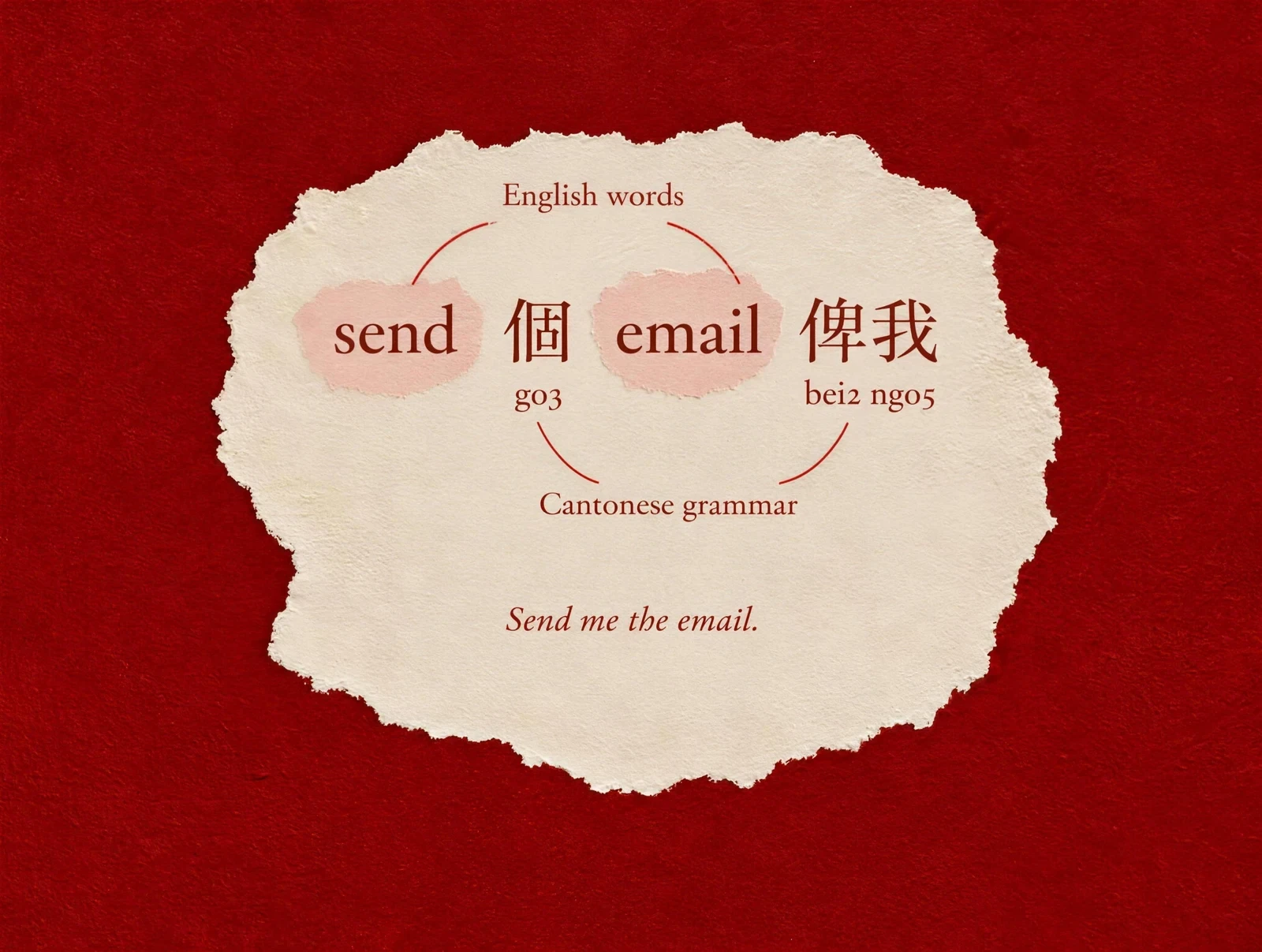
Real workplace Cantonese mixes English and Cantonese. Sentences like send 個 email 俾我 (
send go3 email bei2 ngo5) are completely normal and professional, not lazy.Start with greetings and thanks such as 早晨 (
zou2 san4) and 唔該晒 (m4 goi1 saai3), routine words like 返工 (faan1 gung1) and 放工 (fong3 gung1), and meeting language such as 開會 (hoi1 wui2) and 跟進 (gan1 zeon3).Sounding natural is more about tone, timing and recognising office slang (捽數
zeot1 sou3, 炒魷魚caau2 jau4 jyu4) than about long, formal sentences.The phrases you need depend on your role, which is why learning works best when it is built around your actual job.
English is the main language of business in Hong Kong. It gets you hired. Spoken Cantonese is what gets you in: into the side conversations, the lunch invitations and the trust that sits underneath every project. Whether you join meetings from London or walk into an office in Central, this guide covers the Cantonese phrases for work that actually matter, with the meaning of each one and an example of when to use it.
Do you really need Cantonese for work in Hong Kong?
Most international companies in Hong Kong run in English. Contracts, slides, presentations and client proposals are almost always in English. Many local colleagues speak fluent English, and the formal layer of business works without a word of Cantonese.
The informal layer is a different world. Side comments in meetings, corridor chats, internal WhatsApp groups and lunch plans default to Cantonese the moment Hong Kongers are talking among themselves. On a Zoom call from the UK, you will hear the agenda in English, then catch quick asides in Cantonese: someone mentioning 開會 (hoi1 wui2) to set up the next meeting, or a colleague promising to 跟進 (gan1 zeon3) something after the call. Knowing basic Cantonese helps you build rapport and understand what is really going on.
How much you need depends on where you are. If you are staying in the UK and working with a Hong Kong team remotely, a small bank of workplace phrases is usually enough to make a good first impression. If you are relocating to Hong Kong, Cantonese becomes part of daily life: in corridors, at lunch, in the lift. Outside the business districts it is the everyday language, so errands like buying fruit at a local market or ordering in a cha chaan teng get easier with a few phrases too.
Every example in this article uses Traditional characters plus Jyutping with tone numbers, reflecting how Hong Kongers actually speak.
Cantonese phrases for work: greetings and daily routines
Think of this section as your survival toolkit for the first week. Greetings are the easiest place to start, and a good greeting goes a long way towards a good first impression.
早晨 (zou2 san4) is the standard way to say good morning as colleagues arrive, step into the lift or join a morning video meeting. Use it with every 同事 (tung4 si6), your colleagues at any level. It is simple, warm and a polite way to show effort, and small daily greetings like this help build trust before anyone talks about work. When you introduce yourself, a quick 早晨 before switching to English is perfectly fine.
返工 (faan1 gung1) means “go to work” and 放工 (fong3 gung1) means “finish work”. Both come up in small talk about commuting, long days and logging off. A colleague might ask, half in English, “What time do you 放工 tonight?”
For people, 同事 (tung4 si6) is the neutral word for colleague, while 老細 (lou5 sai3) means “the boss”, whether that person is your line manager or the head of the business. Knowing who the 老細 is, and showing the right level of respect, matters in any Hong Kong workplace.
Two polite essentials to learn early. 唔該晒 (m4 goi1 saai3) means “thanks very much”. Use it for everyday favours: someone holds the door, shares a file or answers a quick question. 辛苦晒 (san1 fu2 saai3) means “thanks for your hard work” and carries more weight. Use it after a late night, a long meeting or a project crunch.
Meetings, follow-ups and the English–Cantonese mix
Forget textbook “pure Cantonese”. Real Hong Kong meetings sound like a conversation where English nouns and verbs sit comfortably inside Cantonese sentences. Many learners worry that slipping English into Cantonese is cheating. It is not: this mixing is how Hong Kongers naturally talk at work.
開會 (hoi1 wui2) is the basic phrase for “have a meeting”, and it comes up constantly when colleagues are arranging meetings across time zones. Even if you present in English, it helps to recognise it. After the meeting, next steps often involve 跟進 (gan1 zeon3), “follow up”. On a team split between the UK and Hong Kong, for example, “I’ll 跟進 the client’s request” is an everyday sentence.
The hybrid phrases are where it gets interesting. send 個 email 俾我 (send go3 email bei2 ngo5), “send me the email”, and check 吓 (check haa5), “have a quick check”, are completely normal. They are how your colleagues actually think and talk, and they are the easiest Cantonese phrases for an English speaker to pick up first.
Quick reactions keep discussions moving. 冇問題 (mou5 man6 tai4) means “no problem”: use it to respond when you accept a task or an instruction. 搞掂 (gaau2 dim6) means “sorted” or “done”, a confident signal that something is or will be handled. 等陣 (dang2 zan6) means “hang on” or “in a bit”, the word for any moment when someone needs to wait before they answer.
Small talk, lunch and building relationships
In Hong Kong offices, relationships are built around food and drink. Even very basic Cantonese matters here, because this is where the real conversation happens.
食晏 (sik6 aan3) means “have lunch”. Colleagues invite each other casually, and you might hear “Shall we 食晏?” as noon approaches. You do not need to follow every word of the conversation that follows. Saying yes and joining is what counts.
飲茶 (jam2 caa4), yum cha, means going out for dim sum and tea. It is a classic way for Hong Kong teams to celebrate a deal, pass on congratulations, welcome a new joiner or simply end the week. If it is your first week in an office in Quarry Bay and someone invites you to 飲茶, go. You will pick up more natural Cantonese over one dim sum lunch than in a month of formal meetings.
等陣 (dang2 zan6) turns up here too: waiting for the lift, pushing lunch back a little, asking someone to hold on. It is one of the first words you will start to recognise.
Office slang and what your colleagues are really saying
Hong Kong office talk is full of slang and metaphors that never appear in a textbook. Knowing their meaning helps you navigate what your colleagues are really talking about.
捽數 (zeot1 sou3) means “pushing to hit the numbers”. It is common in sales and target-driven business roles, especially before quarter end. A manager might say, “This month we really need to 捽數.”
鐵飯碗 (tit3 faan6 wun2), literally “iron rice bowl”, is a stable job for life, such as a government post. It often comes up when people compare the security of the civil service with the risk of a startup.
擦鞋 (caat3 haai4), literally “polishing shoes”, means sucking up to the boss. 卸膊 (se3 bok3), literally “dropping it off your shoulder”, means passing the buck. Both are common in office gossip. Recognise them before you ever use them, and never aim either at someone senior.
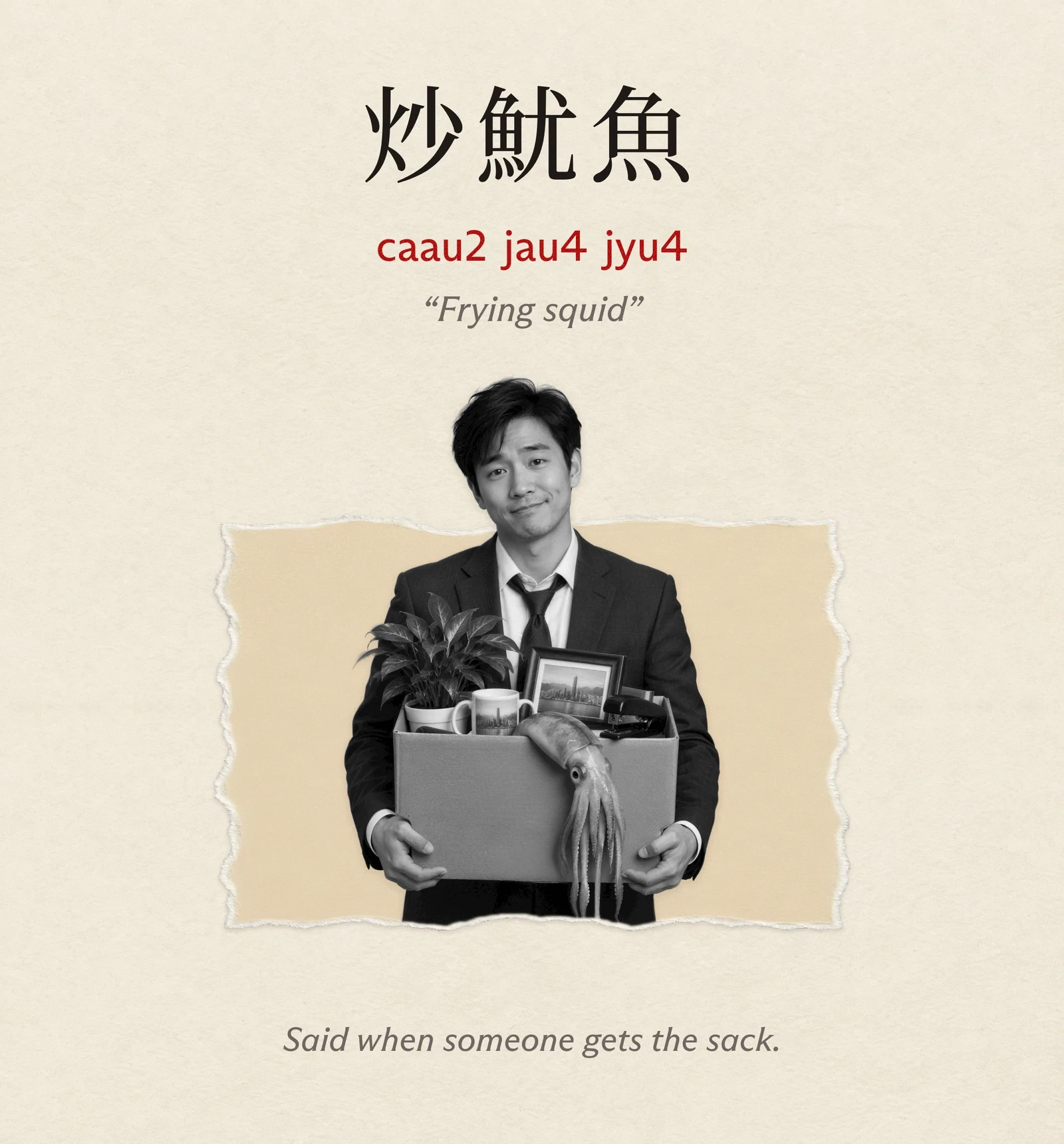
炒魷魚 (caau2 jau4 jyu4), literally “frying squid”, means getting fired. It is informal, so keep it for repeating what others said rather than talking about someone in the room.
The idea is not to use all of these on day one. It is to stop feeling lost when you hear them, and to know which slang is neutral and which would sound rude in the wrong setting.
Politeness, hierarchy and sounding natural
Hong Kong workplace culture mixes British-influenced formality with a clear sense of hierarchy. A few polite, respectful Cantonese phrases help you fit in far beyond what English alone achieves, and most colleagues will support the effort the moment they see you are prepared to try.
When replying to your 老細 (lou5 sai3), even a simple 冇問題 (mou5 man6 tai4) needs the right tone: warm and willing, not dismissive. 搞掂 (gaau2 dim6) reassures a manager that something is handled, but say it with confidence rather than curtness. On Teams calls, short answers can sound abrupt if your voice is flat. A little warmth makes the difference.
After a long week or a project crunch, 辛苦晒 (san1 fu2 saai3) is the way to thank your team. Keep 唔該晒 (m4 goi1 saai3) for smaller, everyday favours. Getting that distinction right shows you have noticed the effort involved.
Hong Kongers often soften requests with small sentence-final particles that take time to master. Even without them, using the core phrases gently and at the right moment is far better than silence. If you get something wrong, a smile and a quick “sorry” in English is fine. People are rarely offended by a learner.
Spoken Cantonese vs written Chinese at work
In many Hong Kong workplaces, formal emails are written in English, while chats, voice notes, WhatsApp messages and quick conversations run in Cantonese. Government notices and transport signs are bilingual, so reading is less of a barrier than many learners expect.
The phrases in this article are spoken Cantonese, written in Traditional characters with Jyutping. Formal written Chinese, the kind you see on official letters, uses different grammar and vocabulary. You do not need to master it to work well with Hong Kong colleagues.
Mixed phrases like send 個 email 俾我 (send go3 email bei2 ngo5) and check 吓 (check haa5) are normal in WhatsApp groups and internal chats. Client-facing emails switch back to English. Knowing this helps you focus your learning where it matters.
Cantonese phrases for work: quick reference
Cantonese | Jyutping | Meaning | Example of when to use it |
|---|---|---|---|
早晨 |
| good morning | arriving at the office |
唔該晒 |
| thanks very much | someone shares a file |
辛苦晒 |
| thanks for your hard work | after a project crunch |
開會 |
| have a meeting | arranging meetings |
跟進 |
| follow up | next steps after a call |
send 個 email 俾我 |
| send me the email | asking for a document |
冇問題 |
| no problem | accepting a task |
搞掂 |
| sorted, done | confirming a job is finished |
等陣 |
| hang on, in a bit | asking someone to wait |
食晏 |
| have lunch | joining colleagues at noon |
How to learn the Cantonese phrases you actually need
Start by collecting phrases that match your real tasks. A project manager may lean on 跟進 (gan1 zeon3) and 等陣 (dang2 zan6). Someone in a client-facing role will get more out of 食晏 (sik6 aan3) and 飲茶 (jam2 caa4) small talk. There is no single business Cantonese list that fits every person, so the best idea is to learn the language your own job actually uses.
Keep a personal phrase list with the characters, the Jyutping and a short note on when to use each one. Update it after real meetings, and focus on the five or six phrases you need most often.
Cantonese has six tones, and a change of tone changes the meaning. That is the real challenge for most learners. Regular practice with feedback from a native speaker is what moves you from recognising phrases like 捽數 (zeot1 sou3) or 卸膊 (se3 bok3) to saying them with confidence.
That is how Cantoflow’s Business Cantonese pathway works. Lessons are one-to-one with a native Hong Kong tutor and built around your job, whether that means Zoom calls with a Hong Kong team or your first month in an office there, rather than a fixed curriculum.
If you’re not sure which phrases your job needs most, a £30 trial lesson is the easiest way to find out where you stand and what to work on first.
Set small, realistic goals. Greet the team with 早晨 (zou2 san4) all week. Say 唔該晒 (m4 goi1 saai3) every time someone shares a file. Add one or two new phrases a week to real calls and chats rather than waiting until you feel fluent. Progress comes from use, not from reading lists. Tomorrow, try one phrase. That is how you begin to learn Cantonese for work.
Frequently asked questions
How much Cantonese do I need before starting a job in Hong Kong?
Plenty of people start work in Hong Kong with almost no Cantonese and rely on English for formal tasks. A small core of workplace phrases quickly improves your relationships, though. A realistic target for your first month: greetings (早晨 zou2 san4), thanks (唔該晒 m4 goi1 saai3, 辛苦晒 san1 fu2 saai3) and a few office verbs (返工 faan1 gung1, 放工 fong3 gung1, 開會 hoi1 wui2). For the bigger picture, see how long it takes to learn Cantonese.
Is spoken Cantonese still useful if all my emails are in English?
Yes. Side comments in meetings, internal calls, lunch and WhatsApp chats often switch to Cantonese even when the email threads stay in English. Understanding mixed phrases like send 個 email 俾我 (send go3 email bei2 ngo5) or check 吓 (check haa5) helps you follow how your colleagues naturally blend the two languages.
Will I offend anyone if I use slang like 捽數 or 炒魷魚?
These terms are normal in Hong Kong offices, but use them carefully. They are safer when you are echoing what colleagues said than when you raise a sensitive topic yourself. As a beginner, focus on understanding slang and stick to neutral, polite phrases with your 老細 (lou5 sai3) and senior clients.
What is the best way to practise pronunciation and tones for work phrases?
Use the Jyutping with tone numbers given here, then repeat after a native speaker. Practise short, everyday sentences rather than isolated syllables, and get feedback on the words you say most, such as 同事 (tung4 si6), 老細 (lou5 sai3) and 冇問題 (mou5 man6 tai4). If you are starting from scratch, our beginner’s guide is a good place to begin.
How quickly can I start using Cantonese in real meetings and calls?
Phrases like 早晨 (zou2 san4), 唔該晒 (m4 goi1 saai3) and 冇問題 (mou5 man6 tai4) can go into your meetings within your first few weeks of lessons or self-study. Add one or two new phrases a week. You do not need to be fluent before you speak. You just need to begin.
Working in Hong Kong? Business Cantonese builds the confidence to talk with colleagues and clients, in one-to-one lessons shaped around your job.
Book a £30 trial lesson
Book a £30 trial lesson


