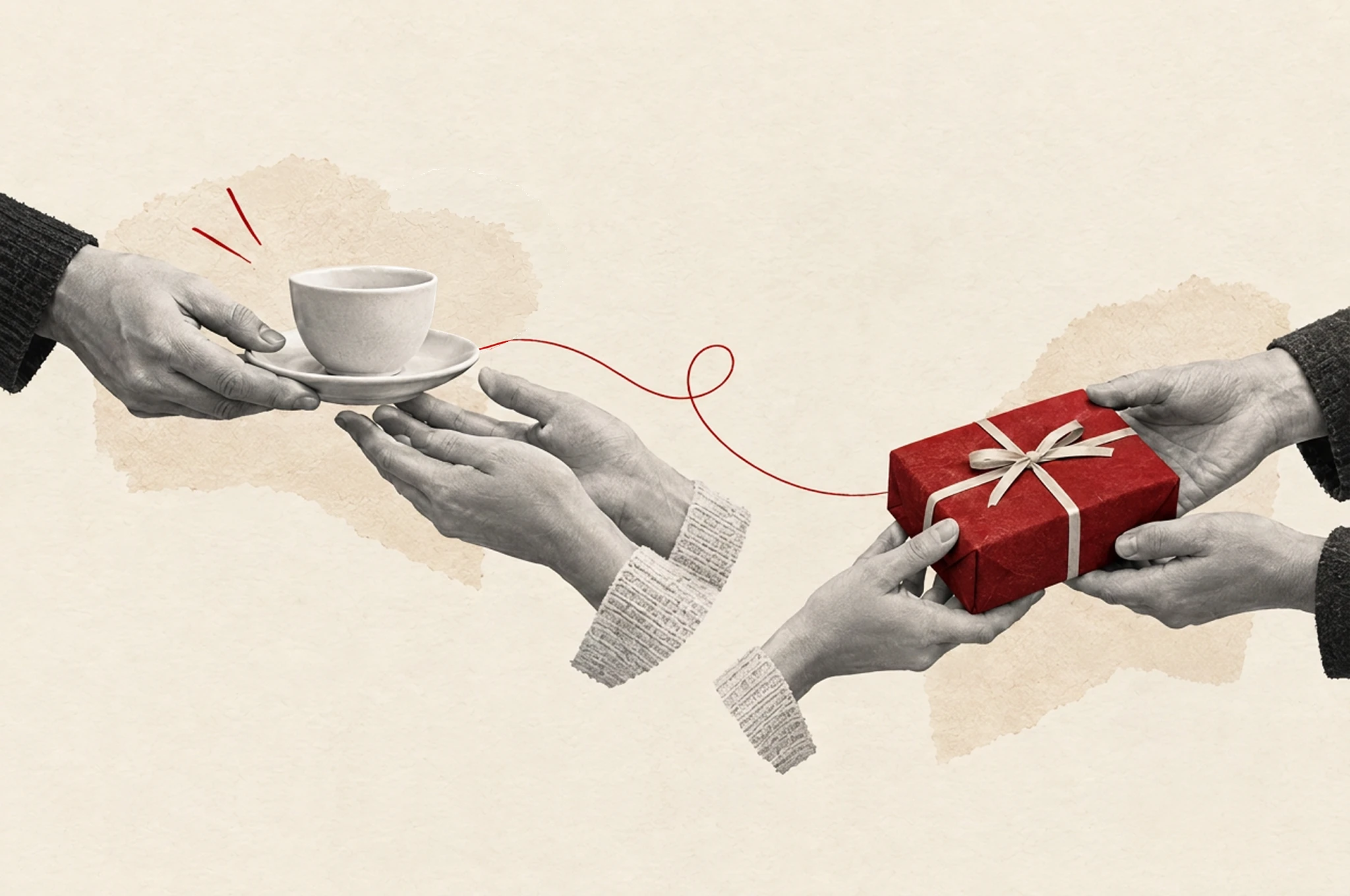
Dim sum in Cantonese: how to order at yum cha, from tea to bill
The Cantonese you need for a Hong Kong yum cha, in the order it happens: getting a table, choosing tea, ticking the order sheet, dim sum names and paying the bill.

Tea first:
Nobody in Hong Kong says “let’s get dim sum”. They say 去飲茶 (heoi3 jam2 caa4), “go and drink tea”, and then order far more than tea.
Key takeaways
飲茶 (
jam2 caa4), “drink tea”, is what Hong Kongers call going for dim sum. Tea comes first and the food follows.At the door you’ll hear 幾位? (
gei2 wai2), “how many?”. Answer 兩位 (loeng5 wai2) for two.Most Hong Kong restaurants now use a 點心紙 (
dim2 sam1 zi2) order sheet. Write how many you want next to each dish.Tap two fingers on the table to say thanks when someone tops up your tea, and leave the teapot lid ajar for more hot water.
Ask for the bill with 唔該,埋單 (
m4 goi1, maai4 daan1).
Ask a Hong Konger to go for dim sum and they won’t say “dim sum” at all. They’ll say 去飲茶 (heoi3 jam2 caa4), “go and drink tea”. That tells you a lot about how the meal works. Tea comes first, the little dishes follow, and the whole thing can stretch across a lazy late morning. This guide walks through one dim sum meal in Hong Kong in the order it actually happens, with the Cantonese you’ll hear and the Cantonese you can say back at each step, plus the dim sum dishes worth knowing by name.
What do dim sum and yum cha mean?
點心 (dim2 sam1) is the food: small dim sum dishes served in bamboo steamers or on little plates, meant for sharing. Cantonese dim sum grew up in the teahouses of Guangzhou and southern China, and Hong Kong made it a fixture of weekend life. 飲茶 (jam2 caa4), usually written yum cha in English, is the occasion: sitting down with a pot of tea and ordering dim sum a few dishes at a time.
The classic saying is 一盅兩件 (jat1 zung1 loeng5 gin6), “one cup, two pieces”: a cup of tea and a couple of dumplings, the most modest yum cha there is. In practice, families go to a big Cantonese restaurant or 茶樓 (caa4 lau4), a teahouse, at the weekend, order far more than two pieces and stay for hours. Dim sum is traditionally eaten in the morning and at lunchtime. Many traditional dim sum restaurants open early for older regulars with a newspaper, and the busiest time is late morning into early afternoon, especially at weekends.
How do you get a table at a dim sum restaurant?
At the door of a busy dim sum restaurant, staff will ask 幾位? (gei2 wai2), “how many?”. You’ll also hear the longer 幾多位? (gei2 do1 wai2), which means the same. Answer with a number and the polite counter 位 (wai2):
兩位 (
loeng5 wai2): two people三位 (
saam1 wai2): three people四位 (
sei3 wai2): four people
Notice it’s 兩位 for two, not 二位. Our guide to numbers in Cantonese explains when 兩 replaces 二. Add 唔該 (m4 goi1) and you have a full, polite answer: 兩位,唔該 (loeng5 wai2, m4 goi1), “two, please”.
Busy places may give you a numbered ticket and call it out when a table is free, so keep an ear out for your number. If the restaurant is full, staff may ask whether you’ll share a table, 搭枱 (daap3 toi2). Sitting with strangers is completely normal at a busy teahouse. Just nod, or say 得 (dak1), “OK”.
How do you choose tea at a dim sum meal?
Tea is not optional at a dim sum meal, because tea is the point. As soon as you sit down, someone will ask 飲咩茶? (jam2 me1 caa4), “what tea are you drinking?”. These are the teas you’ll see most often:
普洱 (
bou2 lei2): pu’er, a dark, earthy tea and the Hong Kong favourite. It’s written 普洱 but usually saidbou2 lei2.香片 (
hoeng1 pin2): jasmine tea, light and fragrant.鐵觀音 (
tit3 gun1 jam1): tieguanyin, a roasted oolong.菊花 (
guk1 faa1): chrysanthemum, a caffeine-free herbal tea.壽眉 (
sau6 mei4): shou mei, a mellow white tea.
Order by naming the tea and adding 唔該: 普洱,唔該 (bou2 lei2, m4 goi1). A pot of Chinese tea arrives for the whole table, often with a bowl of hot water. Many people rinse their tea cup, bowl and chopsticks with that first pour before the meal starts. It’s a habit, not a rule, and nobody will mind if you skip it.
What is the 點心紙 order sheet?
Dim sum was traditionally served from rolling carts, with staff wheeling steamers between tables and calling out what they had. A few traditional dim sum restaurants still use a dim sum cart, but many dim sum restaurants in Hong Kong now give you a 點心紙 (dim2 sam1 zi2), a printed dim sum menu and order sheet listing every dish. Write the number you want in the box next to each dish and hand it to a member of staff. As dishes arrive, they stamp or tick the sheet, which is also how your bill gets added up.
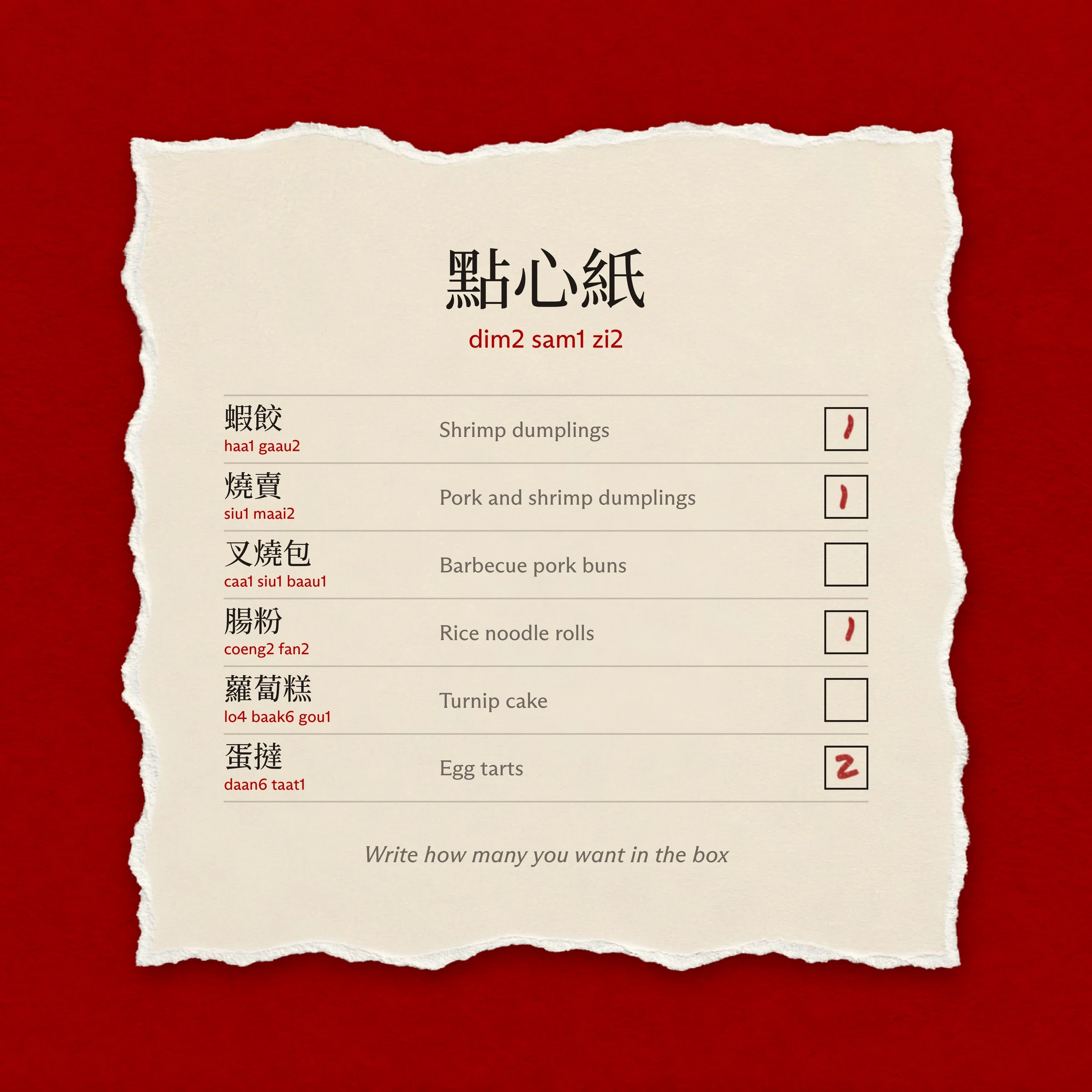
If nobody gives you a sheet, ask: 唔該,畀張點心紙我 (m4 goi1, bei2 zoeng1 dim2 sam1 zi2 ngo5), “a dim sum sheet, please”. If you’re not sure how it works, 點樣填呀? (dim2 joeng2 tin4 aa3) means “how do I fill this in?”.
The sheet is usually in Chinese only, and the dishes are sorted by price band rather than by type. That’s where knowing a handful of dish names pays off. You’ll also see a few counting words on the sheet and hear them from staff:
籠 (
lung4): a steamer basket, as in 一籠蝦餃 (jat1 lung4 haa1 gaau2), “a basket of shrimp dumplings”碟 (
dip6): a plate, for things like rice noodle rolls件 (
gin6): a piece
A rough guide is two or three dishes per person, then order more if you’re still hungry. To order out loud, use 我要 (ngo5 jiu3), “I want”, or simply point at a dish going past and say 呢個 (ni1 go3), “this one”. To call staff over, raise a hand and say 唔該 (m4 goi1), which works as “excuse me” here.
What are the dim sum names in Cantonese?
These are the dim sum dishes you’ll find on almost every Hong Kong dim sum menu. The English names many people know, like har gow and siu mai, are simply old spellings of the Cantonese.
Steamed dim sum
蝦餃 (
haa1 gaau2): har gow, shrimp dumplings in a thin, see-through wrapper made from wheat starch and tapioca flour. Juicy shrimp dumplings are the test of a good kitchen.燒賣 (
siu1 maai2): siu mai, open-topped dumplings of minced pork and shrimp, sometimes topped with crab roe.叉燒包 (
caa1 siu1 baau1): char siu bao, fluffy steamed buns filled with sweet barbecue pork, 叉燒 (caa1 siu1), one of the stars of Cantonese cooking.腸粉 (
coeng2 fan2): cheung fun, slippery rice noodle rolls made from rice flour, filled with shrimp, beef or barbecue pork and served with sweet soy sauce.鳳爪 (
fung6 zaau2): steamed chicken feet, fried, braised and then steamed in fermented black bean sauce. Literally “phoenix claws”, and better than they sound.排骨 (
paai4 gwat1): small pieces of pork spare rib steamed with fermented black beans and garlic.糯米雞 (
no6 mai5 gai1): lo mai gai, sticky rice with chicken, mushroom and Chinese sausage, steamed in a lotus leaf so the rice cooked inside picks up its fragrance.韭菜餃 (
gau2 coi3 gaau2): chive dumplings, with garlic chives and minced shrimp.
Pan-fried and fried dim sum
蘿蔔糕 (
lo4 baak6 gou1): lo bak go, turnip cake made with white radish, dried shrimp and Chinese sausage, pan-fried until golden brown.春卷 (
ceon1 gyun2): fried spring rolls.鹹水角 (
haam4 seoi2 gok3): fried glutinous rice dumplings with a savoury pork filling.
Sweet dim sum
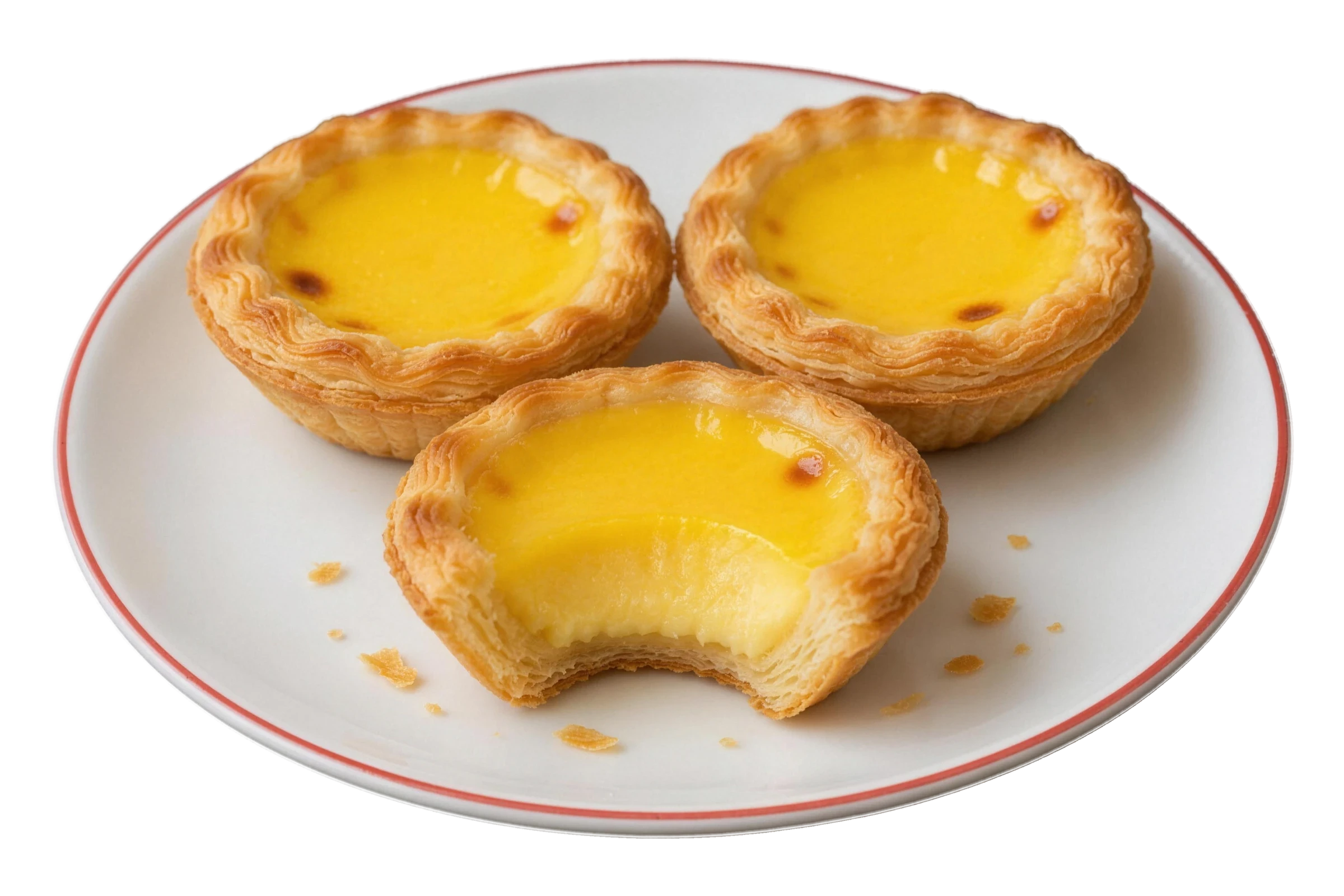
蛋撻 (
daan6 taat1): egg tarts, a buttery pastry shell around a smooth egg custard filling.奶皇包 (
naai5 wong4 baau1): nai wong bao, steamed custard buns.煎堆 (
zin1 deoi1): fried sesame balls, crisp and coated in sesame seeds, with a sweet filling.馬拉糕 (
maa5 laai1 gou1): a soft, springy steamed sponge cake.芒果布甸 (
mong1 gwo2 bou3 din1): mango pudding.
Most tables also order a plate of greens. 蠔油芥蘭 (hou4 jau4 gaai3 laan2) is Chinese broccoli with oyster sauce. You may also see 小籠包 (siu2 lung4 baau1), soup dumplings, on the menu. They’re from Shanghai rather than Cantonese, but plenty of Hong Kong dim sum restaurants serve them anyway.
There’s no fixed order. Dishes arrive as they’re ready, and sweet things often come out alongside the last savoury ones. To put a few dishes together in one sentence, join them with 同埋 (tung4 maai4), “and”: 一籠蝦餃,同埋一碟腸粉 (jat1 lung4 haa1 gaau2, tung4 maai4 jat1 dip6 coeng2 fan2), “a basket of har gow and a plate of cheung fun”.
If you have something you don’t eat, these help:
呢個有冇蝦? (
ni1 go3 jau5 mou5 haa1): does this have shrimp in it?我唔食豬肉 (
ngo5 m4 sik6 zyu1 juk6): I don’t eat pork.我對花生敏感 (
ngo5 deoi3 faa1 sang1 man5 gam2): I’m allergic to peanuts.
What are the table manners for eating dim sum?
Eating dim sum is a shared meal, so most of the etiquette is about looking after the people around you.
Pour for others first
When pouring tea, fill other people’s cups before your own, starting with the eldest. If you want to offer, say 我幫你斟茶 (ngo5 bong1 nei5 zam1 caa4), “let me pour you some tea”.
Tap two fingers to say thank you
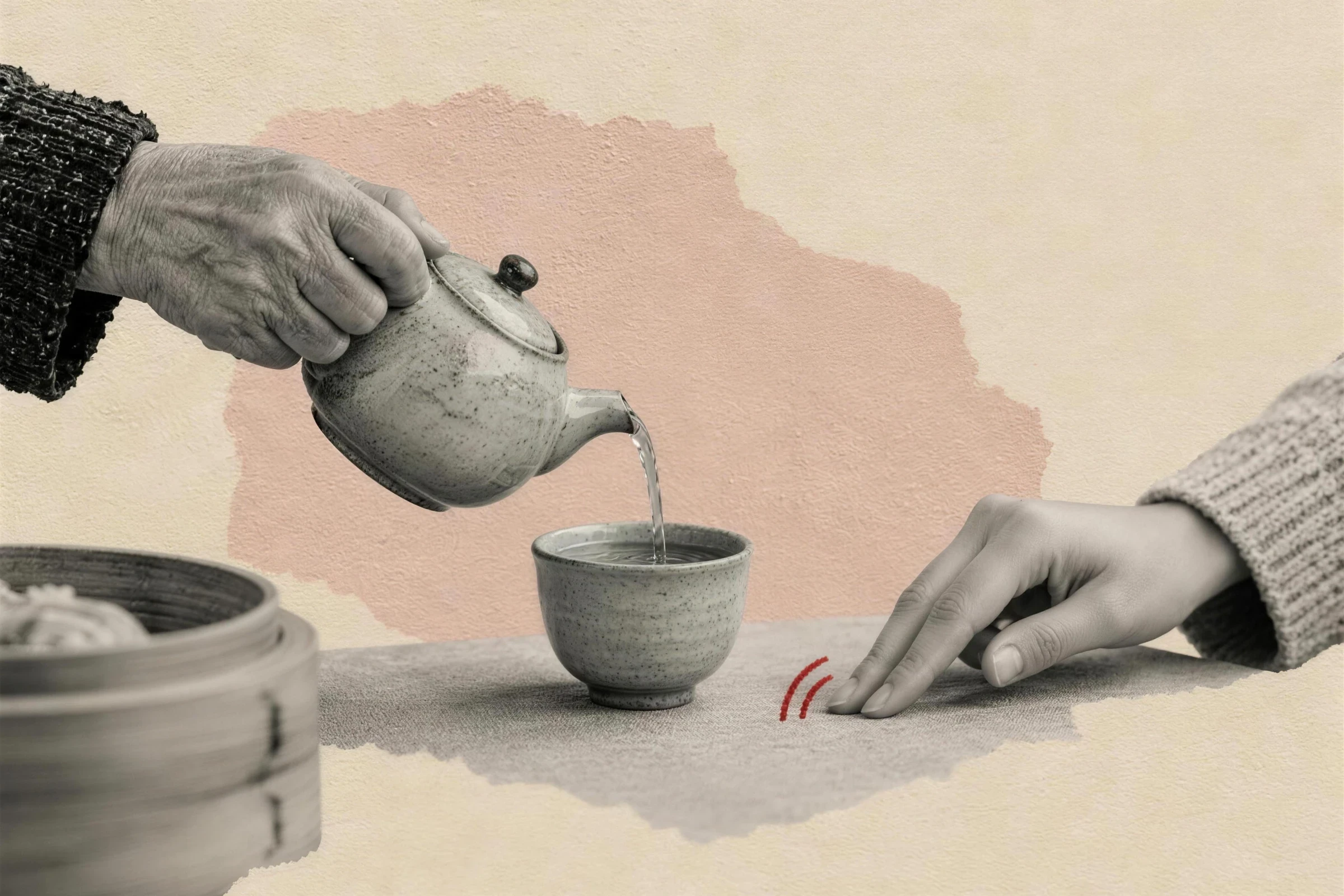
When someone tops up your cup, tap your index and middle fingers lightly on the table. It’s a silent thank you, used so the conversation doesn’t have to stop. A popular story traces it to an emperor travelling in disguise, whose servants tapped the table instead of bowing so as not to give him away. Whether or not it’s true, everyone in Hong Kong knows the gesture. For the spoken versions, see our guide to saying thank you in Cantonese.
Leave the lid open for more hot water
When the teapot runs dry, lift the lid and leave it resting ajar on the pot. Staff will see it and bring hot water without you saying a word. You can also ask: 唔該加水 (m4 goi1 gaa1 seoi2), “more water, please”.
Share the food sensibly
Everything goes in the middle and everyone helps themselves. Offer dishes to elders first, and offer the last piece around before taking it. As at any Chinese meal, don’t leave chopsticks standing upright in a bowl of rice. You’ll find soy sauce and chilli sauce on the table. Ask for chilli with 有冇辣椒醬? (jau5 mou5 laat6 ziu1 zoeng3).
How do you ask for the bill in Cantonese?
When you’re done, catch a member of staff’s eye and say 唔該,埋單 (m4 goi1, maai4 daan1), “the bill, please”. Some people mime writing on their palm instead, which works just as well.
Staff add up the stamps on your 點心紙. Dishes are priced by size band rather than one by one, usually small, medium, large and special, and a tea charge per person is added on top. This is called 茶芥 (caa4 gaai3). Many restaurants also add a service charge, so check the bill before tipping.
A few more phrases for the end of the meal:
可唔可以碌卡? (
ho2 m4 ho2 ji5 luk1 kaat1): can I pay by card?可唔可以分單? (
ho2 m4 ho2 ji5 fan1 daan1): can we split the bill?多謝晒 (
do1 ze6 saai3): thank you very much.
Splitting the bill is less common than you might expect. Among friends and family, there’s often a friendly tussle over who pays, with someone sneaking off to settle up before the others notice. If you’re a guest, offer at least once. Then let your host win, and pay next time.
How do you practise dim sum Cantonese?
A dim sum meal in Hong Kong is one of the best places to use Cantonese for real, because the phrases are short, they repeat every visit, and staff are used to them. Start with 兩位, your tea order and 唔該,埋單, and add a few dish names each time you go. For the rest of a trip, our Cantonese phrases for travellers cover getting around, shopping and eating out. If you’d like to practise out loud before you go, our Survival Cantonese lessons with a native Hong Kong tutor are built around everyday situations like this one. To sound right, it helps to know how Cantonese tones work too.
Frequently asked questions
What does dim sum mean in Cantonese?
點心 (dim2 sam1) is often translated as “touch the heart”, meaning a little something that hits the spot. In everyday use, it simply means the small dishes you eat at yum cha.
What’s the difference between dim sum and yum cha?
Dim sum is the food. Yum cha, 飲茶 (jam2 caa4), is the meal and the outing: drinking tea and eating dim sum together. Hong Kongers say they’re going to yum cha, not going for dim sum.
How many dishes should we order?
Start with two or three dishes per person, including something steamed, something fried and something sweet. You can always add more to the order sheet as you go, and dishes come out as they’re ready.
Can I eat dim sum on my own?
Yes. Solo diners are common, especially at quieter times, and you may be asked to share a table. Two or three dishes and a pot of tea make a perfectly good meal for one.
What if I can’t read the order sheet?
Ask whether there’s an English menu: 有冇英文餐牌? (jau5 mou5 jing1 man2 caan1 paai2). If not, point at dishes at the next table or on a trolley and say 呢個 (ni1 go3), “this one”. A few characters go a long way: 蝦 (haa1) is shrimp, 牛 (ngau4) is beef and 雞 (gai1) is chicken.
Is it rude to order in English?
Not at all, and in tourist areas many staff speak some English. Even so, 唔該 and a couple of dish names in Cantonese usually earn a smile, and they make the whole meal run more smoothly.
How good is your Cantonese?
Five quick questions to see where your Cantonese is at.
Question 1 of 5. The waiter brings your food. What do you say?
Heading to Hong Kong? Survival Cantonese gets you speaking the phrases you’ll actually use, in one-to-one lessons shaped around your trip.
Book a £30 trial lesson
Book a £30 trial lesson