Skip to content

7 min read

Cantonese expressions: funny sayings Hong Kongers actually use

Funny Cantonese expressions, proverbs and idioms Hong Kongers actually use, with Chinese characters, Jyutping, literal meanings and when to say them.

A young woman with long, sleek dark hair cups one hand beside her mouth as if whispering a secret, smiling knowingly at the camera. A black-and-white portrait on deep red paper.

Not really about food:

Psst. The sayings Hong Kongers actually use, and what they really mean.

Key takeaways

  • Cantonese expressions are funny because the literal picture and the real meaning are miles apart.

  • 放飛機 (fong3 fei1 gei1), “flying a plane”, means standing someone up.

  • Older relatives win arguments with 食鹽多過你食米 (sik6 jim4 do1 gwo3 nei5 sik6 mai5): “I’ve eaten more salt than you’ve eaten rice.”

  • Many of the best-loved sayings are pure Cantonese, so a Mandarin speaker won’t necessarily follow them.

  • Tone of voice matters: some sound rude in English but are affectionate between friends, while others carry a real sting.

Spend an evening with Hong Kong friends and you’ll hear someone accused of eating a dead cat, another of boiling telephone congee, and a third told they’ve been fired by way of stir-fried squid. Nobody is talking about food. These are everyday Cantonese expressions, and the gap between the literal meaning and the real one is half the fun.

This guide collects the Cantonese proverbs, idioms and sayings you’re most likely to hear in Hong Kong today, grouped by where you’ll hear them: between friends, at work, at home, around food, and when people talk about each other. Each one comes in Chinese characters with Jyutping, a literal translation, what it really means, the closest English equivalent and when you’d say it.

What Cantonese proverbs reveal about Cantonese culture

Every language has its proverbs, but Cantonese proverbs are unusually visual, and learning a few is one of the most enjoyable parts of the Cantonese language. They lean on food, animals, ghosts and household objects, the stuff of ordinary local people’s everyday lives, and they pack a whole story into a handful of words. That simple and brief wording is what makes them stick.

Some Cantonese idioms have roots in classical Chinese literature and are shared across the Chinese language, often as four-character phrases. Cantonese proverbs from everyday speech tend to be longer and more playful. Many of the best-loved ones, though, are pure Cantonese. They grew out of Hong Kong and Guangdong street life, markets and kitchens, and a Mandarin speaker won’t necessarily understand them. That’s part of why Cantonese speakers are so fond of them: they carry the Cantonese language and its culture in a way textbook vocabulary can’t.

Plenty of Cantonese proverbs convey folk wisdom: work hard, don’t brag, respect experience, don’t judge a whole group by one person. Each proverb teaches people something about how to live, and parents and grandparents use them to teach lessons to children, usually in the middle of an argument. Over the past few generations they’ve been handed down at the dinner table, and families still pass them on to future generations, particularly children growing up overseas.

That’s what makes them such a good window into Cantonese culture. People nowadays still reach for them in group chats and comment sections, which is why the most relevant Cantonese proverbs today are the lively, everyday ones below rather than dusty classical quotations.

How to read the Cantonese language in this guide

Every saying is written in traditional Chinese characters, the ones used in Hong Kong, followed by its Jyutping in red. The number after each syllable is its tone. Cantonese pronunciation has six tones, and a wrong one can turn a proverb into nonsense, so it’s worth reading our guide to Cantonese tones if the numbers are new to you.

Cantonese words written in characters don’t always match Mandarin ones, either. A few characters in these sayings, like 冇 (mou5), not have, and 咗 (zo2), which marks a finished action, belong to written Cantonese and you won’t find them in a Mandarin textbook. Our guide to written Cantonese explains why.

For each one you’ll get the literal meaning first, then what the proverb means in real life, then an English equivalent where a good one exists. English translations only get you so far, though. The tone of voice matters too. Plenty of these sound rude in English but are affectionate between friends, while others carry a real sting. We’ve said which is which.
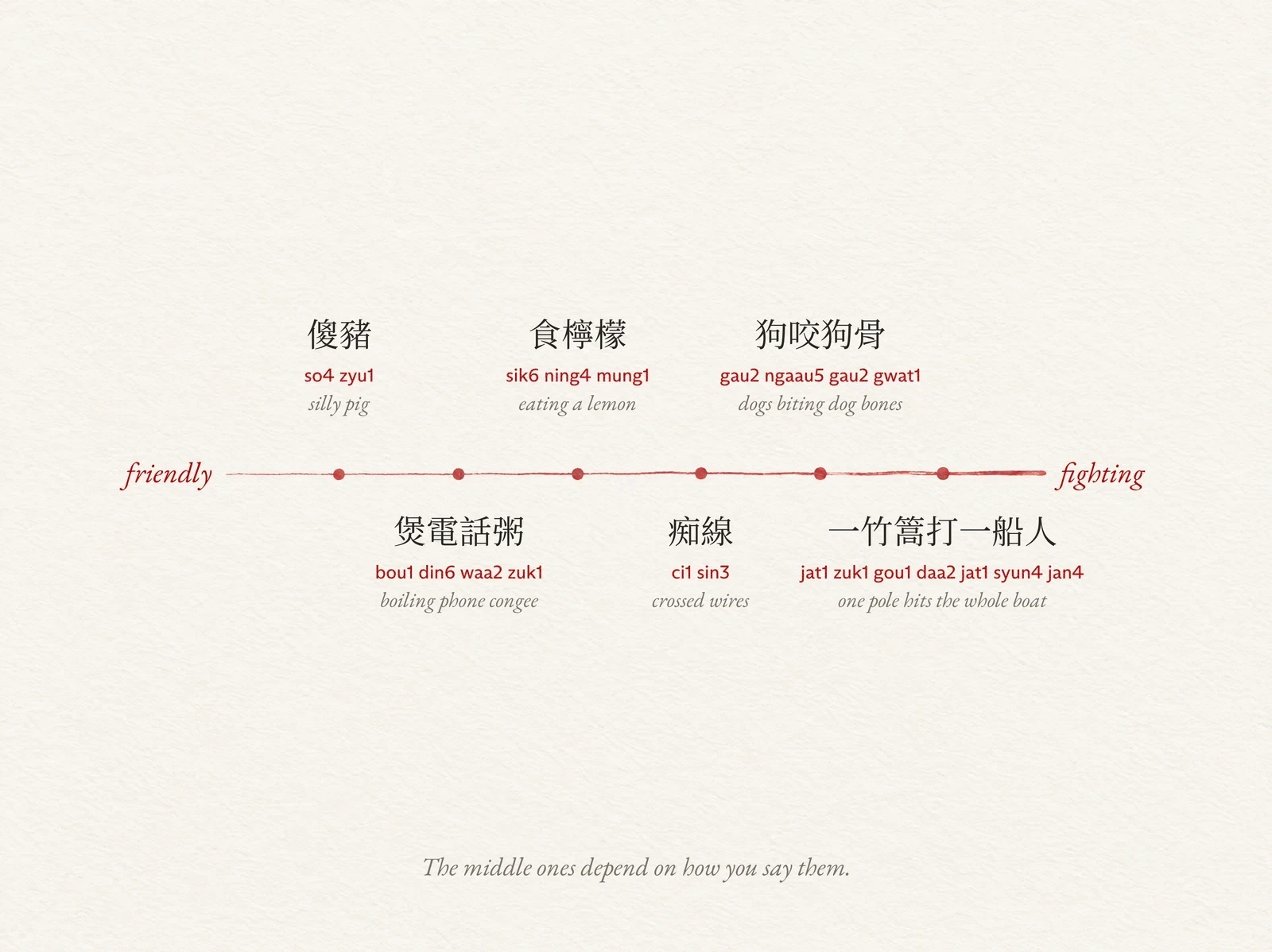
On soft paper, a thin red line runs from friendly on the left to fighting on the right, getting bolder as it goes. Six sayings sit along it in order: 傻豬 so4 zyu1, silly pig; 煲電話粥 bou1 din6 waa2 zuk1, boiling phone congee; 食檸檬 sik6 ning4 mung1, eating a lemon; 痴線 ci1 sin3, crossed wires; 狗咬狗骨 gau2 ngaau5 gau2 gwat1, dogs biting dog bones; and 一竹篙打一船人 jat1 zuk1 gou1 daa2 jat1 syun4 jan4, one pole hits the whole boat. The caption reads: the middle ones depend on how you say them.

Funny Cantonese phrases between friends

Teasing is a big part of Cantonese culture among friends. Friends in Hong Kong tease each other constantly, and these are the Cantonese phrases that come up over dinner and in group chats.

痴線: crossed wires

痴線 (ci1 sin3). Literal meaning: wires stuck together, like a short circuit. English equivalent: “you’re nuts”.

Friends say it whenever someone suggests something outrageous, like a 6am hike after a late night. Said with a laugh, it’s warm. Said flatly, it’s an insult, so keep it for people who know you.

傻豬: silly pig

傻豬 (so4 zyu1). Literal translation: silly pig. English equivalent: “silly billy”.

A soft, teasing way to call someone silly. Couples use it, parents use it with small children, and friends use it when someone leaves their phone in the taxi for the second time this month. It’s affectionate, so it sounds odd from a stranger.

食檸檬: eating lemons

食檸檬 (sik6 ning4 mung1). Literal meaning: to eat a lemon. English equivalent: “to get knocked back”.

Ask someone out and get a polite no, and your friends will tell you you’ve eaten a lemon. The sour face is the whole joke. Younger Cantonese speakers use it for any rejection, romantic or not.
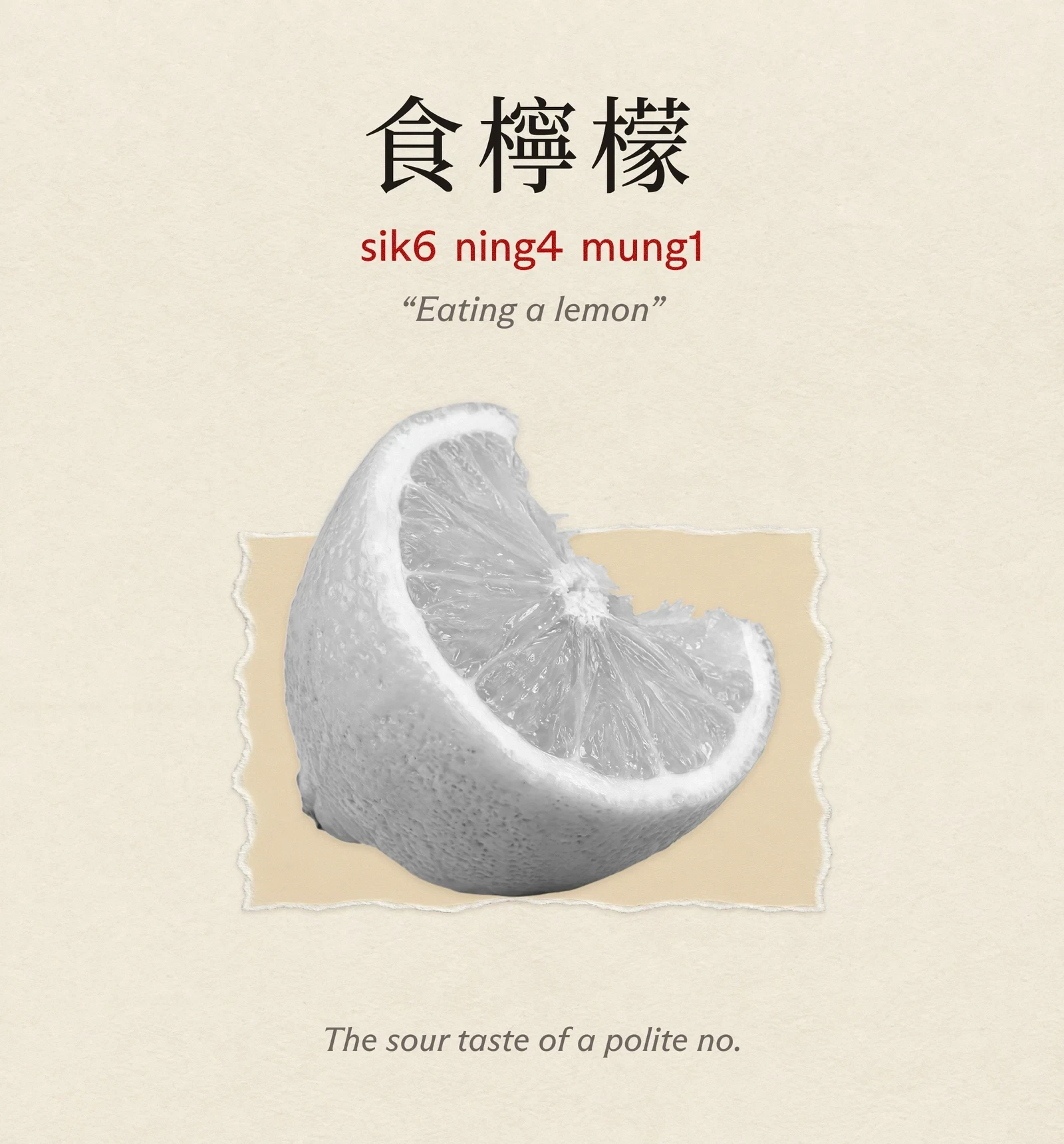
A card titled 食檸檬, sik6 ning4 mung1, “Eating a lemon”. A black-and-white cut-out of half a lemon with a bite taken out of it, on a torn beige patch. Underneath: the sour taste of a polite no.

放飛機: flying a plane

放飛機 (fong3 fei1 gei1). Literal translation: to fly a plane. English equivalent: “to stand someone up”.

If a friend promised to meet at seven and never appeared, they flew you a plane. It works for small letdowns too, like a colleague who said they’d help and quietly didn’t.
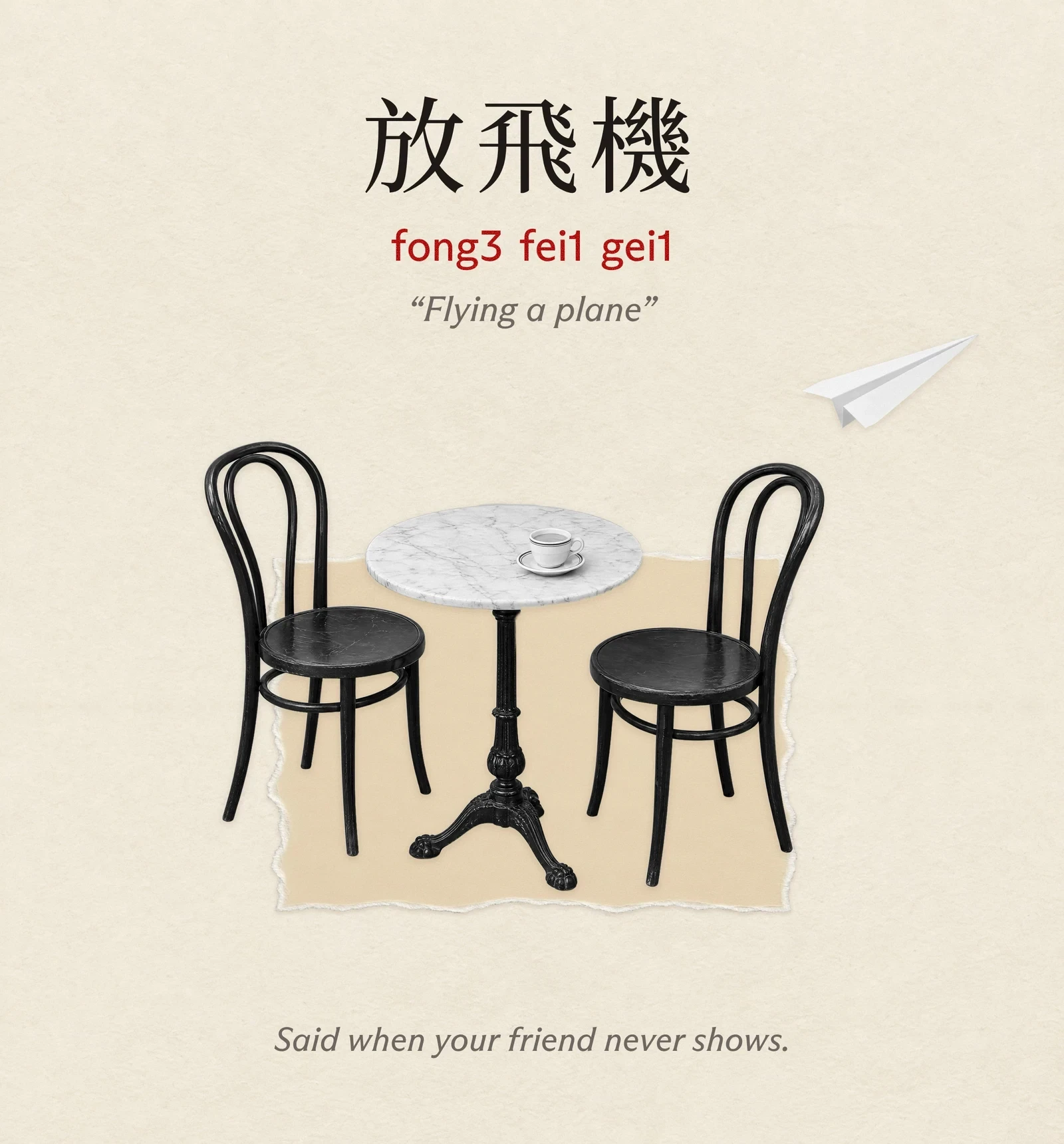
A card titled 放飛機, fong3 fei1 gei1, “Flying a plane”. A black-and-white cut-out of an empty café table for two, a cup of tea on the marble top and both chairs empty, while a paper plane flies off to the top right. Underneath: said when your friend never shows.

Cantonese idioms for work

Hong Kong’s working culture is fast and long-houred, and office Cantonese has a dark sense of humour about it. These Cantonese proverbs and idioms are the ones you’ll hear by the water cooler. For the everyday phrases you’ll need in an office, see our guide to Cantonese for work.

炒魷魚: stir-frying squid

炒魷魚 (caau2 jau4 jyu2). Literal meaning: to stir-fry squid. English equivalent: “to get the sack”.

The usual explanation is that workers once kept their bedding rolled up at work, and when they were sacked they rolled it up and left, just as squid curls up in a hot wok. You can turn it round too: 我炒咗老闆魷魚 (ngo5 caau2 zo2 lou5 baan2 jau4 jyu2) means “I fired my boss”, in other words, I quit.

食死貓: eating a dead cat

食死貓 (sik6 sei2 maau1). Literal translation: to eat a dead cat. English equivalent: “to take the fall”.

The project went wrong, the manager needed someone to blame, and you ate the dead cat. It means taking the blame for something you didn’t do, and it’s said with a sigh, usually over lunch.

做牛做馬: working like an ox, working like a horse

做牛做馬 (zou6 ngau4 zou6 maa5). Literal meaning: to work as an ox, to work as a horse. English equivalent: “to work like a dog”.

It means working yourself into the ground, often for someone else’s benefit. Office workers say it about overtime, students about exam season, and parents about raising children.

狗咬狗骨: dogs biting dog bones

狗咬狗骨 (gau2 ngaau5 gau2 gwat1). Literal translation: dogs gnawing on dog bones. English equivalent: “infighting”.

It describes people on the same side fighting each other: two departments, two managers, two relatives. Outsiders watch and roll their eyes.
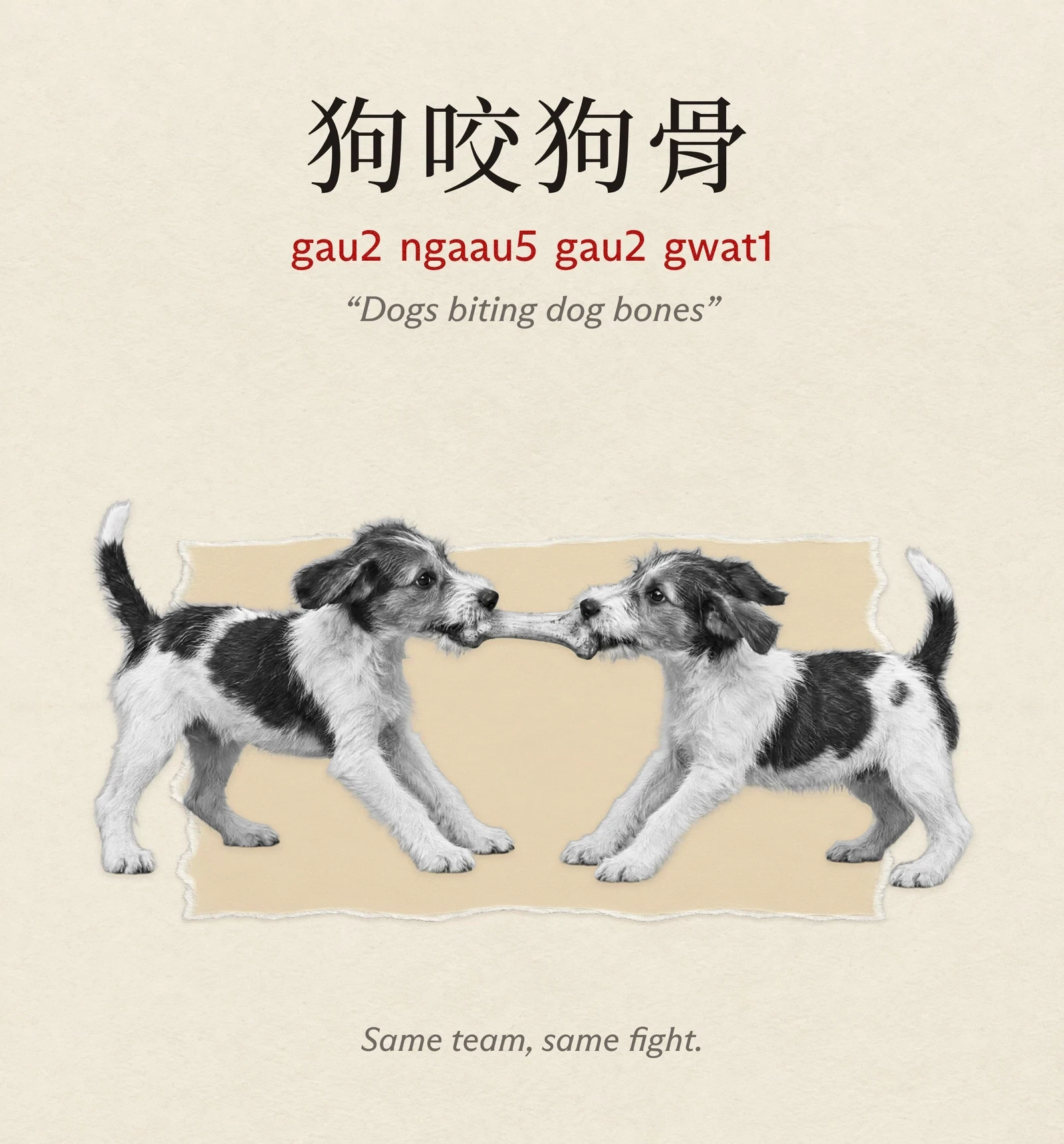
A card titled 狗咬狗骨, gau2 ngaau5 gau2 gwat1, “Dogs biting dog bones”. Two scruffy terrier pups in a tug of war over one bone, spilling out of both sides of a torn beige patch. Underneath: same team, same fight.

Cantonese proverbs from home

Older relatives love Cantonese proverbs, especially in the middle of an argument. Cantonese proverbs are often used to teach children, and if you’re learning to speak Cantonese with family, you’ll hear these sooner or later. Our guide to Cantonese family terms covers who you’ll be talking to, and our guide for people who understand Cantonese but can’t speak it covers how to start talking back.

食鹽多過你食米: I’ve eaten more salt than you’ve eaten rice

食鹽多過你食米 (sik6 jim4 do1 gwo3 nei5 sik6 mai5). Literal meaning: I’ve eaten more salt than you’ve eaten rice. English equivalent: “I’ve been around the block”.

This Cantonese proverb means “I’ve got far more experience than you, so listen.” It’s the classic line from a parent or grandparent who is about to win the argument. Younger people now use it jokingly with each other too.
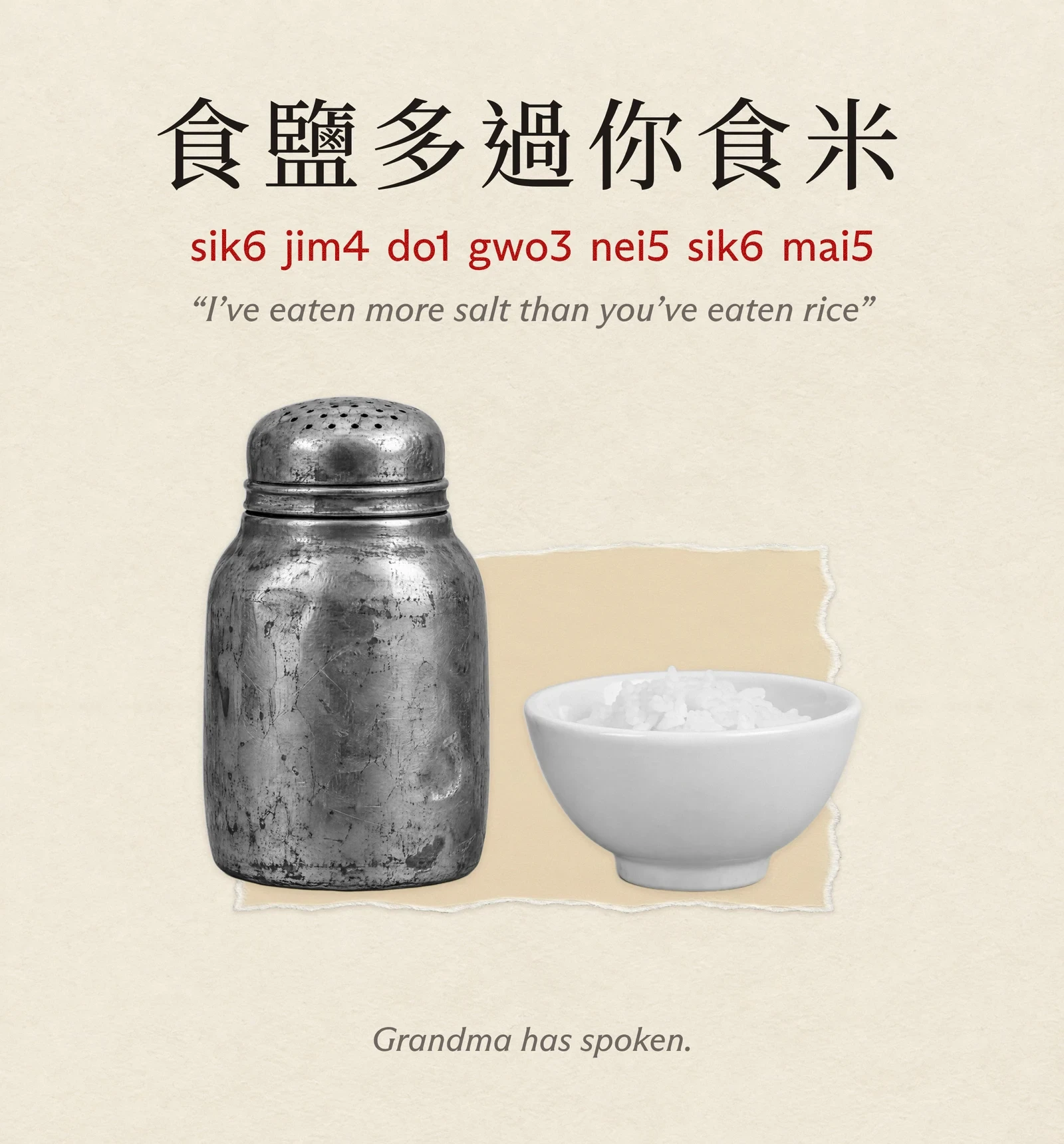
A card titled 食鹽多過你食米, sik6 jim4 do1 gwo3 nei5 sik6 mai5, “I’ve eaten more salt than you’ve eaten rice”. A big, battered old salt shaker towering over a small bowl of rice. Underneath: grandma has spoken.

樹大有枯枝: a big tree has dead branches

樹大有枯枝 (syu6 daai6 jau5 fu1 zi1). Literal translation: a big tree has dead branches. English equivalent: “every family has its black sheep”.

It’s used to excuse one difficult relative without blaming everyone else, and it works for big companies too. It’s gentler than it sounds.
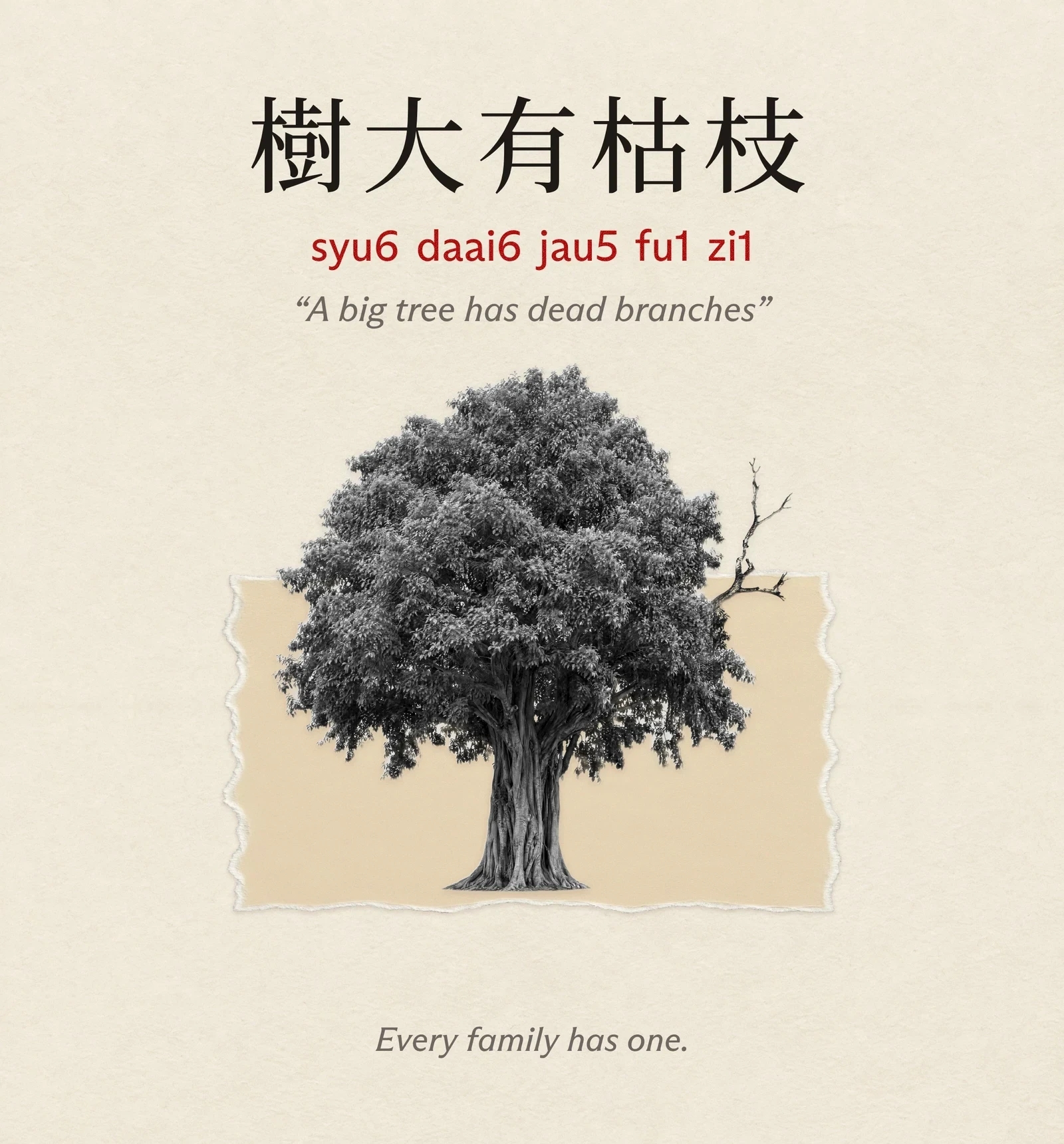
A card titled 樹大有枯枝, syu6 daai6 jau5 fu1 zi1, “A big tree has dead branches”. A full, leafy tree with one bare dead branch sticking out to the right. Underneath: every family has one.

有頭髮邊個想做癩痢: who’d choose to be bald if they had hair?

有頭髮邊個想做癩痢 (jau5 tau4 faat3 bin1 go3 soeng2 zou6 laat3 lei1). Literal meaning: if you had hair, who would want to be bald? English equivalent: “beggars can’t be choosers”.

It means nobody chooses a bad situation if they have a better option. People say it to explain someone taking a cramped flat or a dull job: they would have done better if they could.

牛唔飲水唔撳得牛頭低: you can’t push an ox’s head down to drink

牛唔飲水唔撳得牛頭低 (ngau4 m4 jam2 seoi2 m4 gam6 dak1 ngau4 tau4 dai1). Literal translation: if the ox won’t drink, you can’t push its head down. English equivalent: “you can lead a horse to water, but you can’t make it drink”.

If someone doesn’t want to do something, no amount of pushing will make them. Parents say it, a little wearily, about teenagers.

Cantonese food idioms

Food sits at the heart of Cantonese culture, and many Cantonese proverbs come from the kitchen, so it’s no surprise that plenty of Cantonese idioms start with 食 (sik6), to eat, or 飲 (jam2), to drink. If you want the real menu, our dim sum guide has the dishes.

冇啖好食: not one good mouthful

冇啖好食 (mou5 daam6 hou2 sik6). Literal meaning: not a single good mouthful. English equivalent: “hard times”.

It means having a hard time of it, with nothing good coming your way. People use it about a tough economy, a thankless job, or a situation where every option is bad.

飲頭啖湯: drinking the first sip of soup

飲頭啖湯 (jam2 tau4 daam6 tong1). Literal translation: to drink the first mouthful of soup. English equivalent: “the early bird catches the worm”.

It means getting in first and enjoying the benefits before anyone else. Early investors, the first shop on a new street, the friend who tried the restaurant before it got famous: they all drank the first sip.
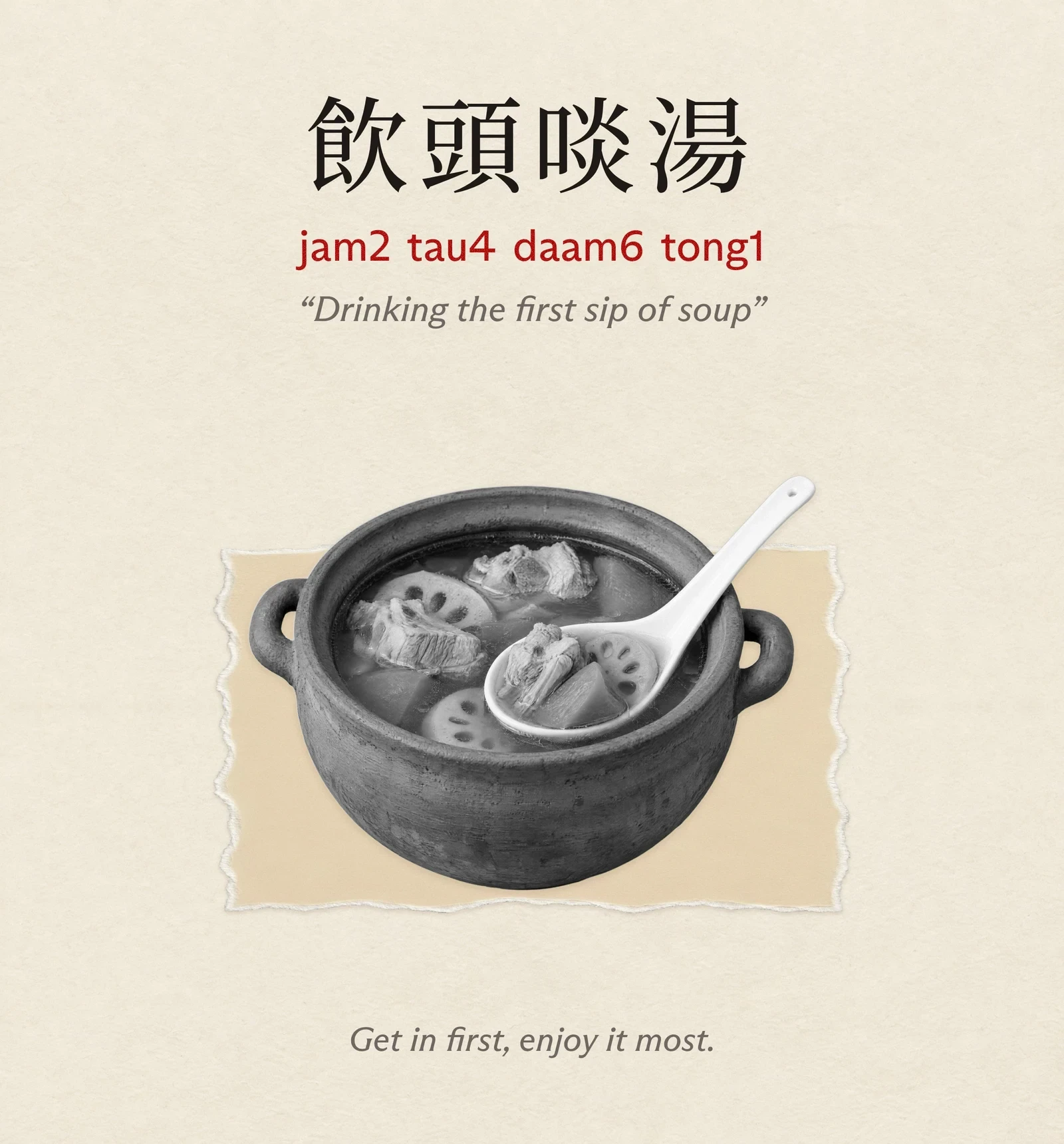
A card titled 飲頭啖湯, jam2 tau4 daam6 tong1, “Drinking the first sip of soup”. An earthenware pot of soup with lotus root and pork, and a white spoon dipped in for the first sip. Underneath: get in first, enjoy it most.

煲電話粥: boiling telephone congee

煲電話粥 (bou1 din6 waa2 zuk1). Literal meaning: to boil telephone congee. English equivalent: “to be glued to the phone”.

Congee takes hours on a low heat, and so does a teenager’s phone call. It has survived perfectly into the age of video calls.

豬籠入水: water pouring into a pig basket

豬籠入水 (zyu1 lung4 jap6 seoi2). Literal translation: water pouring into a pig basket. English equivalent: “raking it in”.

A bamboo pig basket dropped in a river fills from every gap at once, and so does the bank account of someone with three side businesses. It means money flowing in from every side.

What Cantonese people say about each other

Some of the best-loved sayings, particularly Hong Kong proverbs about money and status, are small judgements about human nature. Some of the oldest Cantonese proverbs live here too.

一竹篙打一船人: one bamboo pole hits a whole boatload

一竹篙打一船人 (jat1 zuk1 gou1 daa2 jat1 syun4 jan4). Literal meaning: to hit everyone on a boat with one bamboo pole. English equivalent: “to tar everyone with the same brush”.

It means blaming a whole group for what one person did. If someone writes off every tourist because of one rude one, you can tell them they’re hitting the whole boat with one pole.
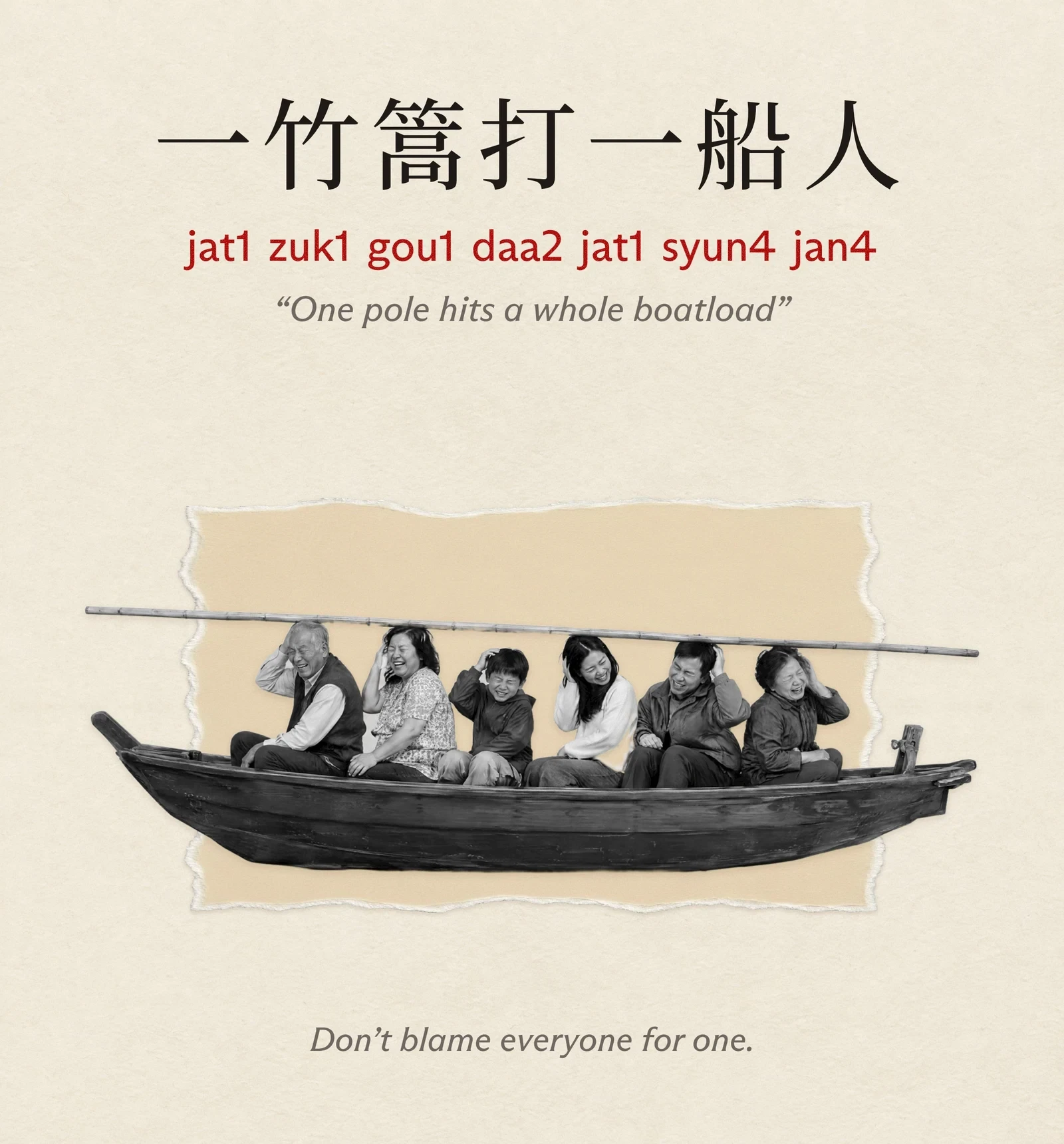
A card titled 一竹篙打一船人, jat1 zuk1 gou1 daa2 jat1 syun4 jan4, “One pole hits a whole boatload”. A wooden sampan full of people ducking under one long bamboo pole that runs past both edges. Underneath: don’t blame everyone for one.

有錢使得鬼推磨: with money, you can make ghosts turn the millstone

有錢使得鬼推磨 (jau5 cin2 sai2 dak1 gwai2 teoi1 mo6). Literal translation: with money, you can get a ghost to push the millstone. English equivalent: “money talks”.

This Cantonese proverb means money can get almost anything done. It’s usually said with a raised eyebrow, about property, politics or a suspiciously fast planning approval.

鬼遮眼: a ghost covers one’s eyes

鬼遮眼 (gwai2 ze1 ngaan5). Literal meaning: a ghost covers one’s eyes. English equivalent: “it was staring me in the face”.

It’s what you say when you somehow miss something obvious: the keys that were on the table the whole time, the typo in the email you checked three times. A ghost must have covered your eyes.
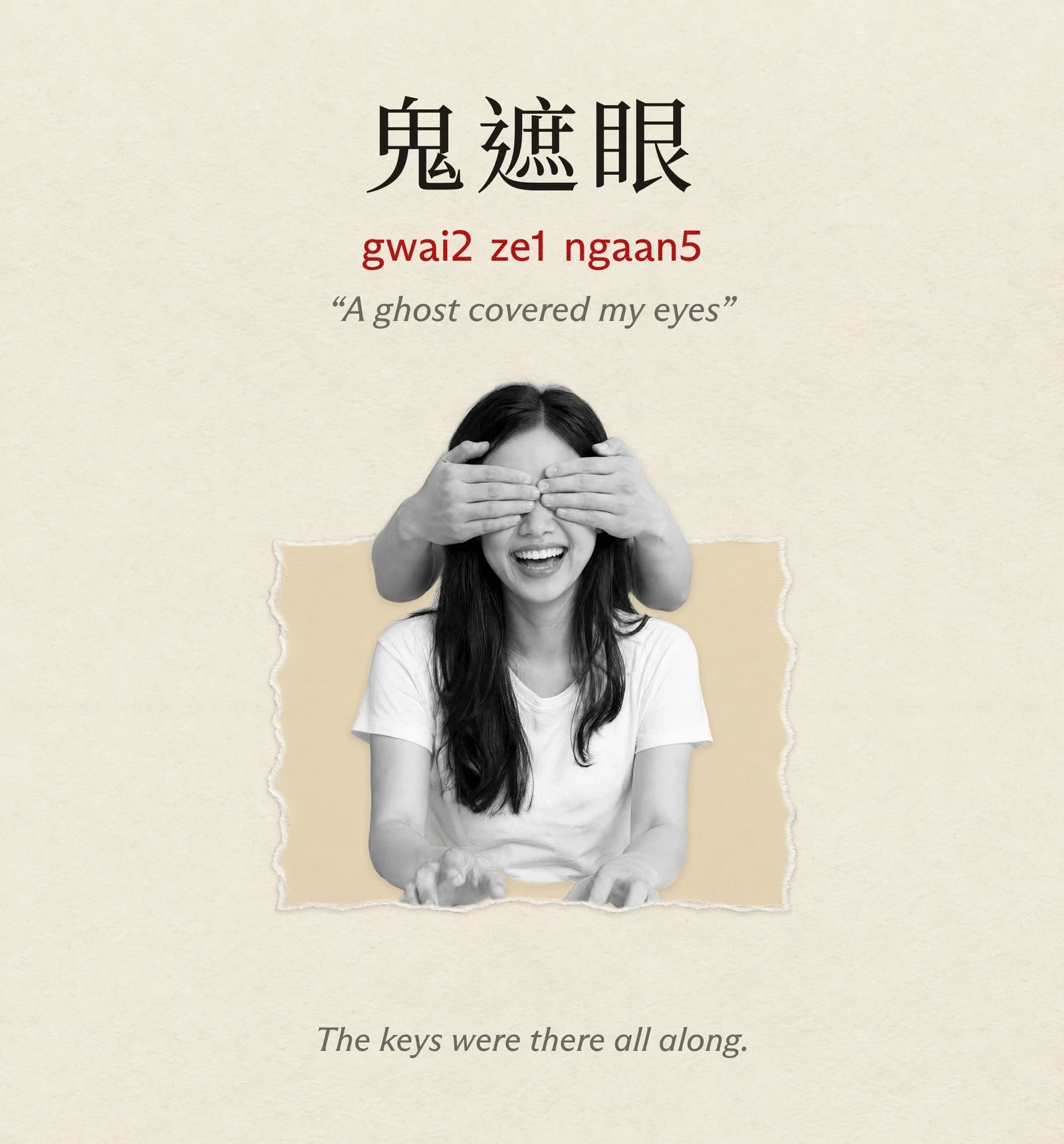
A card titled 鬼遮眼, gwai2 ze1 ngaan5, “A ghost covered my eyes”. A laughing woman with two hands from behind covering her eyes. Underneath: the keys were there all along.

有麝自然香: musk smells sweet on its own

有麝自然香 (jau5 se6 zi6 jin4 hoeng1). Literal translation: if you have musk, you’ll naturally smell fragrant. English equivalent: “good wine needs no bush”.

This proverb means real talent doesn’t need advertising. It’s a gentle way to tell someone to stop boasting, or to praise someone who never does.

Other Cantonese proverbs worth knowing

Once you start listening for them, you’ll notice more. These four come up often enough in Hong Kong that they’re worth adding to your list.

一雞死一雞鳴 (jat1 gai1 sei2 jat1 gai1 ming4). Literal meaning: one chicken dies, another crows. It means nobody is irreplaceable: when one person leaves, someone else steps in. You’ll hear it about jobs and about relationships.

人比人,比死人 (jan4 bei2 jan4, bei2 sei2 jan4). Literal translation: compare people with people, and the comparison will kill you. English equivalent: “comparison is the thief of joy”. It’s what friends say when someone is fretting over a cousin’s bigger flat.

心急食唔到熱豆腐 (sam1 gap1 sik6 m4 dou2 jit6 dau6 fu6). Literal meaning: if you’re impatient, you can’t eat hot tofu. English equivalent: “good things come to those who wait”. Rush it and you’ll burn your mouth.
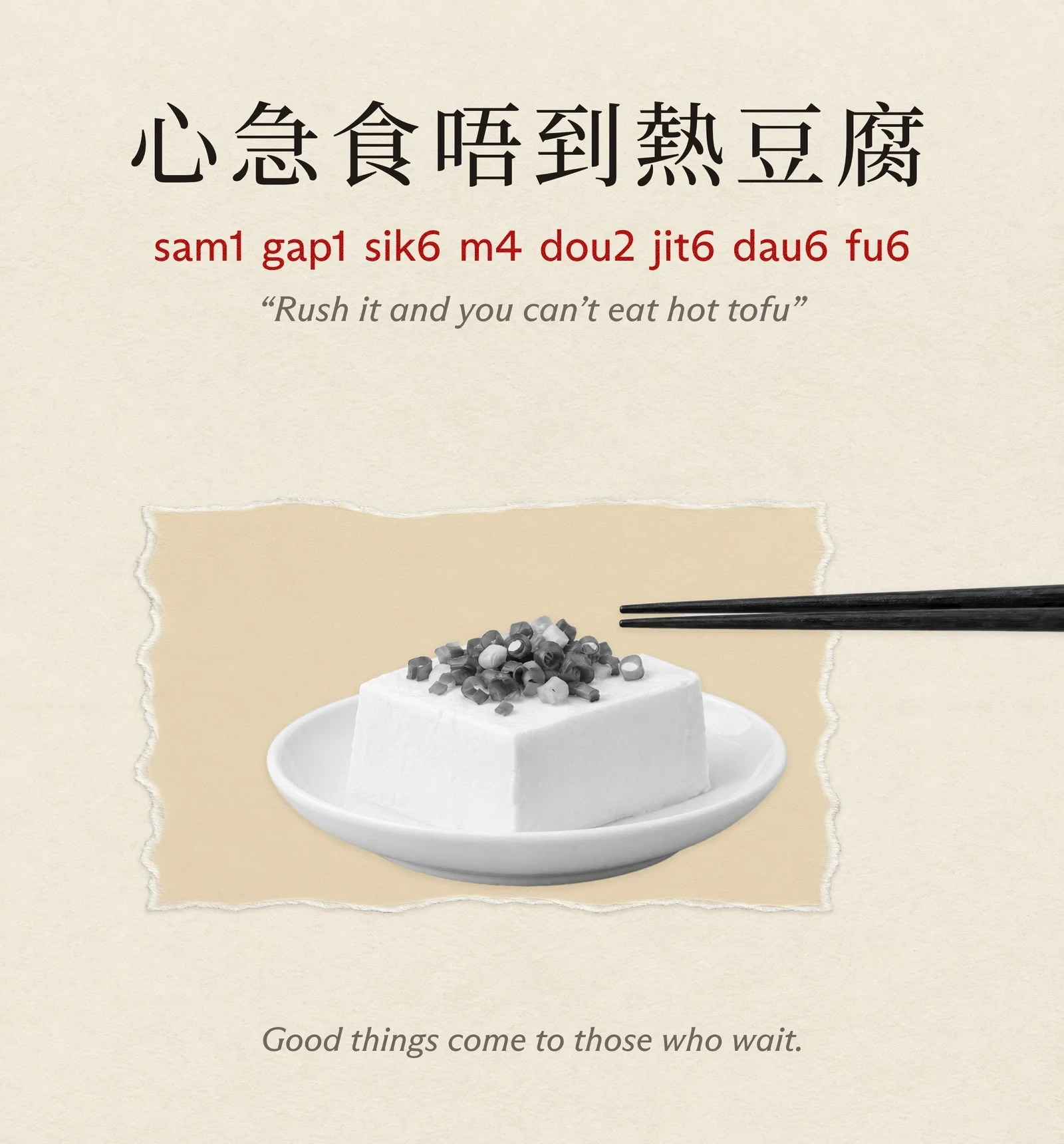
A card titled 心急食唔到熱豆腐, sam1 gap1 sik6 m4 dou2 jit6 dau6 fu6, “Rush it and you can’t eat hot tofu”. A block of silken tofu topped with spring onion on a small plate, with chopsticks coming in from the edge and hovering just above it. Underneath: good things come to those who wait.

執輸行頭,慘過敗家 (zap1 syu1 haang4 tau4, caam2 gwo3 baai6 gaa1). Literal translation: falling behind at the start is worse than losing the family fortune. It sums up a very Hong Kong fear of missing out, from school places to queueing for a new bubble tea shop, and it says a lot about Cantonese culture in a competitive city.

How to use Cantonese proverbs without sounding odd

Learn to recognise Cantonese proverbs before you try them out. Most learners pick up Cantonese proverbs by ear long before they use them. Hong Kong films, TV dramas and YouTube are full of them, and hearing which Cantonese people say what, to whom, teaches you more than any list or grammar explanation.

Start with the friendly Cantonese proverbs and phrases, like 煲電話粥 or 食檸檬, and save the sharper ones for people who know you well. Copy the intonation as well as the words: the same Cantonese saying can be a joke or a jab depending on how it’s said. A native Cantonese speaker will hear the difference straight away.

If you want to learn Cantonese idioms properly, collect Cantonese proverbs as you meet them, in a notebook or a flashcard deck, with the Jyutping and the sentence you heard them in. It doubles as vocabulary practice. You don’t need to know all the Cantonese words in a saying to get the joke, and you certainly don’t need all the words in this guide. Only the basic ones, a handful of essential Cantonese proverbs used at the right moment, will do more for your speaking skills than fifty memorised ones.

Don’t overdo it. A sentence of plain Cantonese with one well-placed Cantonese proverb sounds natural. Three in a row sounds like you’ve swallowed a phrasebook. If you’re still building the basics, start with how to say hello and thank you, then come back. For shorter street words rather than whole sayings, see our guide to Cantonese slang, which covers a few classics like 雞同鴨講.

FAQ

What’s the difference between a Cantonese proverb and an idiom?

Loosely, a proverb gives advice or states a truth, like 有麝自然香, while an idiom is a fixed phrase whose meaning you can’t guess from the words, like 炒魷魚. In everyday speech Cantonese speakers don’t worry about the difference, and many Cantonese proverbs and idioms sit somewhere in between.

Do young people in Hong Kong still use these Cantonese sayings?

Yes. Cantonese proverbs and idioms are alive and well in Hong Kong. 炒魷魚, 食檸檬, 煲電話粥 and 痴線 are everyday speech for all ages. A few, like 有麝自然香, lean older and more literary, but you’ll still hear them, often with a knowing smile.

Are any of them rude?

Some depend entirely on tone. 痴線 and 傻豬 are fine between friends and odd from a stranger. Treat any Cantonese phrase about animals or ghosts as casual, and keep them out of job interviews.

Are Cantonese proverbs the same as Mandarin ones?

Not really. A few, like 有錢使得鬼推磨, have Mandarin cousins, but most of the Cantonese proverbs here, such as 食死貓 and 煲電話粥, are distinctly Cantonese and won’t make sense to a Mandarin speaker. If you’re weighing up the two, see Cantonese or Mandarin: which is harder?

How good is your Cantonese?

Five quick questions to see where your Cantonese is at.

Question 1 of 5. The waiter brings your food. What do you say?

Complete Cantonese takes you from first words to real conversations with a native Hong Kong tutor.

Book a £30 trial lesson

Book a £30 trial lesson
7 min read

Cantonese expressions: funny sayings Hong Kongers actually use

Funny Cantonese expressions, proverbs and idioms Hong Kongers actually use, with Chinese characters, Jyutping, literal meanings and when to say them.

A young woman with long, sleek dark hair cups one hand beside her mouth as if whispering a secret, smiling knowingly at the camera. A black-and-white portrait on deep red paper.

Not really about food:

Psst. The sayings Hong Kongers actually use, and what they really mean.

Key takeaways

  • Cantonese expressions are funny because the literal picture and the real meaning are miles apart.

  • 放飛機 (fong3 fei1 gei1), “flying a plane”, means standing someone up.

  • Older relatives win arguments with 食鹽多過你食米 (sik6 jim4 do1 gwo3 nei5 sik6 mai5): “I’ve eaten more salt than you’ve eaten rice.”

  • Many of the best-loved sayings are pure Cantonese, so a Mandarin speaker won’t necessarily follow them.

  • Tone of voice matters: some sound rude in English but are affectionate between friends, while others carry a real sting.

Spend an evening with Hong Kong friends and you’ll hear someone accused of eating a dead cat, another of boiling telephone congee, and a third told they’ve been fired by way of stir-fried squid. Nobody is talking about food. These are everyday Cantonese expressions, and the gap between the literal meaning and the real one is half the fun.

This guide collects the Cantonese proverbs, idioms and sayings you’re most likely to hear in Hong Kong today, grouped by where you’ll hear them: between friends, at work, at home, around food, and when people talk about each other. Each one comes in Chinese characters with Jyutping, a literal translation, what it really means, the closest English equivalent and when you’d say it.

What Cantonese proverbs reveal about Cantonese culture

Every language has its proverbs, but Cantonese proverbs are unusually visual, and learning a few is one of the most enjoyable parts of the Cantonese language. They lean on food, animals, ghosts and household objects, the stuff of ordinary local people’s everyday lives, and they pack a whole story into a handful of words. That simple and brief wording is what makes them stick.

Some Cantonese idioms have roots in classical Chinese literature and are shared across the Chinese language, often as four-character phrases. Cantonese proverbs from everyday speech tend to be longer and more playful. Many of the best-loved ones, though, are pure Cantonese. They grew out of Hong Kong and Guangdong street life, markets and kitchens, and a Mandarin speaker won’t necessarily understand them. That’s part of why Cantonese speakers are so fond of them: they carry the Cantonese language and its culture in a way textbook vocabulary can’t.

Plenty of Cantonese proverbs convey folk wisdom: work hard, don’t brag, respect experience, don’t judge a whole group by one person. Each proverb teaches people something about how to live, and parents and grandparents use them to teach lessons to children, usually in the middle of an argument. Over the past few generations they’ve been handed down at the dinner table, and families still pass them on to future generations, particularly children growing up overseas.

That’s what makes them such a good window into Cantonese culture. People nowadays still reach for them in group chats and comment sections, which is why the most relevant Cantonese proverbs today are the lively, everyday ones below rather than dusty classical quotations.

How to read the Cantonese language in this guide

Every saying is written in traditional Chinese characters, the ones used in Hong Kong, followed by its Jyutping in red. The number after each syllable is its tone. Cantonese pronunciation has six tones, and a wrong one can turn a proverb into nonsense, so it’s worth reading our guide to Cantonese tones if the numbers are new to you.

Cantonese words written in characters don’t always match Mandarin ones, either. A few characters in these sayings, like 冇 (mou5), not have, and 咗 (zo2), which marks a finished action, belong to written Cantonese and you won’t find them in a Mandarin textbook. Our guide to written Cantonese explains why.

For each one you’ll get the literal meaning first, then what the proverb means in real life, then an English equivalent where a good one exists. English translations only get you so far, though. The tone of voice matters too. Plenty of these sound rude in English but are affectionate between friends, while others carry a real sting. We’ve said which is which.

On soft paper, a thin red line runs from friendly on the left to fighting on the right, getting bolder as it goes. Six sayings sit along it in order: 傻豬 so4 zyu1, silly pig; 煲電話粥 bou1 din6 waa2 zuk1, boiling phone congee; 食檸檬 sik6 ning4 mung1, eating a lemon; 痴線 ci1 sin3, crossed wires; 狗咬狗骨 gau2 ngaau5 gau2 gwat1, dogs biting dog bones; and 一竹篙打一船人 jat1 zuk1 gou1 daa2 jat1 syun4 jan4, one pole hits the whole boat. The caption reads: the middle ones depend on how you say them.

Funny Cantonese phrases between friends

Teasing is a big part of Cantonese culture among friends. Friends in Hong Kong tease each other constantly, and these are the Cantonese phrases that come up over dinner and in group chats.

痴線: crossed wires

痴線 (ci1 sin3). Literal meaning: wires stuck together, like a short circuit. English equivalent: “you’re nuts”.

Friends say it whenever someone suggests something outrageous, like a 6am hike after a late night. Said with a laugh, it’s warm. Said flatly, it’s an insult, so keep it for people who know you.

傻豬: silly pig

傻豬 (so4 zyu1). Literal translation: silly pig. English equivalent: “silly billy”.

A soft, teasing way to call someone silly. Couples use it, parents use it with small children, and friends use it when someone leaves their phone in the taxi for the second time this month. It’s affectionate, so it sounds odd from a stranger.

食檸檬: eating lemons

食檸檬 (sik6 ning4 mung1). Literal meaning: to eat a lemon. English equivalent: “to get knocked back”.

Ask someone out and get a polite no, and your friends will tell you you’ve eaten a lemon. The sour face is the whole joke. Younger Cantonese speakers use it for any rejection, romantic or not.

A card titled 食檸檬, sik6 ning4 mung1, “Eating a lemon”. A black-and-white cut-out of half a lemon with a bite taken out of it, on a torn beige patch. Underneath: the sour taste of a polite no.

放飛機: flying a plane

放飛機 (fong3 fei1 gei1). Literal translation: to fly a plane. English equivalent: “to stand someone up”.

If a friend promised to meet at seven and never appeared, they flew you a plane. It works for small letdowns too, like a colleague who said they’d help and quietly didn’t.

A card titled 放飛機, fong3 fei1 gei1, “Flying a plane”. A black-and-white cut-out of an empty café table for two, a cup of tea on the marble top and both chairs empty, while a paper plane flies off to the top right. Underneath: said when your friend never shows.

Cantonese idioms for work

Hong Kong’s working culture is fast and long-houred, and office Cantonese has a dark sense of humour about it. These Cantonese proverbs and idioms are the ones you’ll hear by the water cooler. For the everyday phrases you’ll need in an office, see our guide to Cantonese for work.

炒魷魚: stir-frying squid

炒魷魚 (caau2 jau4 jyu2). Literal meaning: to stir-fry squid. English equivalent: “to get the sack”.

The usual explanation is that workers once kept their bedding rolled up at work, and when they were sacked they rolled it up and left, just as squid curls up in a hot wok. You can turn it round too: 我炒咗老闆魷魚 (ngo5 caau2 zo2 lou5 baan2 jau4 jyu2) means “I fired my boss”, in other words, I quit.

食死貓: eating a dead cat

食死貓 (sik6 sei2 maau1). Literal translation: to eat a dead cat. English equivalent: “to take the fall”.

The project went wrong, the manager needed someone to blame, and you ate the dead cat. It means taking the blame for something you didn’t do, and it’s said with a sigh, usually over lunch.

做牛做馬: working like an ox, working like a horse

做牛做馬 (zou6 ngau4 zou6 maa5). Literal meaning: to work as an ox, to work as a horse. English equivalent: “to work like a dog”.

It means working yourself into the ground, often for someone else’s benefit. Office workers say it about overtime, students about exam season, and parents about raising children.

狗咬狗骨: dogs biting dog bones

狗咬狗骨 (gau2 ngaau5 gau2 gwat1). Literal translation: dogs gnawing on dog bones. English equivalent: “infighting”.

It describes people on the same side fighting each other: two departments, two managers, two relatives. Outsiders watch and roll their eyes.

A card titled 狗咬狗骨, gau2 ngaau5 gau2 gwat1, “Dogs biting dog bones”. Two scruffy terrier pups in a tug of war over one bone, spilling out of both sides of a torn beige patch. Underneath: same team, same fight.

Cantonese proverbs from home

Older relatives love Cantonese proverbs, especially in the middle of an argument. Cantonese proverbs are often used to teach children, and if you’re learning to speak Cantonese with family, you’ll hear these sooner or later. Our guide to Cantonese family terms covers who you’ll be talking to, and our guide for people who understand Cantonese but can’t speak it covers how to start talking back.

食鹽多過你食米: I’ve eaten more salt than you’ve eaten rice

食鹽多過你食米 (sik6 jim4 do1 gwo3 nei5 sik6 mai5). Literal meaning: I’ve eaten more salt than you’ve eaten rice. English equivalent: “I’ve been around the block”.

This Cantonese proverb means “I’ve got far more experience than you, so listen.” It’s the classic line from a parent or grandparent who is about to win the argument. Younger people now use it jokingly with each other too.

A card titled 食鹽多過你食米, sik6 jim4 do1 gwo3 nei5 sik6 mai5, “I’ve eaten more salt than you’ve eaten rice”. A big, battered old salt shaker towering over a small bowl of rice. Underneath: grandma has spoken.

樹大有枯枝: a big tree has dead branches

樹大有枯枝 (syu6 daai6 jau5 fu1 zi1). Literal translation: a big tree has dead branches. English equivalent: “every family has its black sheep”.

It’s used to excuse one difficult relative without blaming everyone else, and it works for big companies too. It’s gentler than it sounds.

A card titled 樹大有枯枝, syu6 daai6 jau5 fu1 zi1, “A big tree has dead branches”. A full, leafy tree with one bare dead branch sticking out to the right. Underneath: every family has one.

有頭髮邊個想做癩痢: who’d choose to be bald if they had hair?

有頭髮邊個想做癩痢 (jau5 tau4 faat3 bin1 go3 soeng2 zou6 laat3 lei1). Literal meaning: if you had hair, who would want to be bald? English equivalent: “beggars can’t be choosers”.

It means nobody chooses a bad situation if they have a better option. People say it to explain someone taking a cramped flat or a dull job: they would have done better if they could.

牛唔飲水唔撳得牛頭低: you can’t push an ox’s head down to drink

牛唔飲水唔撳得牛頭低 (ngau4 m4 jam2 seoi2 m4 gam6 dak1 ngau4 tau4 dai1). Literal translation: if the ox won’t drink, you can’t push its head down. English equivalent: “you can lead a horse to water, but you can’t make it drink”.

If someone doesn’t want to do something, no amount of pushing will make them. Parents say it, a little wearily, about teenagers.

Cantonese food idioms

Food sits at the heart of Cantonese culture, and many Cantonese proverbs come from the kitchen, so it’s no surprise that plenty of Cantonese idioms start with 食 (sik6), to eat, or 飲 (jam2), to drink. If you want the real menu, our dim sum guide has the dishes.

冇啖好食: not one good mouthful

冇啖好食 (mou5 daam6 hou2 sik6). Literal meaning: not a single good mouthful. English equivalent: “hard times”.

It means having a hard time of it, with nothing good coming your way. People use it about a tough economy, a thankless job, or a situation where every option is bad.

飲頭啖湯: drinking the first sip of soup

飲頭啖湯 (jam2 tau4 daam6 tong1). Literal translation: to drink the first mouthful of soup. English equivalent: “the early bird catches the worm”.

It means getting in first and enjoying the benefits before anyone else. Early investors, the first shop on a new street, the friend who tried the restaurant before it got famous: they all drank the first sip.

A card titled 飲頭啖湯, jam2 tau4 daam6 tong1, “Drinking the first sip of soup”. An earthenware pot of soup with lotus root and pork, and a white spoon dipped in for the first sip. Underneath: get in first, enjoy it most.

煲電話粥: boiling telephone congee

煲電話粥 (bou1 din6 waa2 zuk1). Literal meaning: to boil telephone congee. English equivalent: “to be glued to the phone”.

Congee takes hours on a low heat, and so does a teenager’s phone call. It has survived perfectly into the age of video calls.

豬籠入水: water pouring into a pig basket

豬籠入水 (zyu1 lung4 jap6 seoi2). Literal translation: water pouring into a pig basket. English equivalent: “raking it in”.

A bamboo pig basket dropped in a river fills from every gap at once, and so does the bank account of someone with three side businesses. It means money flowing in from every side.

What Cantonese people say about each other

Some of the best-loved sayings, particularly Hong Kong proverbs about money and status, are small judgements about human nature. Some of the oldest Cantonese proverbs live here too.

一竹篙打一船人: one bamboo pole hits a whole boatload

一竹篙打一船人 (jat1 zuk1 gou1 daa2 jat1 syun4 jan4). Literal meaning: to hit everyone on a boat with one bamboo pole. English equivalent: “to tar everyone with the same brush”.

It means blaming a whole group for what one person did. If someone writes off every tourist because of one rude one, you can tell them they’re hitting the whole boat with one pole.

A card titled 一竹篙打一船人, jat1 zuk1 gou1 daa2 jat1 syun4 jan4, “One pole hits a whole boatload”. A wooden sampan full of people ducking under one long bamboo pole that runs past both edges. Underneath: don’t blame everyone for one.

有錢使得鬼推磨: with money, you can make ghosts turn the millstone

有錢使得鬼推磨 (jau5 cin2 sai2 dak1 gwai2 teoi1 mo6). Literal translation: with money, you can get a ghost to push the millstone. English equivalent: “money talks”.

This Cantonese proverb means money can get almost anything done. It’s usually said with a raised eyebrow, about property, politics or a suspiciously fast planning approval.

鬼遮眼: a ghost covers one’s eyes

鬼遮眼 (gwai2 ze1 ngaan5). Literal meaning: a ghost covers one’s eyes. English equivalent: “it was staring me in the face”.

It’s what you say when you somehow miss something obvious: the keys that were on the table the whole time, the typo in the email you checked three times. A ghost must have covered your eyes.

A card titled 鬼遮眼, gwai2 ze1 ngaan5, “A ghost covered my eyes”. A laughing woman with two hands from behind covering her eyes. Underneath: the keys were there all along.

有麝自然香: musk smells sweet on its own

有麝自然香 (jau5 se6 zi6 jin4 hoeng1). Literal translation: if you have musk, you’ll naturally smell fragrant. English equivalent: “good wine needs no bush”.

This proverb means real talent doesn’t need advertising. It’s a gentle way to tell someone to stop boasting, or to praise someone who never does.

Other Cantonese proverbs worth knowing

Once you start listening for them, you’ll notice more. These four come up often enough in Hong Kong that they’re worth adding to your list.

一雞死一雞鳴 (jat1 gai1 sei2 jat1 gai1 ming4). Literal meaning: one chicken dies, another crows. It means nobody is irreplaceable: when one person leaves, someone else steps in. You’ll hear it about jobs and about relationships.

人比人,比死人 (jan4 bei2 jan4, bei2 sei2 jan4). Literal translation: compare people with people, and the comparison will kill you. English equivalent: “comparison is the thief of joy”. It’s what friends say when someone is fretting over a cousin’s bigger flat.

心急食唔到熱豆腐 (sam1 gap1 sik6 m4 dou2 jit6 dau6 fu6). Literal meaning: if you’re impatient, you can’t eat hot tofu. English equivalent: “good things come to those who wait”. Rush it and you’ll burn your mouth.

A card titled 心急食唔到熱豆腐, sam1 gap1 sik6 m4 dou2 jit6 dau6 fu6, “Rush it and you can’t eat hot tofu”. A block of silken tofu topped with spring onion on a small plate, with chopsticks coming in from the edge and hovering just above it. Underneath: good things come to those who wait.

執輸行頭,慘過敗家 (zap1 syu1 haang4 tau4, caam2 gwo3 baai6 gaa1). Literal translation: falling behind at the start is worse than losing the family fortune. It sums up a very Hong Kong fear of missing out, from school places to queueing for a new bubble tea shop, and it says a lot about Cantonese culture in a competitive city.

How to use Cantonese proverbs without sounding odd

Learn to recognise Cantonese proverbs before you try them out. Most learners pick up Cantonese proverbs by ear long before they use them. Hong Kong films, TV dramas and YouTube are full of them, and hearing which Cantonese people say what, to whom, teaches you more than any list or grammar explanation.

Start with the friendly Cantonese proverbs and phrases, like 煲電話粥 or 食檸檬, and save the sharper ones for people who know you well. Copy the intonation as well as the words: the same Cantonese saying can be a joke or a jab depending on how it’s said. A native Cantonese speaker will hear the difference straight away.

If you want to learn Cantonese idioms properly, collect Cantonese proverbs as you meet them, in a notebook or a flashcard deck, with the Jyutping and the sentence you heard them in. It doubles as vocabulary practice. You don’t need to know all the Cantonese words in a saying to get the joke, and you certainly don’t need all the words in this guide. Only the basic ones, a handful of essential Cantonese proverbs used at the right moment, will do more for your speaking skills than fifty memorised ones.

Don’t overdo it. A sentence of plain Cantonese with one well-placed Cantonese proverb sounds natural. Three in a row sounds like you’ve swallowed a phrasebook. If you’re still building the basics, start with how to say hello and thank you, then come back. For shorter street words rather than whole sayings, see our guide to Cantonese slang, which covers a few classics like 雞同鴨講.

FAQ

What’s the difference between a Cantonese proverb and an idiom?

Loosely, a proverb gives advice or states a truth, like 有麝自然香, while an idiom is a fixed phrase whose meaning you can’t guess from the words, like 炒魷魚. In everyday speech Cantonese speakers don’t worry about the difference, and many Cantonese proverbs and idioms sit somewhere in between.

Do young people in Hong Kong still use these Cantonese sayings?

Yes. Cantonese proverbs and idioms are alive and well in Hong Kong. 炒魷魚, 食檸檬, 煲電話粥 and 痴線 are everyday speech for all ages. A few, like 有麝自然香, lean older and more literary, but you’ll still hear them, often with a knowing smile.

Are any of them rude?

Some depend entirely on tone. 痴線 and 傻豬 are fine between friends and odd from a stranger. Treat any Cantonese phrase about animals or ghosts as casual, and keep them out of job interviews.

Are Cantonese proverbs the same as Mandarin ones?

Not really. A few, like 有錢使得鬼推磨, have Mandarin cousins, but most of the Cantonese proverbs here, such as 食死貓 and 煲電話粥, are distinctly Cantonese and won’t make sense to a Mandarin speaker. If you’re weighing up the two, see Cantonese or Mandarin: which is harder?

How good is your Cantonese?

Five quick questions to see where your Cantonese is at.

Question 1 of 5. The waiter brings your food. What do you say?

Complete Cantonese takes you from first words to real conversations with a native Hong Kong tutor.

Book a £30 trial lesson

Book a £30 trial lesson

7 min read

Cantonese expressions: funny sayings Hong Kongers actually use

Funny Cantonese expressions, proverbs and idioms Hong Kongers actually use, with Chinese characters, Jyutping, literal meanings and when to say them.

A young woman with long, sleek dark hair cups one hand beside her mouth as if whispering a secret, smiling knowingly at the camera. A black-and-white portrait on deep red paper.

Not really about food:

Psst. The sayings Hong Kongers actually use, and what they really mean.

Key takeaways

  • Cantonese expressions are funny because the literal picture and the real meaning are miles apart.

  • 放飛機 (fong3 fei1 gei1), “flying a plane”, means standing someone up.

  • Older relatives win arguments with 食鹽多過你食米 (sik6 jim4 do1 gwo3 nei5 sik6 mai5): “I’ve eaten more salt than you’ve eaten rice.”

  • Many of the best-loved sayings are pure Cantonese, so a Mandarin speaker won’t necessarily follow them.

  • Tone of voice matters: some sound rude in English but are affectionate between friends, while others carry a real sting.

Spend an evening with Hong Kong friends and you’ll hear someone accused of eating a dead cat, another of boiling telephone congee, and a third told they’ve been fired by way of stir-fried squid. Nobody is talking about food. These are everyday Cantonese expressions, and the gap between the literal meaning and the real one is half the fun.

This guide collects the Cantonese proverbs, idioms and sayings you’re most likely to hear in Hong Kong today, grouped by where you’ll hear them: between friends, at work, at home, around food, and when people talk about each other. Each one comes in Chinese characters with Jyutping, a literal translation, what it really means, the closest English equivalent and when you’d say it.

What Cantonese proverbs reveal about Cantonese culture

Every language has its proverbs, but Cantonese proverbs are unusually visual, and learning a few is one of the most enjoyable parts of the Cantonese language. They lean on food, animals, ghosts and household objects, the stuff of ordinary local people’s everyday lives, and they pack a whole story into a handful of words. That simple and brief wording is what makes them stick.

Some Cantonese idioms have roots in classical Chinese literature and are shared across the Chinese language, often as four-character phrases. Cantonese proverbs from everyday speech tend to be longer and more playful. Many of the best-loved ones, though, are pure Cantonese. They grew out of Hong Kong and Guangdong street life, markets and kitchens, and a Mandarin speaker won’t necessarily understand them. That’s part of why Cantonese speakers are so fond of them: they carry the Cantonese language and its culture in a way textbook vocabulary can’t.

Plenty of Cantonese proverbs convey folk wisdom: work hard, don’t brag, respect experience, don’t judge a whole group by one person. Each proverb teaches people something about how to live, and parents and grandparents use them to teach lessons to children, usually in the middle of an argument. Over the past few generations they’ve been handed down at the dinner table, and families still pass them on to future generations, particularly children growing up overseas.

That’s what makes them such a good window into Cantonese culture. People nowadays still reach for them in group chats and comment sections, which is why the most relevant Cantonese proverbs today are the lively, everyday ones below rather than dusty classical quotations.

How to read the Cantonese language in this guide

Every saying is written in traditional Chinese characters, the ones used in Hong Kong, followed by its Jyutping in red. The number after each syllable is its tone. Cantonese pronunciation has six tones, and a wrong one can turn a proverb into nonsense, so it’s worth reading our guide to Cantonese tones if the numbers are new to you.

Cantonese words written in characters don’t always match Mandarin ones, either. A few characters in these sayings, like 冇 (mou5), not have, and 咗 (zo2), which marks a finished action, belong to written Cantonese and you won’t find them in a Mandarin textbook. Our guide to written Cantonese explains why.

For each one you’ll get the literal meaning first, then what the proverb means in real life, then an English equivalent where a good one exists. English translations only get you so far, though. The tone of voice matters too. Plenty of these sound rude in English but are affectionate between friends, while others carry a real sting. We’ve said which is which.

On soft paper, a thin red line runs from friendly on the left to fighting on the right, getting bolder as it goes. Six sayings sit along it in order: 傻豬 so4 zyu1, silly pig; 煲電話粥 bou1 din6 waa2 zuk1, boiling phone congee; 食檸檬 sik6 ning4 mung1, eating a lemon; 痴線 ci1 sin3, crossed wires; 狗咬狗骨 gau2 ngaau5 gau2 gwat1, dogs biting dog bones; and 一竹篙打一船人 jat1 zuk1 gou1 daa2 jat1 syun4 jan4, one pole hits the whole boat. The caption reads: the middle ones depend on how you say them.

Funny Cantonese phrases between friends

Teasing is a big part of Cantonese culture among friends. Friends in Hong Kong tease each other constantly, and these are the Cantonese phrases that come up over dinner and in group chats.

痴線: crossed wires

痴線 (ci1 sin3). Literal meaning: wires stuck together, like a short circuit. English equivalent: “you’re nuts”.

Friends say it whenever someone suggests something outrageous, like a 6am hike after a late night. Said with a laugh, it’s warm. Said flatly, it’s an insult, so keep it for people who know you.

傻豬: silly pig

傻豬 (so4 zyu1). Literal translation: silly pig. English equivalent: “silly billy”.

A soft, teasing way to call someone silly. Couples use it, parents use it with small children, and friends use it when someone leaves their phone in the taxi for the second time this month. It’s affectionate, so it sounds odd from a stranger.

食檸檬: eating lemons

食檸檬 (sik6 ning4 mung1). Literal meaning: to eat a lemon. English equivalent: “to get knocked back”.

Ask someone out and get a polite no, and your friends will tell you you’ve eaten a lemon. The sour face is the whole joke. Younger Cantonese speakers use it for any rejection, romantic or not.

A card titled 食檸檬, sik6 ning4 mung1, “Eating a lemon”. A black-and-white cut-out of half a lemon with a bite taken out of it, on a torn beige patch. Underneath: the sour taste of a polite no.

放飛機: flying a plane

放飛機 (fong3 fei1 gei1). Literal translation: to fly a plane. English equivalent: “to stand someone up”.

If a friend promised to meet at seven and never appeared, they flew you a plane. It works for small letdowns too, like a colleague who said they’d help and quietly didn’t.

A card titled 放飛機, fong3 fei1 gei1, “Flying a plane”. A black-and-white cut-out of an empty café table for two, a cup of tea on the marble top and both chairs empty, while a paper plane flies off to the top right. Underneath: said when your friend never shows.

Cantonese idioms for work

Hong Kong’s working culture is fast and long-houred, and office Cantonese has a dark sense of humour about it. These Cantonese proverbs and idioms are the ones you’ll hear by the water cooler. For the everyday phrases you’ll need in an office, see our guide to Cantonese for work.

炒魷魚: stir-frying squid

炒魷魚 (caau2 jau4 jyu2). Literal meaning: to stir-fry squid. English equivalent: “to get the sack”.

The usual explanation is that workers once kept their bedding rolled up at work, and when they were sacked they rolled it up and left, just as squid curls up in a hot wok. You can turn it round too: 我炒咗老闆魷魚 (ngo5 caau2 zo2 lou5 baan2 jau4 jyu2) means “I fired my boss”, in other words, I quit.

食死貓: eating a dead cat

食死貓 (sik6 sei2 maau1). Literal translation: to eat a dead cat. English equivalent: “to take the fall”.

The project went wrong, the manager needed someone to blame, and you ate the dead cat. It means taking the blame for something you didn’t do, and it’s said with a sigh, usually over lunch.

做牛做馬: working like an ox, working like a horse

做牛做馬 (zou6 ngau4 zou6 maa5). Literal meaning: to work as an ox, to work as a horse. English equivalent: “to work like a dog”.

It means working yourself into the ground, often for someone else’s benefit. Office workers say it about overtime, students about exam season, and parents about raising children.

狗咬狗骨: dogs biting dog bones

狗咬狗骨 (gau2 ngaau5 gau2 gwat1). Literal translation: dogs gnawing on dog bones. English equivalent: “infighting”.

It describes people on the same side fighting each other: two departments, two managers, two relatives. Outsiders watch and roll their eyes.

A card titled 狗咬狗骨, gau2 ngaau5 gau2 gwat1, “Dogs biting dog bones”. Two scruffy terrier pups in a tug of war over one bone, spilling out of both sides of a torn beige patch. Underneath: same team, same fight.

Cantonese proverbs from home

Older relatives love Cantonese proverbs, especially in the middle of an argument. Cantonese proverbs are often used to teach children, and if you’re learning to speak Cantonese with family, you’ll hear these sooner or later. Our guide to Cantonese family terms covers who you’ll be talking to, and our guide for people who understand Cantonese but can’t speak it covers how to start talking back.

食鹽多過你食米: I’ve eaten more salt than you’ve eaten rice

食鹽多過你食米 (sik6 jim4 do1 gwo3 nei5 sik6 mai5). Literal meaning: I’ve eaten more salt than you’ve eaten rice. English equivalent: “I’ve been around the block”.

This Cantonese proverb means “I’ve got far more experience than you, so listen.” It’s the classic line from a parent or grandparent who is about to win the argument. Younger people now use it jokingly with each other too.

A card titled 食鹽多過你食米, sik6 jim4 do1 gwo3 nei5 sik6 mai5, “I’ve eaten more salt than you’ve eaten rice”. A big, battered old salt shaker towering over a small bowl of rice. Underneath: grandma has spoken.

樹大有枯枝: a big tree has dead branches

樹大有枯枝 (syu6 daai6 jau5 fu1 zi1). Literal translation: a big tree has dead branches. English equivalent: “every family has its black sheep”.

It’s used to excuse one difficult relative without blaming everyone else, and it works for big companies too. It’s gentler than it sounds.

A card titled 樹大有枯枝, syu6 daai6 jau5 fu1 zi1, “A big tree has dead branches”. A full, leafy tree with one bare dead branch sticking out to the right. Underneath: every family has one.

有頭髮邊個想做癩痢: who’d choose to be bald if they had hair?

有頭髮邊個想做癩痢 (jau5 tau4 faat3 bin1 go3 soeng2 zou6 laat3 lei1). Literal meaning: if you had hair, who would want to be bald? English equivalent: “beggars can’t be choosers”.

It means nobody chooses a bad situation if they have a better option. People say it to explain someone taking a cramped flat or a dull job: they would have done better if they could.

牛唔飲水唔撳得牛頭低: you can’t push an ox’s head down to drink

牛唔飲水唔撳得牛頭低 (ngau4 m4 jam2 seoi2 m4 gam6 dak1 ngau4 tau4 dai1). Literal translation: if the ox won’t drink, you can’t push its head down. English equivalent: “you can lead a horse to water, but you can’t make it drink”.

If someone doesn’t want to do something, no amount of pushing will make them. Parents say it, a little wearily, about teenagers.

Cantonese food idioms

Food sits at the heart of Cantonese culture, and many Cantonese proverbs come from the kitchen, so it’s no surprise that plenty of Cantonese idioms start with 食 (sik6), to eat, or 飲 (jam2), to drink. If you want the real menu, our dim sum guide has the dishes.

冇啖好食: not one good mouthful

冇啖好食 (mou5 daam6 hou2 sik6). Literal meaning: not a single good mouthful. English equivalent: “hard times”.

It means having a hard time of it, with nothing good coming your way. People use it about a tough economy, a thankless job, or a situation where every option is bad.

飲頭啖湯: drinking the first sip of soup

飲頭啖湯 (jam2 tau4 daam6 tong1). Literal translation: to drink the first mouthful of soup. English equivalent: “the early bird catches the worm”.

It means getting in first and enjoying the benefits before anyone else. Early investors, the first shop on a new street, the friend who tried the restaurant before it got famous: they all drank the first sip.

A card titled 飲頭啖湯, jam2 tau4 daam6 tong1, “Drinking the first sip of soup”. An earthenware pot of soup with lotus root and pork, and a white spoon dipped in for the first sip. Underneath: get in first, enjoy it most.

煲電話粥: boiling telephone congee

煲電話粥 (bou1 din6 waa2 zuk1). Literal meaning: to boil telephone congee. English equivalent: “to be glued to the phone”.

Congee takes hours on a low heat, and so does a teenager’s phone call. It has survived perfectly into the age of video calls.

豬籠入水: water pouring into a pig basket

豬籠入水 (zyu1 lung4 jap6 seoi2). Literal translation: water pouring into a pig basket. English equivalent: “raking it in”.

A bamboo pig basket dropped in a river fills from every gap at once, and so does the bank account of someone with three side businesses. It means money flowing in from every side.

What Cantonese people say about each other

Some of the best-loved sayings, particularly Hong Kong proverbs about money and status, are small judgements about human nature. Some of the oldest Cantonese proverbs live here too.

一竹篙打一船人: one bamboo pole hits a whole boatload

一竹篙打一船人 (jat1 zuk1 gou1 daa2 jat1 syun4 jan4). Literal meaning: to hit everyone on a boat with one bamboo pole. English equivalent: “to tar everyone with the same brush”.

It means blaming a whole group for what one person did. If someone writes off every tourist because of one rude one, you can tell them they’re hitting the whole boat with one pole.

A card titled 一竹篙打一船人, jat1 zuk1 gou1 daa2 jat1 syun4 jan4, “One pole hits a whole boatload”. A wooden sampan full of people ducking under one long bamboo pole that runs past both edges. Underneath: don’t blame everyone for one.

有錢使得鬼推磨: with money, you can make ghosts turn the millstone

有錢使得鬼推磨 (jau5 cin2 sai2 dak1 gwai2 teoi1 mo6). Literal translation: with money, you can get a ghost to push the millstone. English equivalent: “money talks”.

This Cantonese proverb means money can get almost anything done. It’s usually said with a raised eyebrow, about property, politics or a suspiciously fast planning approval.

鬼遮眼: a ghost covers one’s eyes

鬼遮眼 (gwai2 ze1 ngaan5). Literal meaning: a ghost covers one’s eyes. English equivalent: “it was staring me in the face”.

It’s what you say when you somehow miss something obvious: the keys that were on the table the whole time, the typo in the email you checked three times. A ghost must have covered your eyes.

A card titled 鬼遮眼, gwai2 ze1 ngaan5, “A ghost covered my eyes”. A laughing woman with two hands from behind covering her eyes. Underneath: the keys were there all along.

有麝自然香: musk smells sweet on its own

有麝自然香 (jau5 se6 zi6 jin4 hoeng1). Literal translation: if you have musk, you’ll naturally smell fragrant. English equivalent: “good wine needs no bush”.

This proverb means real talent doesn’t need advertising. It’s a gentle way to tell someone to stop boasting, or to praise someone who never does.

Other Cantonese proverbs worth knowing

Once you start listening for them, you’ll notice more. These four come up often enough in Hong Kong that they’re worth adding to your list.

一雞死一雞鳴 (jat1 gai1 sei2 jat1 gai1 ming4). Literal meaning: one chicken dies, another crows. It means nobody is irreplaceable: when one person leaves, someone else steps in. You’ll hear it about jobs and about relationships.

人比人,比死人 (jan4 bei2 jan4, bei2 sei2 jan4). Literal translation: compare people with people, and the comparison will kill you. English equivalent: “comparison is the thief of joy”. It’s what friends say when someone is fretting over a cousin’s bigger flat.

心急食唔到熱豆腐 (sam1 gap1 sik6 m4 dou2 jit6 dau6 fu6). Literal meaning: if you’re impatient, you can’t eat hot tofu. English equivalent: “good things come to those who wait”. Rush it and you’ll burn your mouth.

A card titled 心急食唔到熱豆腐, sam1 gap1 sik6 m4 dou2 jit6 dau6 fu6, “Rush it and you can’t eat hot tofu”. A block of silken tofu topped with spring onion on a small plate, with chopsticks coming in from the edge and hovering just above it. Underneath: good things come to those who wait.

執輸行頭,慘過敗家 (zap1 syu1 haang4 tau4, caam2 gwo3 baai6 gaa1). Literal translation: falling behind at the start is worse than losing the family fortune. It sums up a very Hong Kong fear of missing out, from school places to queueing for a new bubble tea shop, and it says a lot about Cantonese culture in a competitive city.

How to use Cantonese proverbs without sounding odd

Learn to recognise Cantonese proverbs before you try them out. Most learners pick up Cantonese proverbs by ear long before they use them. Hong Kong films, TV dramas and YouTube are full of them, and hearing which Cantonese people say what, to whom, teaches you more than any list or grammar explanation.

Start with the friendly Cantonese proverbs and phrases, like 煲電話粥 or 食檸檬, and save the sharper ones for people who know you well. Copy the intonation as well as the words: the same Cantonese saying can be a joke or a jab depending on how it’s said. A native Cantonese speaker will hear the difference straight away.

If you want to learn Cantonese idioms properly, collect Cantonese proverbs as you meet them, in a notebook or a flashcard deck, with the Jyutping and the sentence you heard them in. It doubles as vocabulary practice. You don’t need to know all the Cantonese words in a saying to get the joke, and you certainly don’t need all the words in this guide. Only the basic ones, a handful of essential Cantonese proverbs used at the right moment, will do more for your speaking skills than fifty memorised ones.

Don’t overdo it. A sentence of plain Cantonese with one well-placed Cantonese proverb sounds natural. Three in a row sounds like you’ve swallowed a phrasebook. If you’re still building the basics, start with how to say hello and thank you, then come back. For shorter street words rather than whole sayings, see our guide to Cantonese slang, which covers a few classics like 雞同鴨講.

FAQ

What’s the difference between a Cantonese proverb and an idiom?

Loosely, a proverb gives advice or states a truth, like 有麝自然香, while an idiom is a fixed phrase whose meaning you can’t guess from the words, like 炒魷魚. In everyday speech Cantonese speakers don’t worry about the difference, and many Cantonese proverbs and idioms sit somewhere in between.

Do young people in Hong Kong still use these Cantonese sayings?

Yes. Cantonese proverbs and idioms are alive and well in Hong Kong. 炒魷魚, 食檸檬, 煲電話粥 and 痴線 are everyday speech for all ages. A few, like 有麝自然香, lean older and more literary, but you’ll still hear them, often with a knowing smile.

Are any of them rude?

Some depend entirely on tone. 痴線 and 傻豬 are fine between friends and odd from a stranger. Treat any Cantonese phrase about animals or ghosts as casual, and keep them out of job interviews.

Are Cantonese proverbs the same as Mandarin ones?

Not really. A few, like 有錢使得鬼推磨, have Mandarin cousins, but most of the Cantonese proverbs here, such as 食死貓 and 煲電話粥, are distinctly Cantonese and won’t make sense to a Mandarin speaker. If you’re weighing up the two, see Cantonese or Mandarin: which is harder?

How good is your Cantonese?

Five quick questions to see where your Cantonese is at.

Question 1 of 5. The waiter brings your food. What do you say?

Complete Cantonese takes you from first words to real conversations with a native Hong Kong tutor.

Book a £30 trial lesson

Book a £30 trial lesson

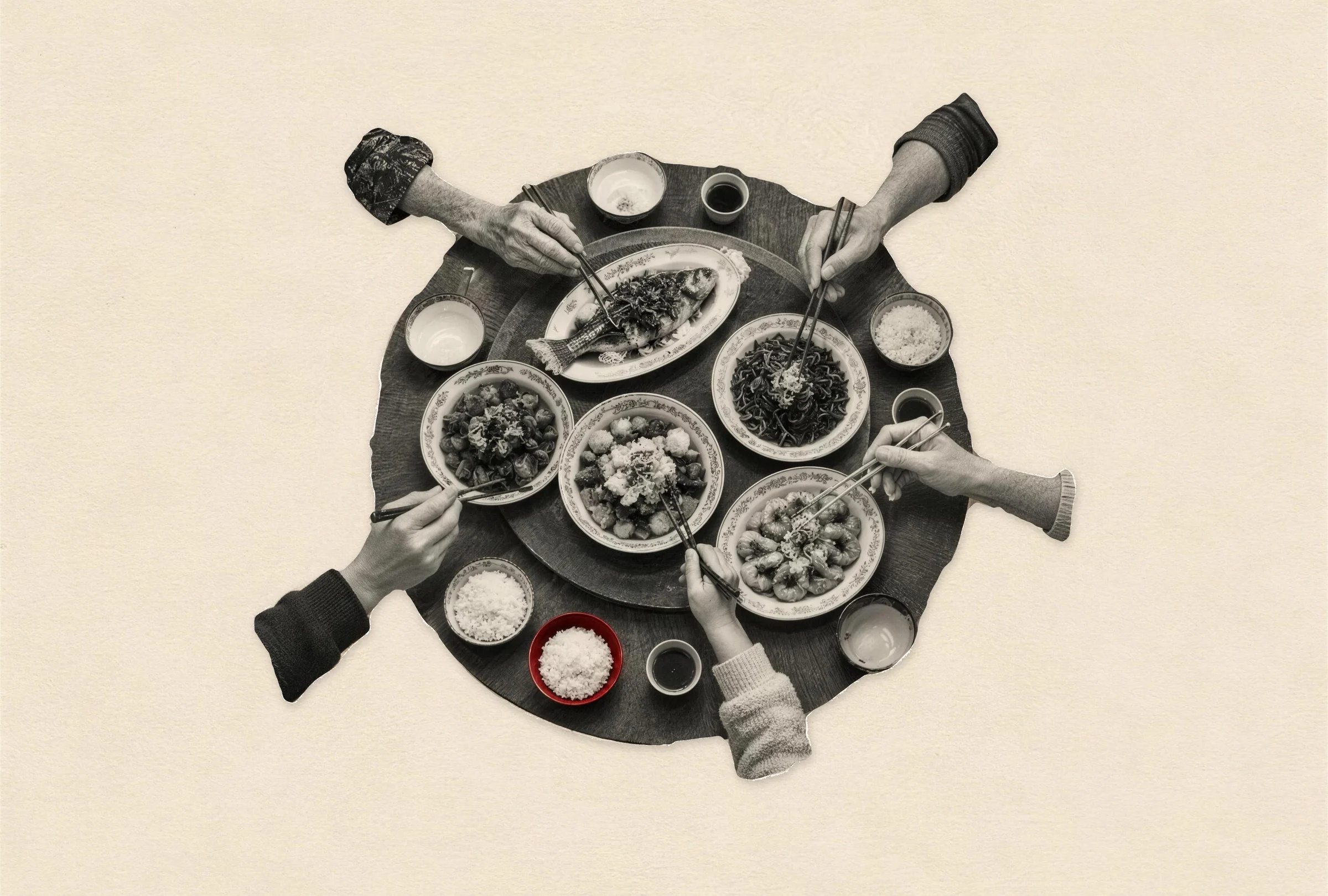
An overhead black-and-white cut-out of a round family dinner table on cream paper. Hands of every age, from an elderly grandparent’s to a small child’s, reach in with chopsticks over shared dishes of steamed fish, greens and prawns, beside small bowls of rice, one of them red.

Cantonese family terms: who is who, and what to call them

21 Oct 2026

Collage of six smiling young Hong Kong colleagues in black and white on a blush torn-paper patch; one in a white shirt shares a laptop covered in a white lucky cat, an I love Cantoflow and a red 早晨 sticker, while a colleague in a suit carries a red folder stamped 卸膊 (passing the buck).

6 min read

Cantonese for work: the phrases Hong Kong colleagues actually use

19 Oct 2026

A young man and woman laughing together, with handwritten red Cantonese exclamations between them, 得啦! (dak1 laa1, “all right!”) and 正呀! (zeng3 aa3, “brilliant!”), on torn cream paper.

Updated for 2026

12 min read

Cantonese slang: Essential Hong Kong street language for 2026

27 Aug 2025

A young man and woman laughing together, with handwritten red Cantonese exclamations between them, 得啦! (dak1 laa1, “all right!”) and 正呀! (zeng3 aa3, “brilliant!”), on torn cream paper.

12 min read

Cantonese slang: Essential Hong Kong street language for 2026

27 Aug 2025

A young man and woman laughing together, with handwritten red Cantonese exclamations between them, 得啦! (dak1 laa1, “all right!”) and 正呀! (zeng3 aa3, “brilliant!”), on torn cream paper.

12 min read

Cantonese slang: Essential Hong Kong street language for 2026

27 Aug 2025

The Cantoflow letter, sent once a month. Join and get our free tone cheat sheet. Unsubscribe any time.

© 2026 Cantoflow

Privacy Policy

Terms and Conditions

Cookie Policy

The Cantoflow letter, sent once a month. Join and get our free tone cheat sheet. Unsubscribe any time.

© 2026 Cantoflow

Privacy Policy

Terms and Conditions

Cookie Policy

The Cantoflow letter, sent once a month. Join and get our free tone cheat sheet. Unsubscribe any time.

© 2026 Cantoflow

Privacy Policy

Terms and Conditions

Cookie Policy