Merry Christmas in Cantonese: festive greetings and how Hong Kong celebrates
How to say Merry Christmas in Cantonese, how to reply, what to write in cards, and how Hong Kong celebrates, from Christmas Eve dates to the harbour lights.

Season’s greetings:
Bamboo, steam and one red star: Christmas, the Hong Kong way.
Key takeaways
Merry Christmas in Cantonese is 聖誕快樂 (
sing3 daan3 faai3 lok6), and the easiest reply is simply to say it back.For cards and messages, pair it with 新年快樂 (
san1 nin4 faai3 lok6), Happy New Year.Christmas in Hong Kong is a social season rather than a religious one for most people: light displays, dinners with friends, dates and two public holidays.
Save 恭喜發財 for Chinese New Year. It isn’t a Christmas greeting.
Merry Christmas in Cantonese is 聖誕快樂 (sing3 daan3 faai3 lok6). It’s the phrase on every shopping-mall banner and shop sign in Hong Kong from late November, and the one people will say to you across the office, the dinner table and the group chat.
Most Hong Kongers don’t celebrate Christmas as a religious festival, but almost everyone celebrates it. The city goes all in on lights, decorations, long dinners and time off, and knowing a few Christmas greetings will get you smiles at every one of them. Whether you’re visiting Hong Kong in December, writing a card to Cantonese-speaking family or learning the language from scratch, this guide covers what to say, how to reply and what the Christmas season in Hong Kong actually looks like.
How to say Merry Christmas in Cantonese
聖誕快樂 breaks down neatly. 聖誕 (sing3 daan3) means Christmas, literally “holy birth”, and 快樂 (faai3 lok6) means happy, or happiness. So the English translation is close to word for word: a happy holy birth, or simply Merry Christmas. Christmas Day itself is 聖誕節 (sing3 daan3 zit3), with 節 meaning festival.
All four syllables of 聖誕快樂 sit in the middle of your voice: three mid-level tones, then a low level 樂 to finish. Say it slowly and evenly at first, without the rise and fall English gives to “Merry Christmas”, and you’ll sound natural. The best way to get the sounds right is to listen to a native speaker and copy them. If tones are new to you, our guide to Cantonese tones explains the system.
To make the greeting a little warmer or more formal, add 祝你 (zuk1 nei5), “I wish you”: 祝你聖誕快樂 (zuk1 nei5 sing3 daan3 faai3 lok6). It suits a colleague, a neighbour or anyone you want to be a touch more polite with.
You’ll also hear plenty of English. “Merry Christmas” and “Merry Xmas” are everywhere in Hong Kong, and nobody will blink if you mix the two languages. Using the Cantonese phrase, though, always lands well.
One thing to know if you’ve learned some Mandarin: both Cantonese and Mandarin write it with the same Chinese characters, but the Mandarin, Shèngdàn kuàilè, sounds quite different. That’s the version you’ll hear in mainland China. In Hong Kong or with Cantonese-speaking family, the Cantonese is the one people expect. You may also see 耶誕 instead of 聖誕 on cards from Taiwan; in Hong Kong it’s almost always 聖誕.
How to reply when someone says 聖誕快樂
The easiest answer is to say it straight back: 聖誕快樂! That’s what most people do, and it’s never wrong.
For a more casual reply among friends, try 你都係呀 (nei5 dou1 hai6 aa3), “you too”. Add a thank you first if someone has given you a card or a present: 多謝 (do1 ze6). Our guide to saying thank you in Cantonese covers when to use 多謝 and when to use 唔該.
Christmas words you’ll hear in Hong Kong
A handful of words cover most festive conversations:
平安夜 (
ping4 on1 je6): Christmas Eve, literally “peaceful night”. 平安 means peace and safety, and it’s also the Chinese title of the Christmas song Silent Night.聖誕老人 (
sing3 daan3 lou5 jan4): Santa Claus, or Father Christmas.聖誕樹 (
sing3 daan3 syu6): Christmas tree.聖誕裝飾 (
sing3 daan3 zong1 sik1): Christmas decorations.聖誕歌 (
sing3 daan3 go1): Christmas songs, which play on a loop in every shopping mall.聖誕禮物 (
sing3 daan3 lai5 mat6): Christmas present.拆禮物 (
caak3 lai5 mat6): to open presents.交換禮物 (
gaau1 wun6 lai5 mat6): a gift exchange, the Secret Santa of Hong Kong offices and schools.聖誕大餐 (
sing3 daan3 daai6 caan1): Christmas dinner, literally “Christmas big meal”.放假 (
fong3 gaa3): to be on holiday, or to have the day off.
Two questions you’re likely to be asked in December are 聖誕節去邊度玩呀? (sing3 daan3 zit3 heoi3 bin1 dou6 waan2 aa3), “where are you going for Christmas?”, and 聖誕放幾多日假? (sing3 daan3 fong3 gei2 do1 jat6 gaa3), “how many days off do you get at Christmas?”. 玩 (waan2) means to play or have fun, so the first is really asking where you’ll be having fun.
How Hong Kong celebrates Christmas
Christmas in Hong Kong is less about church and family rituals and more about the city itself. Don’t expect snow: December is usually mild and dry, warm enough for a light jacket. A few things make the holiday season here distinctive.
The lights
From mid-November, the buildings along the Tsim Sha Tsui waterfront light up with festive light displays. The tradition dates back to the early 1980s, when developers in Tsim Sha Tsui East decorated their towers to draw people to a new part of town, and families have been walking the harbourfront to see them ever since. Shopping malls compete too, with giant Christmas trees and themed decorations that become selfie spots for the whole of December, and Christmas sales, 減價 (gaam2 gaa3), fill the shops. Some malls even stage fake snowfall. Over in Central, the Hong Kong Tourism Board’s WinterFest puts a giant Christmas tree in Statue Square, and Hong Kong Ballet’s The Nutcracker, retold as a Hong Kong story, plays at the Cultural Centre through December.
Christmas Eve is for going out
平安夜 is one of the busiest nights of the year. For many young couples it’s a date night, a chance to 拍拖 (paak3 to1), go on a date, with Christmas Eve dinner booked weeks ahead. Friends crowd into restaurants and bars, and the streets around Tsim Sha Tsui and Causeway Bay are filled with people until late.
Christmas dinner, not turkey
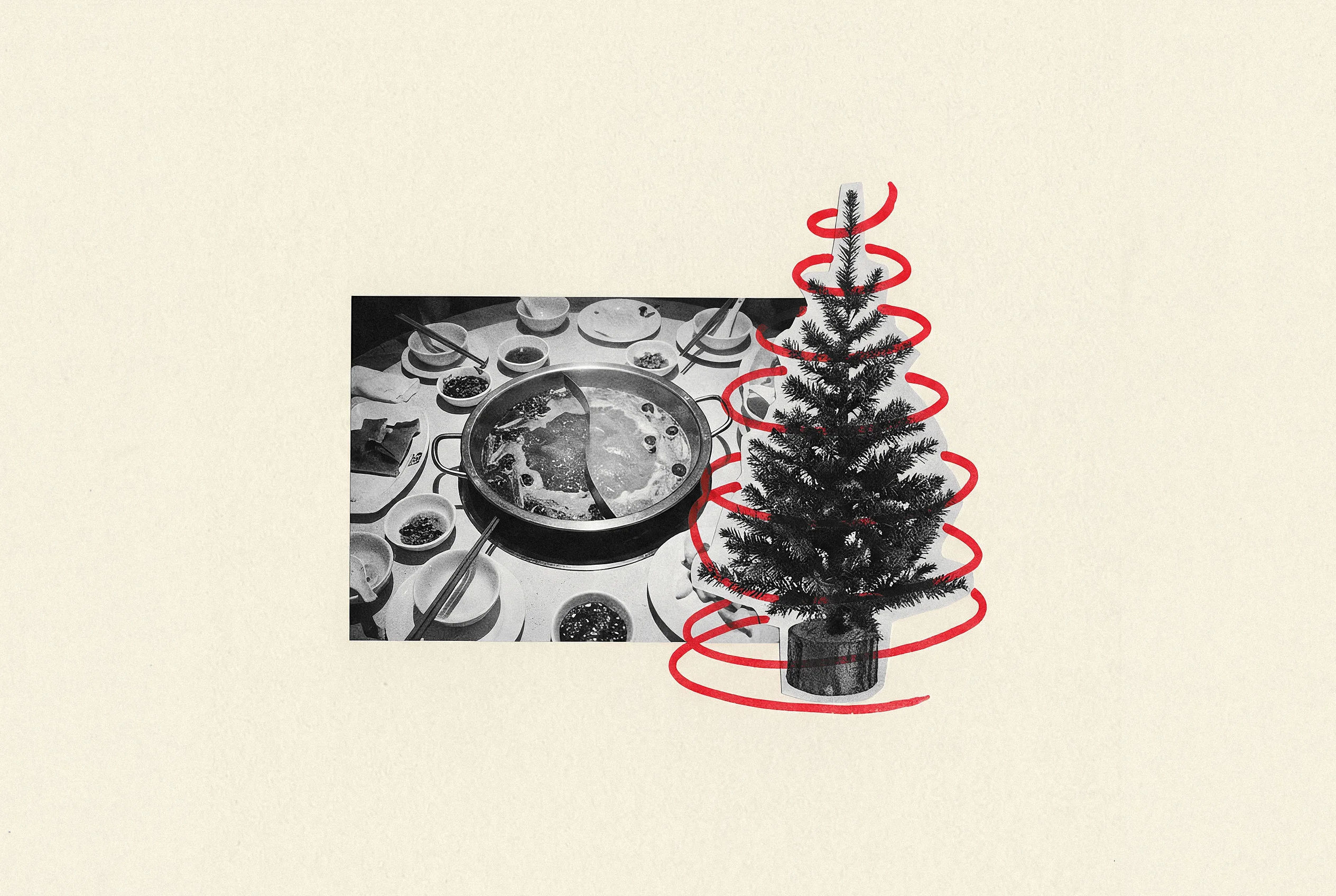
A 聖誕大餐 in Hong Kong is often a restaurant meal rather than a home-cooked roast, which is one of the biggest differences from Christmas in many Western countries. Hotel buffets, 自助餐 (zi6 zo6 caan1), are a festive favourite, and you might see 火雞 (fo2 gai1), turkey, on the menu next to everything else. Families who do eat at home are just as likely to make a hotpot.
Two days off for the holiday season
Hong Kong has two public holidays for Christmas: Christmas Day and the first weekday after it. In 2026 those fall on Friday 25 and Saturday 26 December. Plenty of people take the days around them as leave too, so offices go quiet and flights out of the city fill up.
Christmas greetings for cards and messages
For a Christmas card or a message, the classic line covers both holidays at once:
聖誕快樂,新年快樂! (sing3 daan3 faai3 lok6, san1 nin4 faai3 lok6): Merry Christmas and Happy New Year!
A few good wishes to build on it, for example:
祝你同屋企人聖誕快樂 (
zuk1 nei5 tung4 uk1 kei2 jan4 sing3 daan3 faai3 lok6): wishing you and your family a merry Christmas. 屋企人 is the everyday word for family; our guide to Cantonese family terms has the rest.身體健康 (
san1 tai2 gin6 hong1): good health. It works for anyone, and it’s especially meaningful for older relatives.萬事如意 (
maan6 si6 jyu4 ji3): may everything go as you wish.節日快樂 (
zit3 jat6 faai3 lok6): happy holidays, a safe choice if you’re not sure whether someone celebrates Christmas.
A handwritten note in Cantonese, even a single line, is a lovely touch for family and friends. In a group chat, 聖誕快樂 on its own with a Christmas tree emoji is perfectly normal.
After Christmas: the countdown to New Year
A week later, the greeting changes to 新年快樂 (san1 nin4 faai3 lok6). New Year’s Eve is 除夕 (ceoi4 zik6), and the big event is the 倒數 (dou3 sou2), the countdown, usually with 煙花 (jin1 faa1), fireworks, over Victoria Harbour. 1 January, 元旦 (jyun4 daan3), is a public holiday.
This is the Western new year. Chinese New Year comes later, in January or February, with its own set of greetings, red packets and rules. That’s where 恭喜發財 (gung1 hei2 faat3 coi4) belongs, so don’t use it at Christmas. Our guide to Chinese New Year greetings in Cantonese has everything you need for that one.
Frequently asked questions
How do you say Merry Christmas in Cantonese?
聖誕快樂 (sing3 daan3 faai3 lok6). 聖誕 means Christmas and 快樂 means happy. To be a little more polite, say 祝你聖誕快樂 (zuk1 nei5 sing3 daan3 faai3 lok6), “I wish you a merry Christmas”.
How do you say Happy New Year in Cantonese?
新年快樂 (san1 nin4 faai3 lok6). It’s used for 1 January and can also be used at Chinese New Year, although 恭喜發財 is the greeting most people reach for then.
Do people in Hong Kong celebrate Christmas?
Yes, widely, though mostly as a social and commercial holiday rather than a religious one. Expect light displays, parties, busy restaurants and two public holidays.
Is Merry Christmas the same in Cantonese and Mandarin?
The Chinese characters are the same, 聖誕快樂, but the pronunciation is different. Cantonese is sing3 daan3 faai3 lok6; Mandarin is Shèngdàn kuàilè. For more on how the two languages differ, see our Cantonese vs Mandarin comparison.
How good is your Cantonese?
Five quick questions to see where your Cantonese is at.
Question 1 of 5. The waiter brings your food. What do you say?
Heading to Hong Kong? Survival Cantonese gets you speaking the phrases you’ll actually use, in one-to-one lessons shaped around your trip.
Book a £30 trial lesson
Book a £30 trial lesson