Chinese idioms in Cantonese: the four-character sayings Hong Kongers actually use
Popular Chinese idioms (成語) read in Cantonese with Jyutping: what they mean, the stories behind them, and when Hong Kongers really say them.

Four characters, one story:
Horse, horse, tiger, tiger: the Chinese idiom for “so-so”, and usually the first one learners remember.
Key takeaways
成語 (
sing4 jyu5) are fixed four-character Chinese idioms, most of them drawn from classical literature, history and fables.They are shared across the Chinese language, but Hong Kongers say them with Cantonese sounds, so learn the Jyutping, not the pinyin.
Many are daily life, not exam material: 馬馬虎虎, 人山人海 and 手忙腳亂 come up all the time.
Cantonese also has its own four-character phrases, like 唔湯唔水 and 一字咁淺, that Mandarin speakers won’t use.
One idiom at the right moment makes you sound fluent; three in a row sounds like a school essay.
Read a Hong Kong newspaper headline, sit in on a primary school Chinese lesson, or just listen to a grandmother describe the chaos of Lunar New Year shopping, and you’ll hear them: short, punchy four-character phrases that pack a whole story into four syllables. These are 成語 (sing4 jyu5), Chinese idioms. Most are centuries old, plenty are still everyday speech, and in Hong Kong every one of them is said with Cantonese sounds.
This guide is for heritage learners who grew up half-hearing these at the dinner table, and for intermediate learners who want to sound fluent rather than textbook. Chinese idioms matter because they’re shorthand for shared stories: drop the right one into a conversation and people hear that you understand Chinese culture, not just Chinese words. Below are the popular Chinese idioms you’re most likely to hear in Hong Kong today, with Jyutping, what each one literally means, its figurative meaning, the story where there is one, and the moment to use it.
What are Chinese idioms? 成語 (Chinese chengyu) explained
A 成語 is a set phrase, almost always four Chinese characters long, that means more than the sum of its parts. Chengyu literally means “formed words”: language that arrives ready-made. A good one squeezes a complex idea into what feels like a single word, the way “Achilles’ heel” does in English.
Most come from classical literature and Chinese history. Sima Qian’s Records of the Grand Historian gave the language dozens, ancient philosophers like Han Feizi supplied fables, and the Three Kingdoms period added more: 三顧草廬 (saam1 gu3 cou2 lou4), “three visits to the thatched cottage”, recalls the warlord Liu Bei calling on the strategist Zhuge Liang three times before he agreed to join him. Hong Kongers still use it for anyone who has to be asked repeatedly. That’s why chengyu are sometimes called cultural time capsules: four characters, and a whole moral lesson from ancient Chinese life comes with them.
Hong Kongers often just call them 四字詞 (sei3 zi6 ci4), “four-character words”. Children learn them at school in Chinese Language lessons, but they don’t stay in the classroom. They turn up in TV news, adverts, WhatsApp groups and arguments about whose turn it is to wash up.
Chinese idioms vs Chinese proverbs, sayings and expressions
English tends to lump them together, but Chinese people draw a line between a few kinds of idiomatic expressions:
成語 (
sing4 jyu5): Chinese idioms, the fixed four-character set phrases in this guide, usually with a story behind them.諺語 (
jin6 jyu5): Chinese proverbs, longer folk wisdom such as 不入虎穴,焉得虎子 (bat1 jap6 fu2 jyut6, jin1 dak1 fu2 zi2), “if you don’t enter the tiger’s den, how will you catch the cub?”俗語 (
zuk6 jyu5): Chinese sayings and colloquial expressions, the everyday turns of phrase people trade without thinking.
Many idioms are also quoted as Chinese proverbs, so the edges blur. If it’s four characters and fixed, though, it’s almost certainly a 成語. For the longer, chattier Chinese sayings Hong Kongers love, see our guide to Cantonese expressions and idioms.
Same Chinese language on paper, Cantonese sounds out loud
Chinese chengyu are shared across the Chinese-speaking world, so a Mandarin speaker in Beijing and a Cantonese speaker in Mong Kok will recognise the same characters. They just won’t sound the same. Each character is read in its Cantonese pronunciation, with Cantonese tones, so 人山人海 is jan4 saan1 jan4 hoi2 in Hong Kong, not rén shān rén hǎi.
That’s why it pays to learn Chinese idioms with Jyutping rather than pinyin. If tones are still a puzzle, our Cantonese tones guide is the place to start, and our guide to Cantonese vs Mandarin explains why the two sound so different.

Chinese idioms about learning
熟能生巧: practice makes perfect
熟能生巧 (suk6 nang4 sang1 haau2). Literally means: familiarity gives rise to skill. English equivalent: “practice makes perfect”.
It’s the line every Hong Kong parent uses about piano practice, and every tutor uses about tones. It’s also true.
半途而廢: giving up halfway
半途而廢 (bun3 tou4 ji4 fai3). Literal translation: to abandon something halfway along the road. English equivalent: “to give up halfway through”.
It’s usually a warning rather than a description: 唔好半途而廢 (m4 hou2 bun3 tou4 ji4 fai3), “don’t give up halfway”. Worth remembering around week six of trying to learn Chinese, or any language. Our honest look at how long it takes to learn Cantonese will help you pace yourself.
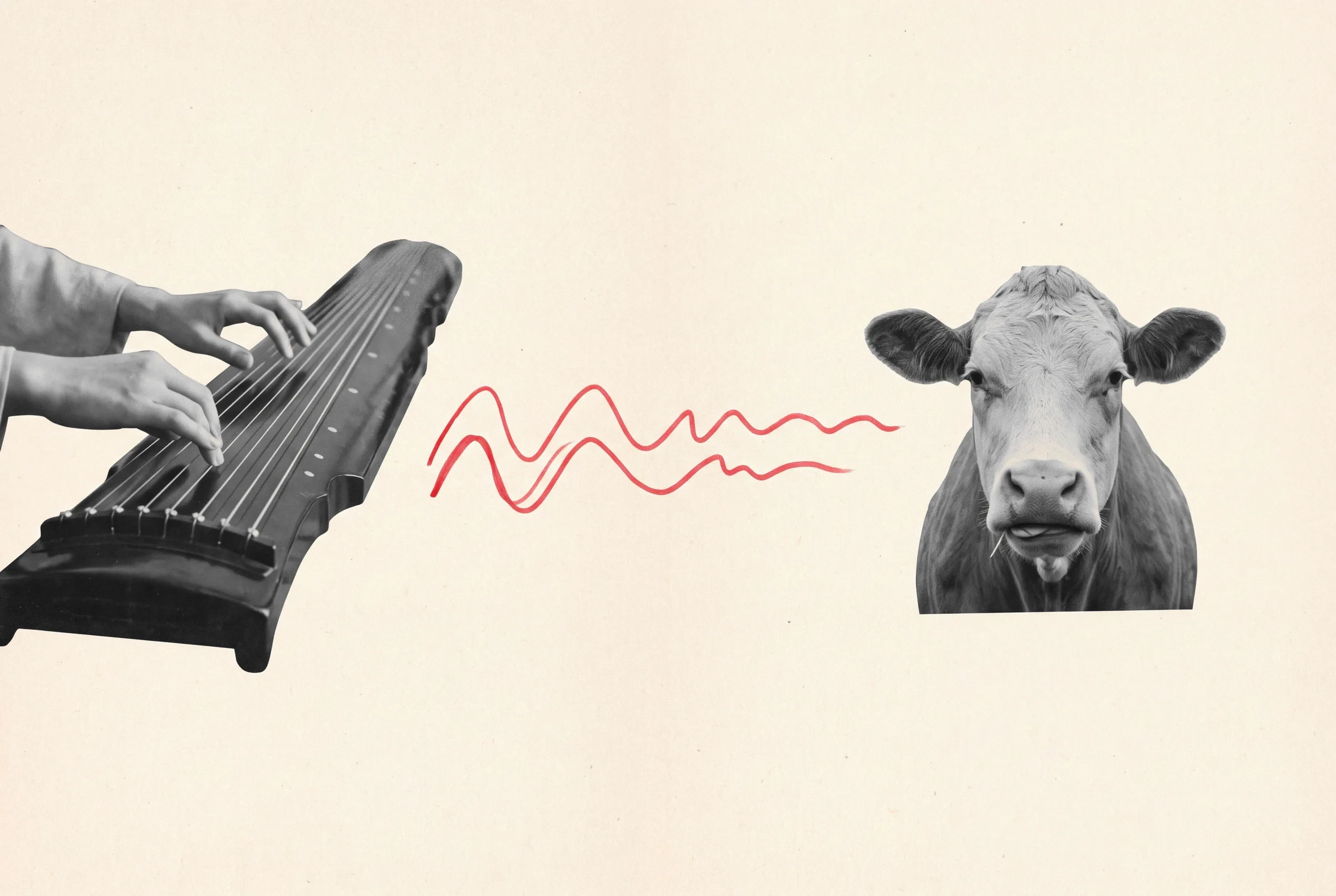
對牛彈琴: playing the zither to a cow
對牛彈琴 (deoi3 ngau4 taan4 kam4). Literally means: to play the zither to a cow. English equivalent: “casting pearls before swine”, or more gently, “talking to a brick wall”.
The idiom describes wasting a good explanation on someone who can’t or won’t appreciate it. Hong Kongers use it with a sigh, often about a teenager or a manager.
Chinese idioms for daily life in a busy city
人山人海: a mountain of people, a sea of people
人山人海 (jan4 saan1 jan4 hoi2). Literal translation: people mountain, people sea. English equivalent: “packed”, or “heaving”.
There may be no more useful idiom in Hong Kong. The Lunar New Year flower fair, the harbour on fireworks night, the MTR at half past six: all 人山人海.
手忙腳亂: busy hands, scrambling feet
手忙腳亂 (sau2 mong4 goek3 lyun6). Literally means: hands busy, feet in a muddle. English equivalent: “in a flap”, or “running around like a headless chicken”.
It describes the frantic, everything-at-once rush: the morning you oversleep, or the dinner party where three dishes need to come off the heat at the same time. When the rush leaves the flat a total mess, that’s 亂七八糟 (lyun6 cat1 baat3 zou1), literally “chaos seven, eight, rotten”.
入鄉隨俗: follow the customs of the village
入鄉隨俗 (jap6 hoeng1 ceoi4 zuk6). Literal translation: when you enter a village, follow its customs. English equivalent: “when in Rome, do as the Romans do”.
Visitors hear this one a lot, usually with a smile, when they try to queue politely for a minibus or attempt dim sum etiquette. Our phrases for travellers will help you live up to it.
Chinese idioms for everyday verdicts
馬馬虎虎: horse horse, tiger tiger
馬馬虎虎 (maa5 maa5 fu2 fu2). Literally means: horse horse tiger tiger. English equivalent: “so-so”, or “not bad, not great”.
Ask how the new restaurant was, or how your exam went, and this is the shrug of an answer you’ll get. It can also mean careless, as in a job done 馬馬虎虎.
半斤八兩: half a catty, eight taels
半斤八兩 (bun3 gan1 baat3 loeng2). Literal translation: half a catty and eight taels. English equivalent: “six of one, half a dozen of the other”.
In the old Chinese system of weights there were 16 taels to a catty, so half a catty and eight taels are exactly the same. Use it when two options, or two people, are as bad as each other. Hong Kong film fans will know it as the Chinese title of Michael Hui’s 1976 comedy The Private Eyes.
一舉兩得: one move, two gains (two birds, one stone)
一舉兩得 (jat1 geoi2 loeng5 dak1). Literally means: one action, two gains. English equivalent: “killing two birds with one stone”.
Walking to work instead of taking the bus: you save money and get your steps in. 一舉兩得. Learning Cantonese with your grandmother’s recipes counts too.
恍然大悟 and 一見鍾情: two more for daily life
恍然大悟 (fong2 jin4 daai6 ng6) is a moment of sudden enlightenment, when the penny finally drops. 一見鍾情 (jat1 gin3 zung1 cing4) is love at first sight, a staple of Cantopop lyrics and TVB dramas. Both are easy to say and you’ll hear them constantly.
Chinese idioms at work
In a Hong Kong office, a well-placed 成語 in a meeting or an email marks you out as someone with real command of the language. These two are safe, positive and useful.
腳踏實地: feet on solid ground
腳踏實地 (goek3 daap6 sat6 dei6). Literally means: feet treading on solid ground. English equivalent: “down to earth”, or “steady and hard-working”.
It’s praise for someone who does the work properly, step by step, with no shortcuts. You’ll hear it in performance reviews and leaving speeches, and it’s a good word for how to learn a language, too.
一心一意: one heart, one mind
一心一意 (jat1 sam1 jat1 ji3). Literally means: one heart, one intention. English equivalent: “wholeheartedly”, or “single-minded”.
Use it for total commitment: 一心一意做好呢份工 (jat1 sam1 jat1 ji3 zou6 hou2 ni1 fan6 gung1), “to give this job everything”. It turns up in wedding speeches, too.
Chinese idioms with a story behind them
Many Chinese chengyu come from fables in which a farmer, a fox or other animals learn a lesson the hard way. Know the story and the idiom sticks.
塞翁失馬: the old man at the frontier lost his horse (a blessing in disguise)
塞翁失馬 (coi3 jung1 sat1 maa5). Literal translation: the old man at the frontier lost his horse. English equivalent: “a blessing in disguise”, or “every cloud has a silver lining”.
The story, from the Huainanzi, follows an old man living near the frontier whose horse runs away. His neighbours commiserate; he shrugs, who knows if it’s bad luck? The horse comes back with a fine wild horse. His neighbours congratulate him; he shrugs again. His son rides the new horse, falls and breaks his leg. Then war comes, the young men are sent to fight and most never return, but the son is spared because of his leg. The full saying is 塞翁失馬,焉知非福 (coi3 jung1 sat1 maa5, jin1 zi1 fei1 fuk1): the old man lost his horse, but who’s to say it wasn’t good fortune? Hong Kongers say it to cheer up a friend who lost a job or missed a flight.
畫蛇添足: drawing a snake and adding feet
畫蛇添足 (waak6 se4 tim1 zuk1). Literally means: to draw a snake and add feet. English equivalent: “gilding the lily”, or “overdoing it”.
In the story, from the Strategies of the Warring States, a group of men hold a drawing competition for a jug of wine: first to draw a snake wins. The fastest finishes, then decides to add feet. While he’s drawing them, someone else finishes, points out that snakes don’t have feet, and takes the wine. The idiom refers to ruining something with unnecessary details. Designers, editors and anyone who has ever added one more slide to a presentation will understand.
狐假虎威: the fox borrows the tiger’s might
狐假虎威 (wu4 gaa2 fu2 wai1). Literal translation: the fox borrows the tiger’s power. English equivalent: “throwing your weight around”.
Also from the Strategies of the Warring States: a tiger catches a fox, and the fox claims heaven has made it king of the animals. “Walk behind me and see,” it says. Every animal in the forest runs, and the tiger, not realising they’re running from him, lets the fox go. The idiom describes someone who bullies others with borrowed authority, like the boss’s assistant who suddenly starts giving orders.
守株待兔: waiting by the tree stump for a rabbit
守株待兔 (sau2 zyu1 doi6 tou3). Literal translation: guarding a tree stump, waiting for a rabbit. English equivalent: “waiting for lightning to strike twice”.
The story comes from the philosopher Han Feizi. A farmer saw a rabbit run into a tree stump and break its neck, so he gave up farming and sat by the stump waiting for the next one. His fields went to weeds. The idiom is aimed at anyone waiting for luck instead of working for it, like someone hoping to pick up Cantonese without ever opening their mouth.
九牛一毛: one cow hair from nine cows
九牛一毛 (gau2 ngau4 jat1 mou4). Literally means: one strand of hair from nine cows. English equivalent: “just a drop in the ocean”.
Sima Qian, the Grand Historian, used the image in a famous letter: if he were executed, he wrote, it would matter to the world about as much as nine oxen losing a single hair. Today it’s for anything tiny next to the whole, like a HK$50 fine to a tycoon.
Four-character phrases that are pure Cantonese
Not every four-character phrase in Hong Kong is a traditional Chinese idiom. Cantonese has its own set, built from everyday Cantonese words, that a Mandarin speaker wouldn’t use. These two are favourites.
唔湯唔水: neither soup nor water
唔湯唔水 (m4 tong1 m4 seoi2). Literal translation: not soup, not water. English equivalent: “neither one thing nor the other”, or “half-baked”.
Think of a broth so weak it can’t decide what it is. It’s said about work that falls short, a plan nobody has thought through, or a relationship that’s neither on nor off. A colleague’s report can be 唔湯唔水, and so can a cup of milk tea with too much water.
一字咁淺: as easy as the character for one
一字咁淺 (jat1 zi6 gam3 cin2). Literally means: as shallow as the character 一. English equivalent: “dead easy”, or “a piece of cake”.
一, one, is a single horizontal stroke and the first character every child learns to write. So when something is 一字咁淺, there’s nothing to it. Friends will tell you ordering milk tea is 一字咁淺. After a week, it is.
How to use Chinese idioms without overdoing them
Using idioms well is a sign of advanced fluency, but restraint is part of it. One well-placed 成語 makes you sound thoughtful. Three in a row makes you sound like a school essay. Start with the conversational ones, 馬馬虎虎, 人山人海 and 手忙腳亂, which you can drop into daily life, and keep the story idioms for when the moment fits.
Learn each idiom with a sentence you’d actually say, and practise the tones out loud. Four syllables means four tones, and getting one wrong is the quickest way to turn a neat idiom into a puzzled look. For longer Chinese sayings, our guide to Cantonese expressions and idioms covers the funny ones Hong Kongers trade every day, and our Chinese New Year greetings guide covers the four-character wishes you’ll need in spring.
FAQ
Are Chinese idioms the same in Cantonese and Mandarin?
The written characters are almost always the same, but the pronunciation is different, because each character is read with its Cantonese sound and tone. Cantonese also has four-character phrases of its own, like 唔湯唔水, that Mandarin doesn’t use.
How many Chinese idioms are there?
Large dictionaries list more than 20,000, and around 5,000 is the figure usually given for the ones in common use. You don’t need anywhere near that many: a few dozen cover most of what you’ll hear in everyday Hong Kong conversation.
What’s the difference between Chinese idioms and Chinese proverbs?
Chinese idioms (成語) are fixed four-character phrases, usually pointing back to a story. Chinese proverbs (諺語) are longer sayings of folk wisdom, often in two halves, like 不入虎穴,焉得虎子.
Do Hong Kongers really use 成語 in conversation?
Yes, especially the everyday ones in this guide. The more literary idioms are more common in writing, news headlines and speeches.
Should I learn Chinese idioms as a beginner?
Pick up two or three easy ones, like 馬馬虎虎 and 人山人海, for fun and confidence. Leave the rest until you’re comfortable with tones and everyday phrases.
How good is your Cantonese?
Five quick questions to see where your Cantonese is at.
Question 1 of 5. The waiter brings your food. What do you say?
Complete Cantonese takes you from first words to real conversations with a native Hong Kong tutor.
Book a £30 trial lesson
Book a £30 trial lesson